
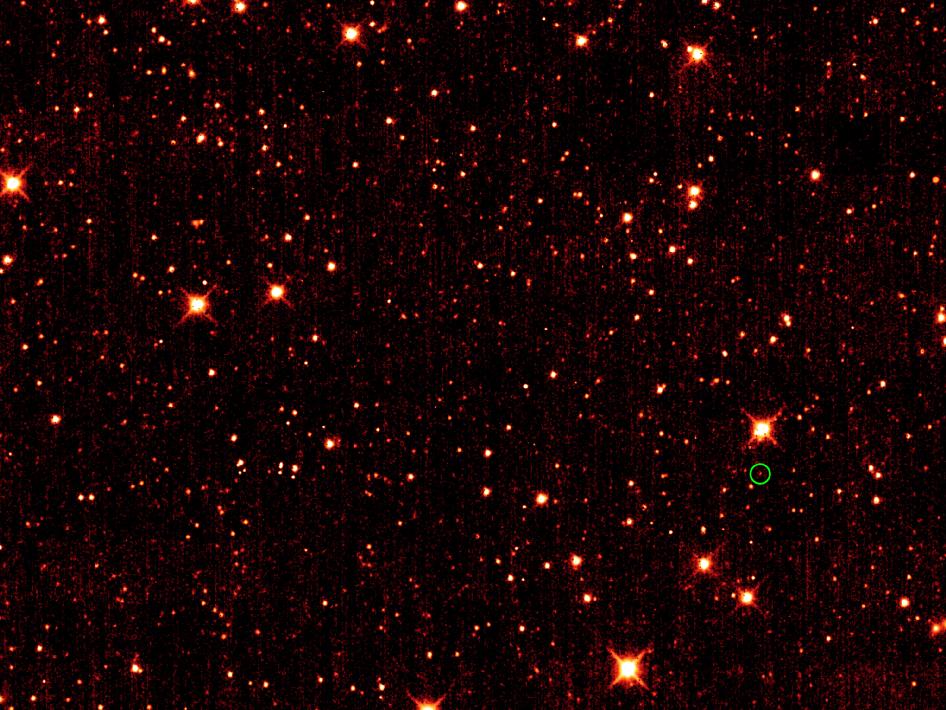
 Asteroid 2010 TK7 is circled in green. Image Credit: NASA / JPL-Caltech / UCLA |
| Scientists using the Wide-field Infrared Survey Explorer (WISE) have discovered the first Trojan Asteroid in Earth orbit. Trojans orbit at a location in front of or behind a planet known as a Lagrange Point.
A video of the asteroid and its orbit at the Lagrange point can be found here. Martin Connors of Athabasca University in Canada is the lead author of a new paper on the discovery in the July 28 issue of the journal Nature. Connors notes that:
TK7 is roughly 300 meters in diameter and traces a complex motion around SEL-4 (Sun Earth Lagrange point 4). The asteroid’s orbit is stable for at least the next 100 years and is currently about 80 million kilometers from the Earth. In that time, it is expected to come no closer that 24 million kilometers. The obvious question is whether this is the logical destination for NASA’s Flexible Path manned asteroid mission? The Lagrange 4 point (SEL-4) is a logical way station on the Solar System exploration highway. Other NEO asteroids that have been identified as possible targets are few and much more difficult to reach and return than an asteroid located directly at SEL-4 would be. An asteroid located there could well be the target of opportunity that opens manned exploration of the Solar System in an “easy” mode. Unfortunately, Asteroid 2010 TK7 would not serve as such a target because it travels in an eccentric orbit around SEL-4 so far above and below the plane of Earth’s orbit that it would require very large amounts of fuel to reach. NEOWISE is the program for searching the WISE database for Near Earth Objects (NEO), as well as other asteroids in the Solar System.The NEOWISE project observed more than 155,000 asteroids in the main belt between Mars and Jupiter, and more than 500 NEOs, discovering 132 that were previously unknown. |


Book Review: HOTOL & Skylon: The Story of Britain’s Spaceplanes
In HOTOL & Skylon: The Story of Britain’s Spaceplanes, Rob Coppinger covers the story of both in great detail, with the reminiscences of many who played integral roles in these ambitious programs. The book shines when it captures the enthusiasm and excitement of those involved, and there are extensive quotes from many who devoted years of work on these projects.









1 thought on “Is an Earth Trojan Asteroid the Logical Target for the "Flexible Path"?”
Some believe there may be remnants in these Trojan orbits of the Mars size object thought to have caused the formation of the moon. That possibility certainly gives scientific validity and importance to exploring this part of our planet’s solar orbit space.