Category: Nonfiction
Reviewed by: Casey Suire
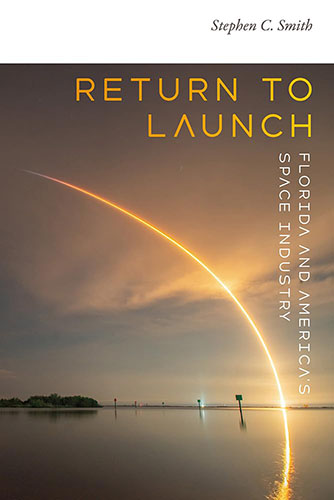
Title: Return to Launch: Florida and America’s Space Industry
Author: Stephen C. Smith
Format: Hardcover/Kindle
Pages: 348
Publisher: University of Florida Press
Date: March 2026
Retail price: $38.00/$36.10
ISBN: 978-1683406563
Find this book
On March 24, NASA unveiled an ambitious plan to construct a lunar base. Infrastructure for the proposed outpost includes robotic and crewed landers, habitat modules, Lunar Terrain Vehicles (LTVs), MoonFall drones, lunar communication satellites, and power generation systems. Furthermore, NASA will pause work on the Lunar Gateway space station. Instead, Lunar Gateway’s Power and Propulsion Element (PPE) will be repurposed as the SR-1 Freedom spacecraft. In December 2028, NASA plans to send SR-1 Freedom to Mars using nuclear electric propulsion (NEP). Upon arrival on Mars, SR-1 Freedom will deploy Skyfall, a fleet of several Ingenuity-class helicopters.
On that same day, the University of Florida Press released Return to Launch: Florida and America’s Space Industry. First-time author Stephen C. Smith spent a decade working at the Kennedy Space Center Visitor Complex; this employment influenced this book. Return to Launch covers nearly eight decades of Florida space activity. From the beginning, the Sunshine State factored prominently in the American space program. Smith opens his book with the very first launch from Cape Canaveral, FL: Bumper 8 on July 24, 1950. Curiously, the Pentagon initially wanted a launch site in El Centro, California. However, the Mexican government objected to rockets flying over Baja. The second choice, Cape Canaveral, won. Just imagine how different space history would be without Cape Canaveral.
Since Bumper 8, thousands of rockets have launched from Florida’s Space Coast. The book’s title, Return to Launch, embraces Florida’s role in the new commercial space age. After many painful years following the space shuttle’s retirement, Florida’s space industry is back. The book’s cover photo of a Florida night launch, captured by Julia Bergeron of NASASpaceflight, reflects this newfound optimism.
Smith spent four years writing Return to Launch. This isn’t too surprising. The book is heavily detailed and researched yet not boring. Noticeably, the book does lack a bibliography. Instead, there is a “Notes” section that is eighty-three pages long, occupying approximately the last quarter of the book. Throughout his narrative, Smith likes to cite newspaper articles. Florida newspapers are a popular source: Florida Today, Miami Herald, Orlando Sentinel, Tampa Bay Times, etc. Errors are infrequent and inconsequential. On page 37, it’s claimed that the first SpaceX Falcon 9 launch was in December 2010. Later, on page 222, the correct date of June 2010 is used. SpaceX Crew-1 launched in November 2020, not in September 2020. The Ansari X Prize is mistakenly written as the “XPRIZE Cup.” Outside of these minor errors, Smith always gets the facts straight.
He devotes lots of time discussing the struggles and successes of Space Florida. The organization began as the Florida Space Authority in 1989. The goal of FSA was to “create a ‘commission on space’ that would recommend how the state could compete with other states for aerospace business and investment.” By 2006, FSA consolidated with other Florida space agencies to become Space Florida. Some of Space Florida’s facilities include Exploration Park, the Space Life Sciences Lab, and the Launch and Landing Facility (formerly the Shuttle Landing Facility).
Other Space Florida sites include Launch Complexes LC-20 and LC-46. In 2019, Space Florida leased LC-20 to Firefly Aerospace. However, at the time of this writing, Firefly hasn’t utilized LC-20. In 2002, SpaceX considered LC-46 for launching Falcon 1. Instead, SpaceX settled on the Kwajalein Atoll in the Pacific. In recent years, LC-46 hosted an abort test of the Orion spacecraft and a few launches for Astra.
Smith also covers Florida’s role in NASA’s human spaceflight program. Whereas pace journalist Eric Berger likes to write books about SpaceX engineers, and Christian Davenport specializes in billionaire space entrepreneurs, in Return to Launch Stephen Smith explores the politics of space. He discusses the space policies of several presidential administrations, spending the most time on Obama’s space policy. How Obama’s cancellation of the Constellation program affected Florida is a major topic in later chapters. Former NASA Deputy Director (and former NSS Executive Director) Lori Garver wrote about this period in her book Escaping Gravity. Smith contends that his book is “the rest of the story.” Return to Launch also details George W. Bush’s 2004 Vision for Space Exploration and his administration’s decision to retire the space shuttle.
Additionally, Smith analyzes JFK’s Apollo decision. During his legendary speech at Rice University, Kennedy famously proclaimed, “We choose to go to the Moon!” However, behind the scenes, JFK worried about Apollo’s high cost. He also commented in a taped 1962 meeting that, “I’m not that interested in space.” Even today, many space advocates might not be aware of this statement. Weeks before his assassination, JFK proposed a joint American-Soviet lunar mission during a United Nations speech. Of course, this idea never happened. In the book, Apollo’s main justification was prestige.
It’s impossible to write a proper book about Florida space politics without Bill Nelson. Had Return to Launch been written as a novel, the multi-hyphenate Nelson probably would be the main character. Smith writes an entire chapter solely on Nelson’s early political career and shuttle mission. Later chapters examine Nelson’s influence on recent U.S. space policy.
It’s no secret that NASA’s human space efforts often lack a clear goal. Just look at the last three decades: X-33, VentureStar, X-34, Orbital Space Plane, Constellation, Asteroid Retrieval Mission, etc. Smith discusses every canceled program. It remains to be seen how Jared Isaacman’s Moon base plans will unfold. One important question is what will happen to the Space Launch System (SLS)? Since the announcement of the SLS program, many have criticized the massive booster’s high price tag and low flight rate. Unflattering names for SLS include the “Senate Launch System” and “rocket to nowhere.” Smith notes that “never before in NASA’s history had a major program been proposed with a primary objective of protecting legacy contractors and their workforce.”
During the recent Moon base announcement, NASA suggested that SLS could be phased out after Artemis V. Instead, a cheaper commercial rocket, such as Falcon Heavy, New Glenn, or Vulcan Centaur, could boost the Orion spacecraft into low Earth orbit (LEO). Orion would then dock with a Human Landing System (HLS), and the combined stack will fly to the Moon. On April 1, an SLS rocket, launching from Pad 39B in Florida, sent the Artemis II crew to circle the Moon. Hooray! Humanity has returned to the Moon. It’s about time.
Overall, Smith’s debut book Return to Launch is a solid choice to learn about Florida’s space economy. The Sunshine State will always be vital to future space exploration. Recommended reading for space fans.
© 2026 Casey Suire






2 thoughts on “Book Review: Return to Launch”
Casey, thank you for the review … Regarding the lack of a bibliography, the publisher waived it because the endnotes were so thorough.
I had to rely on newspapers because many sources didn’t respond to interview requests, or clammed up once I got to sensitive topics (e.g. the unpaid loan).
I view the book as a first pass on the topic, leaving bread crumbs for other writers to follow.
Thanks again. And thank you for pointing out the minor inconsistencies. Lots of eyes looked at it but no one catches everything.
Hi Stephen,
You’re welcome. I thought it was a great read. You handled the topic very well. Congrats on publishing your first book!
Casey