From flags and footprints to foundations, NASA’s Moon Base is our Space Station moment: A report on the May 26 NASA press conference
By Burt Dicht
NSS Space Coast Correspondent
On January 25, 1984, President Ronald Reagan stood before a joint session of Congress and outlined an ambitious new direction for America’s space program:
“America has always been greatest when we dared to be great. We can reach for greatness again. We can follow our dreams to distant stars, living and working in space for peaceful, economic, and scientific gain.”
Then he directed NASA to build a permanently crewed space station — within a decade.
In that same breath, Reagan added: “We want our friends to help us meet these challenges and share in their benefits. NASA will invite other countries to participate so we can strengthen peace, build prosperity, and expand freedom.”
I remember the feeling when those words landed. There was something different in the air, not just excitement about a new mission, but a recognition that the rules had changed. We weren’t just visiting space anymore. We were going to live there.
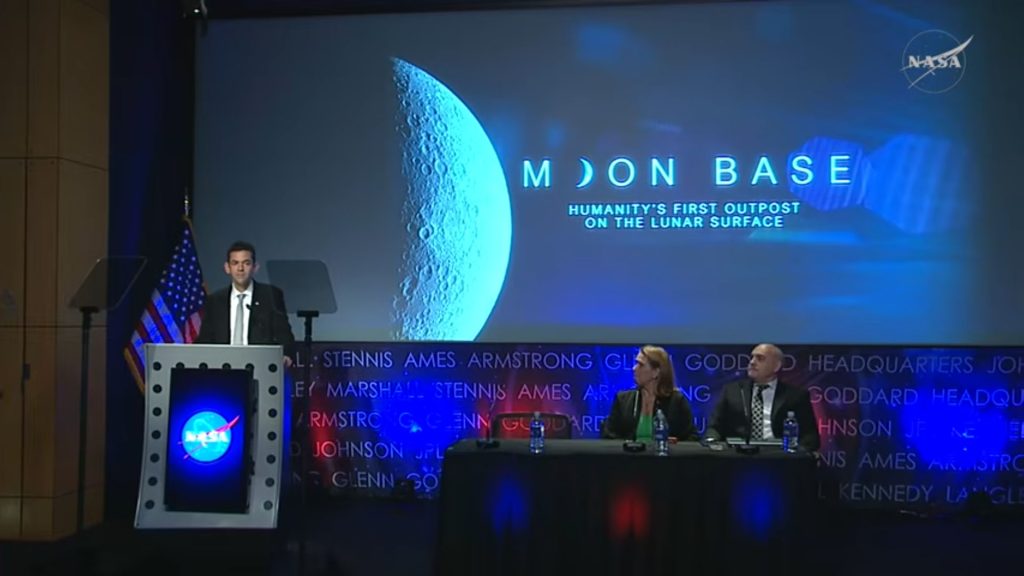
Standing on the other side of that chapter now, I watched the significant May 26 press briefing as NASA Administrator Jared Isaacman stepped to the podium and announced Moon Base, America’s plan to establish a permanent outpost on the lunar South Pole.
As someone who grew up during Apollo and later watched the space station program evolve from presidential vision to orbiting reality, I recognized the pattern immediately. The announcement itself is not the achievement. The achievement comes from the decades of persistence that follow, the budgets, the hardware, the international partnerships, the launches, the setbacks, and the decision to keep going.
This is not Apollo. It is not a flags-and-footprints mission with a new name. NASA is talking about cargo deliveries measured in tons per year, power grids that survive the 14-day lunar night, pressurized habitats, and rovers that stay on the surface long after the astronauts come home. This is the beginning of something that will still be operating when today’s children are grandparents.
This is our Space Station moment.
The Shift That Changes Everything
When Reagan called for the space station, the conceptual leap wasn’t technical, it was philosophical. The question wasn’t “can we build a platform in orbit?” It was “are we serious enough about space to stay?” Signing on meant committing to permanence. It meant budgets, partners, schedules, and a 30-year institutional memory.
Moon Base carries the same weight. The name itself is a statement. NASA didn’t call this “Artemis Surface Operations” or “Lunar Exploration Phase Two.” They called it Moon Base, two words that land with the clarity of a declaration.
The architecture NASA outlined goes well beyond short-duration exploration missions. Early phases focus on robotic cargo delivery, surface mobility, and scouting operations near the lunar South Pole. Later phases introduce pressurized habitats, long-duration power systems, communications infrastructure, autonomous construction capabilities, and eventually crews capable of remaining on the surface for extended stays. NASA also envisions a growing transportation network linking lunar orbit, the surface, and commercial logistics systems operating on a recurring basis.
And the plan backs up the name. NASA has outlined a three-phase buildout stretching from 2026 through the 2030s and beyond, with Phase 3 delivering up to 150,000 kg of cargo per year to sustain habitats, power stations, and scientific outposts at the South Pole. That’s not an expedition. That’s logistics. That’s infrastructure. That’s the cadence of a sustained operation.
The $20 billion, seven-year investment NASA announced in March 2026, with an additional $10 billion appropriated by Congress through 2032 signals institutional commitment at a scale that transcends any single administration. Administrator Isaacman put it plainly: “The Moon Base will be America’s and humanity’s first outpost on another celestial world.”
The Commercial Scaffolding — Why This Time Is Different
Here is where Moon Base departs from the ISS playbook in the most consequential way. Reagan’s vision for the space station grew into something he could only hint at in 1984: a genuine act of international cooperation. The ISS eventually brought together 15 partner nations from five space agencies. Since November 2000, when the first permanent crew arrived, humanity has not left low Earth orbit since, with 290 individuals representing 26 countries having visited the station. Engineers who grew up on opposite sides of the Cold War bolted their modules together in orbit. That is, by any measure, a remarkable achievement.
Moon Base carries that legacy forward. The first missions already include payloads from the European Space Agency and the Korea Astronomy and Space Science Institute. NASA has made clear that all Artemis Accords signatories, now up to 67 nations, will have opportunities to contribute scientific payloads, technology demonstrations, and infrastructure as the base takes shape.
But there is another structural difference that may prove even more important: the commercial ecosystem at the program’s core.
The ISS was built almost entirely by governments. NASA, Roscosmos, ESA, Japan Aerospace Exploration Agency, and Canadian Space Agency pooled sovereign resources, sovereign hardware, and sovereign astronauts. It was a triumph of international public investment and a challenging model whenever geopolitical tensions rise.
Moon Base is being scaffolded by a growing network of commercial companies operating under NASA contracts and delivery task orders. Within the first wave of announced missions, commercial providers will deliver habitats, rovers, science payloads, cargo systems, and lunar surface infrastructure. NASA has already awarded contracts across multiple companies and indicated that many additional missions are expected to follow.
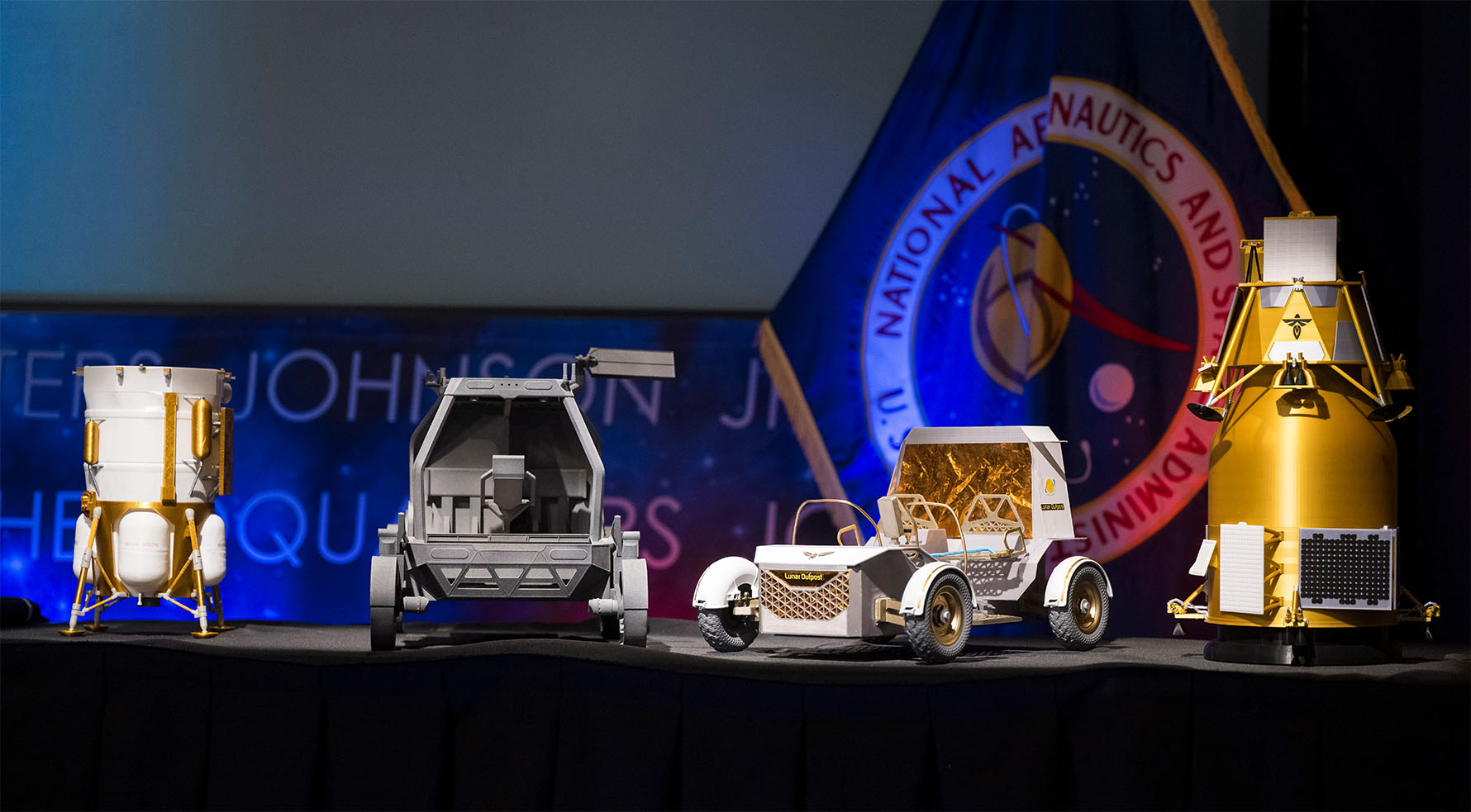
That commercial model matters. When a government program is the sole customer and sole operator, it remains vulnerable to budget cycles and political shifts. When companies invest their own capital, build supply chains, and develop long-term operational capabilities around a program, the architecture forms the basis of a solid foundation. That evolution eventually happened with the ISS through commercial cargo and crew. The difference is that Moon Base is beginning with that framework already in place.
Humanity Is Greatest When We Dare to Be Great
Reagan said America is greatest when it dares to be great. He was right and the ISS proved it. But the ISS also proved something larger: when nations commit to a shared dream over decades, the results can exceed what any one country could accomplish alone.
Twenty-six countries. Two hundred ninety human beings. Twenty-five years of unbroken habitation. The ISS demonstrated that nations with very different political interests could still sustain a shared long-term presence in space. It became, quietly and without fanfare, one of the most hopeful symbols of what humanity can achieve when cooperation survives political tension and national rivalry.
Moon Base is a continuation of that story and an expansion of it. The Artemis Accords as of this month include 67 nations. The scientific payloads on the earliest missions already carry multiple flags. And the technologies being developed, water ice extraction, in-space manufacturing, and nuclear surface power are part of humanity’s future, not just one nation’s.
Moon Base Program Executive Carlos García-Galán described the ultimate vision: “We envision the Moon base to be hundreds of square miles, with different assets all building up to the objective of permanent lunar presence.”
Hundreds of square miles.
Let that land for a moment.
Reagan’s words deserve a revision for this era: Humanity is greatest when we dare to be great. That is what yesterday’s announcement represents. Not a destination. Not a single mission. A beginning of sustained human presence on another world, built by governments and companies and nations working together, supported by infrastructure designed to endure beyond any single administration, and pointed ultimately toward Mars and beyond.
We followed our dreams to distant stars once. We’re doing it again. And this time, we’re staying.
The May 26 Moon Base Press Conference: