National Space Society

The Space Elevator Track at ISDC

ISEC WSPEC Table

Share:

Facebook
X
Pinterest
LinkedIn
For the first time, the space elevator track at ISDC expanded to two sessions: the morning dedicated to powering the space elevator and the afternoon covering a variety of issues critical for space elevator development.

By Dennis Wright
President, International Space Elevator Consortium

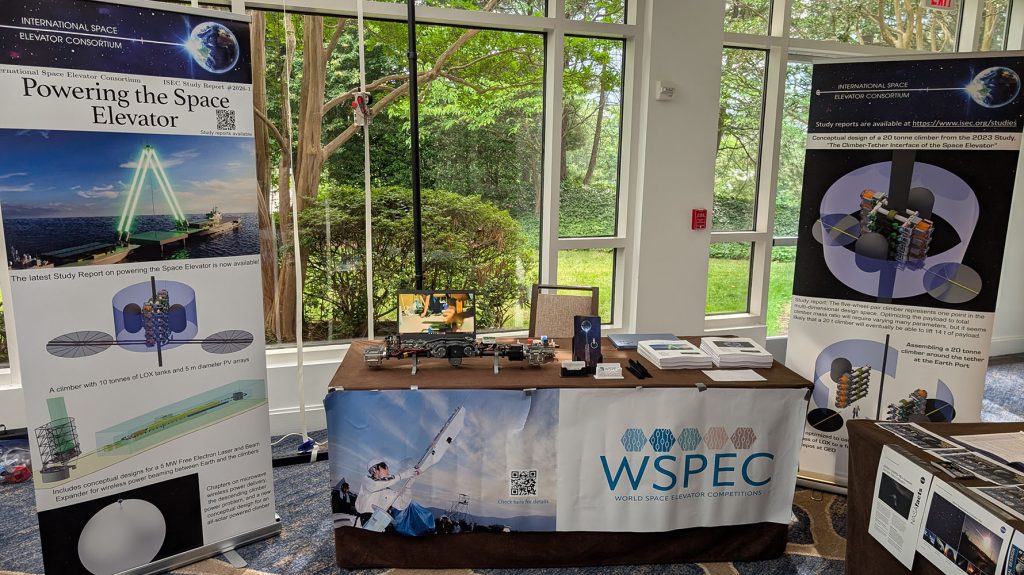
Image: The International Space Elevator Consortium/World Space Elevator Competitions table at ISDC with space elevator posters on either side and a climber from a space elevator competition.

For the first time, the space elevator track at ISDC expanded to two sessions: the morning dedicated to powering the space elevator and the afternoon covering a variety of issues critical for space elevator development.

While the technology for a space elevator climber is close at hand, getting power to it is an open question. The three top contenders are solar power, microwave beaming and laser beaming. Each of these was discussed in detail in the morning session. In the concluding discussion session, the pros and cons of each were debated.

The afternoon session touched on space elevator architecture and how it will transform access to space, a quantitative look at how environmentally friendly the space elevator is and a political and policy look at who will own it and how it might be managed in order to avoid conflicts. Advances in the development of a space elevator tether material were discussed as were the efforts to develop a dynamic simulator of a taut tether with a moving climber. Energy efficiency studies indicated the huge advantage of using space elevators instead of rockets, especially when it comes to moving very large amounts of mass into space.  This last aspect figured importantly in a talk on terraforming the Moon.

An excellent presentation by a student team from Ireland described their detailed settlement habitat and plan of operations.

The session was capped by a lively panel discussion on space elevators and space settlement. The panelists were Bob Zubrin, Pete Swan, Larry Bartoszek and Steve Griggs, with moderator Dennis Wright, who likes provocative topics. Is the space elevator essential for settlement? Most of the panelists thought so, with some disagreement as to the extent, mode and location (Earth, Moon, Mars) of space elevator operations. Lots of participation from the audience added depth and new ideas to the discussion.

Share:

Facebook
X
Pinterest
LinkedIn
Picture of By National Space Society

By National Space Society

1 thought on “The Space Elevator Track at ISDC”

  1. Do we need a Beanstalk to settle the solar system?
    maybe. Settle by how many? how difficult is this Beanstalk? Capacity? How far are we going?
    I’d think: we need it. Maybe soon, maybe later, to reach further targets. Instantly would give us the Moon without breaking us.
    Count on surprises. Build it before China does.

    Reply

Leave a Comment

Don't Miss a Beat!

Be the first to know when new articles are posted!

Search
Categories

Follow Us On Social Media

JOIN THE
GREATEST ADVENTURE

Give The Gift Of Space: Membership For Friends and Family

Book Review

Out of This World

Book Review: Out of This World

Anyone seeking a short but comprehensive introduction to human spaceflight would do well to start with this book. It reviews its history, highlights the accomplishments and tragedies, and describes the equipment used. It also looks at living in space, what space travelers experience, and how they work.

Read More »
desigining farms in space

Book Review: Designing Farms in Space

Meyer’s academic textbook is loaded with numerous photographs, diagrams, charts, and graphs. There are chapters on subjects such as farm machines, animal and fungi production, plant and algae production, and space menus. The farming techniques outlined in the book can be applied to lunar, Martian, or rotating space settlements.

Read More »
Archives


Hilton McLean Tysons Corner, McLean, Virginia
June 4 - 7, 2026

Recent Blog Posts

Anyone seeking a short but comprehensive introduction to human spaceflight would do well to start with this book. It reviews its history, highlights the accomplishments...
The Space Coast has extraordinary assets and an opportunity to continue its preeminence as a spaceport while becoming a destination for a new generation of...

The National Space Society (NSS) enthusiastically welcomes NASA’s proposed PROMISE lunar lander, a bold step forward in expanding scientific access, mobility, and capability across the...

This bold song was painstakingly composed to capture the true essence of that call, "Ad Astra," and covers the future progress of humankind as it...
Back in 1966, Luna 9 became the first spacecraft to soft-land on the Moon. Apogee Books has provided an English-language NASA translation of a detailed...

By Burt Dicht NSS Space Coast Correspondent Image: Starship 13 after “landing” in the Indian Ocean. Last week I had the opportunity to speak to...

On July 20, 2026, 151 people gathered for a special brunch at Space220 in EPCOT at Walt Disney World to celebrate National Space Exploration Day,...

Today, on the 57th anniversary of the Apollo Moon landing, this inspiring song commemorating the past and the future of our presence on the Moon...

adastra magazine

Your Doorway to New Worlds