Category: Nonfiction (?)
Reviewed by: Dale Skran
From Ad Astra Winter 2023
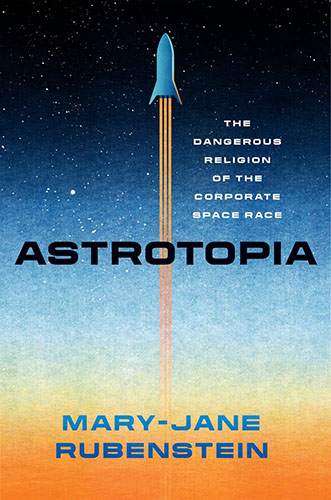
Title: Astrotopia: The Dangerous Religion of the Corporate Space Race
Author: Mary-Jane Rubenstein
Format: Hardcover/Paperback/Kindle
Pages: 224
Publisher: University of Chicago Press
Date: November 2022
Retail Price: $24.00/$18.00/$9.99
ISBN: 978-0226821122
Find this book
In Astrotopia, Mary-Jane Rubenstein, Professor of Religion and Science in Society at Wesleyan University, lays out a religious case against space development and settlement. Unlike Daniel Deudney’s Dark Skies, which attempts a purely political-science-based argument against space settlement, Rubenstein is skeptical of the technical feasibility of space development and settlement. Still, the main thrust of her argument is in a religious vein rather than a more robust technical critique.
Rubenstein argues for pantheism as a reason to “grant rocks rights” and call a halt to the potential mining of the Moon and asteroids. In doing so, she strongly rejects the entire basis of Western civilization and embraces ideas associated with indigenous cultures. As is often the case with such arguments, she seems to be unaware that her privileged position as a scholar at a distinguished university, enjoying the benefits of modern medicine and technology, rests in its entirety on the ideas she rejects—capitalism and scientific progress. Her position within the low-technology indigenous cultures she embraces in this book would be neither as comfortable nor as free as her current lifestyle.
A point never mentioned in Astrotopia is why animist or pantheist views held by less than 10 percent of the world’s population should control the future, while ignoring the views of billions of Christians, Muslims, Hindus, and atheists. Rubenstein appears to reason that stopping space development and settlement is a good thing, and then seeks to ground her opposition with the appropriation of various indigenous animist ideas. It’s not even clear that she believes pantheism is valid, but it’s certainly a convenient, if possibly insincere, cudgel with which to bash Elon Musk and Jeff Bezos. Additionally, Astrotopia fails to comprehensively and objectively survey indigenous religious ideas and instead cherry-picks a few activists that can be used to support her views.
Although Rubenstein generally plays fair in describing the views of Bezos and Musk, she indulges in far too many dishonest rhetorical tactics. The word wealth is frequently coupled with obscene in Astrotopia (i.e., “the obscene wealth of Jeff Bezos”). O’Neill cylinders are described as pods in an apparent effort to trivialize them. Much of the book rests on what-about-ism in which she associates space development and settlement with the exploitation of native Americans and the slave trade—rather dubious connections. A far more appropriate analogy to the current spaceward movement lies with the original African diaspora, in which early humans traveled out of Africa in small groups, eventually reaching Australia, the Americas, and Europe.
Like many who argue against capitalism and the use of science and technology as ways to better the human condition, she offers nothing in their place beyond a diffuse vision of humanity engaging in art and defining new meanings for their lives. Turning back on modern technology-supported lifestyles would result in not just a lower standard of living for much of the world’s population, but also millions of deaths globally. Such issues are simply not discussed.
Rubenstein’s book lacks the in-depth scholarship of Dark Skies. She reduces the entire space movement to Musk and his supposed guru Robert Zubrin, and Bezos and his muses Scott Pace and Gerard O’Neill. Pace is credited with killing the Moon Treaty, among other things. This cartoon version of the history of space settlement advocacy is the inevitable result of poor scholarship, or deliberate bending of the facts to favor her views. The focus on Zubrin is understandable, as he has written many books advocating for space exploration and development and can be a forceful and dramatic speaker. Her calumny of Scott Pace is harder to understand—while opposing the Moon Agreement, he remains a significant and balanced space leader, with the L5 Society and National Space Society in his leadership portfolio, as well as a stint as the executive secretary of the National Space Council. Rubenstein further ignores people like Anita Gale, Lori Garver, Jane Poynter, and Martine Rothblatt in her quest to falsely characterize the space movement as just a boys’ club.
Factual errors and confusion abound. Readers are told that Zubrin’s Mars Society is well-funded, which would surely come as a surprise to them. She frequently states as a fact that Christianity is moving toward such a high degree of respect for nature as to merge into pantheism, while greatly understating the influence of conservative and moderate Jews and Christians. She mocks Musk for saying that radiation on Mars is a solved problem, while appearing to have not the slightest idea why he thinks it’s a non-issue (a thick layer or Martian regolith, or dirt, and a bulldozer blocks sufficient radiation for inhabitants to thrive). Her description of Martian terraforming is dated and largely irrelevant, since terraforming is at best a distant prospect, and ignores the more recent plans of former NASA Chief Scientist James Green for the creation of a Martian magnetic shield.
Rubenstein also indulges in falsehoods, telling tales about how powerful the newspace capitalists are, when in fact the current steps toward space development are timid and faltering. NASA has no established plan to develop and settle space, the bold ideas of a few thinkers like Dr. Green notwithstanding. Musk has spent years trying to get permission to launch his Starship/Superheavy from Boca Chica, Texas, and continues to be subjected to government applications, permits, and approvals before there are any significant number of orbital launches. Another fiction from Rubenstein is that space debris is mainly the fault of rogue capitalists, when in reality the danger comes mostly from anti-satellite weapon tests and government-launched satellites and upper rocket stages that have not been properly deorbited.
Rubenstein at least acknowledges that the old L5 adage, “the meek will inherit the Earth; the rest of us are going to the stars” may well be the basis for a detente between anti-technology activists and those who put their faith in science and technology as the best path to improve lives. She also correctly points out that a belief that people may live in a giant simulation must not be used as a rationale to avoid dealing with problems. Finally, she is skeptical of “long-termism” as a rationale for space settlement. In this argument, which is based on extreme utilitarianism—in the far future, there may be trillions of humans spread across the galaxy—the lives of a few million today are not particularly important. This kind of thinking is simply not a good way to make decisions, since it balances real, current suffering with the purely speculative lives of future people. In rejecting pro-space settlement long-termism, one can also reject the assertions that future space settlers may, for many decades, live limited and painful lives, for reasons including harsh conditions, a lack of oxygen, or vitamin deficiencies, among others. If there are large numbers of settlers, the sum of their future pain suggests space should not be settled at all. Either way, the concept is purely speculative and should be rejected as a basis for making ethical decisions.
It has been said that there are three stages new ideas go through. First they may be laughed at; then they may be fought; and then everyone claims that they always supported the new idea, or that it was their idea. Books like Astrotopia and Dark Skies serve as a reminder that humanity is now in the second stage of regarding this new idea—the fight. Let’s continue to make the case that space development and settlement are the best path forward for creating better lives for everyone. It’s only because of our recent progress that authors like Rubenstein and Deudney feel the need to expend their energies writing books to describe how dangerous the space movement is, and it does represent the danger of new ideas bringing hope to everyone.
© 2025 Dale Skran