
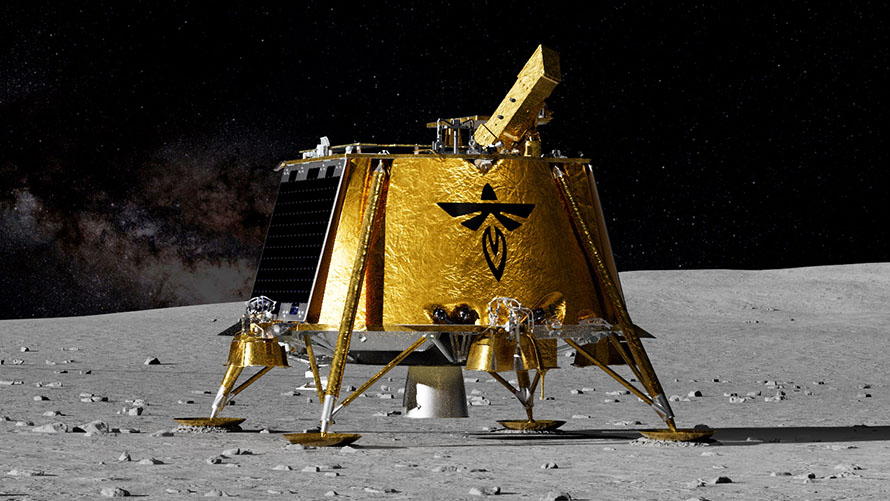
Illustration: A conceptual Lunar Crater Radio Telescope on the Moon’s far side where robots hang wire mesh in a crater on the Moon’s far side, creating a radio telescope to help probe the dawn of the universe. The early-stage concept is being studied under grant funding from the NASA Innovative Advanced Concepts program but is not a NASA mission. Credits: Vladimir Vustyansky, NASA.
NSS Releases Position Paper on “A Long-Term Strategy for Space-Based Astronomy and Lunar Surface Observatories”
You can read the entire report here. The Executive Summary is below.
Executive Summary
The National Space Society (NSS) advocates for a long-term strategy to transition astronomical observatories into space and onto the lunar surface. As the number of satellites and other space infrastructure continues to grow, preserving Earth’s dark and quiet skies becomes increasingly challenging. Establishing space-based and lunar observatories offers a powerful alternative, allowing humanity to continue groundbreaking astronomical discoveries while supporting the development of space infrastructure that provides significant economic, scientific, and national security benefits. Furthermore, developing a comprehensive long-term strategy for extensive space-based astronomy brings together both the astronomical and commercial space communities, fostering cooperation and mutual compromise. This collaborative approach ensures that both sectors work in tandem to achieve sustainable advancements in space exploration and scientific research, rather than being pitted against each other.







3 thoughts on “A Long-Term Strategy for Space-Based Astronomy and Lunar Surface Observatories”
Why are there no comments? There should be hundreds of comments here. Is it because no criticism of NewSpace is allowed here? The present situation is essentially about one person’s vision, and it is not Gerard K. O’Neill’s vision.
Space-based astronomy and lunar observatories are needed to further research on future discoveries. Keeping the status quo will slow down future discoveries.
Scrolled through the paper twice. This looks like something I can support. One obvious question: How? Other than supporting Astronomers Without Borders or the Space Cooperation Act, there doesn’t seem to be many venues mentioned for the wannabe citizen radio astronomer to pursue. Hopefully, that will change when Artemis kicks into high gear.