Guest Essay
By Troy Bird
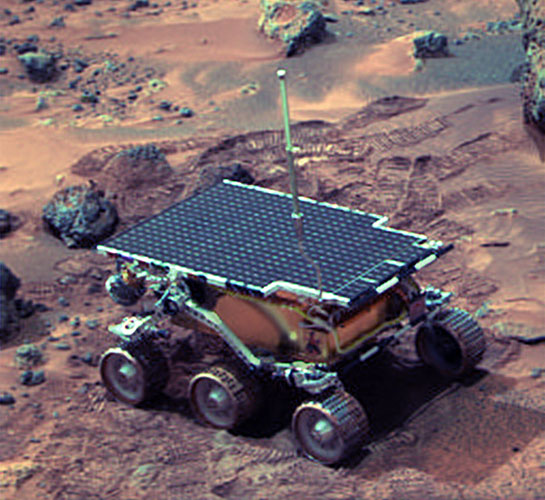
Image: Soujourner on Mars in 1997, which helped inspire Troy when he was 15 years old.
This past April 1st, I must admit that I sat, glued to my screen, watching the live coverage of what I sincerely hoped would be an “All Green” launch of NASA’s much anticipated Artemis II mission. I prayed for the safety of the astronauts and hoped that this wouldn’t turn out to be a bad April Fool’s Day joke. As the countdown commenced, I idly wondered how many others like me were tuned in, thinking suddenly back to the heady days of yore, when it seemed the entire planet paused to hold its breath in expectation of what America was doing.
I’m in my mid-forties now, and many times I’ve secretly bemoaned the fact that I was born too late to have lived through the early days of the Space Race. I grew up with a toy Space Shuttle (the one with the little articulated cargo bay doors) and imagined one day flying in it as an astronaut. However, after Columbia, that too went away. It seemed that my dreams and boyhood aspirations were doomed. Again I lamented that I had evidently been born in the wrong decade, at the wrong point in time to be able to participate in the Grand Adventure.
Then something happened that changed the paradigm completely, the rise of the New Space industry, SpaceX, Blue Origin, Virgin Galactic and many others; suddenly, those boyhood dreams seemed all at once possible. These men were billionaires, yes, and I’m probably the furthest thing from the Musk’s and Bezos’ of the world. During my pre-teen and early teenage years growing up on a mountain in Tennessee, our house had bare studs, no insulation, and didn’t even have a door for a long time — just a sheet of plywood set sideways with a blanket hanging down like a curtain, and we lived for years without electricity or running water.
In my forties now, the likelihood that I could ever be a NASA astronaut is probably slim. But as a born and bred entrepreneurial American, who came up from poverty with the mindset that with hard work and discipline anyone can achieve greatness, the future of Space (capital “S”) has never felt more attainable. Watching the Artemis II lift off bearing the Orion capsule with its four brave astronauts, I had a flash of that old dream. I pictured myself, standing alongside my younger brother, who is my best friend, and peering over a vast Lunar or Martian landscape. Likely? Probably not. Physically possible, however? Perhaps for the first time in human history, yes.
Space has changed greatly since the 1960’s. Now the cutting-edge advancements are dominated by the private sector, and no longer does it take a state sponsored agency to realistically consider a career in space. With enough money virtually ANYONE can at least visit the edge of our atmosphere, and even births on the ISS can be bought. And that’s not even talking about the myriads of near-future planned endeavors, space hotels, and lunar bases.
The New Space marketplace is no longer a lonely neighborhood. And all within my lifetime. This has led some to wonder, why do we even need a NASA? In this 21st century New Space complex, is there a place for the old-seeming dinosaur which was once lauded as the bright vision of and standard setter of humanities future among the stars?
I say yes, if for no other reason (and there are plenty of others) than that it is the established and trusted edifice of NASA and other international legacy state space agencies, which carry forth the torch on scientific research and who set the standards and goals of humanity as a whole. Whereas I revel in the freedom of a capitalistic New Space frontier which allows me to pursue my dream (as long as I can prove it financially profitable!), what fills me with great joy and excitement is the burgeoning joint partnerships between the old Legacy and the New Space corporations.
No one who’s lived longer than ten years believes that the government is skillful at rapid development and deployment of tech. The nature of bureaucracy is to delay and bog down, usually in an attempt to maintain funding and justify its own existence. We inherently dislike and distrust it, but at times it can be a stabilizing thing. While governmental agencies don’t typically move fast, they are usually a constant, forward-pressing force, or in other words, in their own way they are dependable. This is a needed and grounding force in the modern space age. I would argue that with the rise of the Space start-up we NEED the simple (often myopically focused, but reliable) vision of NASA.
When I look at the concept art for the new lunar base, it makes my chest swell. Yeah, it’s a far cry from the grandiose visions of fanciful, needle-like, low gravity towers I once read about as a boy, but it’s a realistic start. One small step if you will, for humanity, and I’m incredibly excited to be of THIS generation as we take it together.
One of the only space milestones I can truly remember from my own childhood was the summer I turned 15, I had the incredible opportunity to spend it living in the Amazon rainforest as a missionary. One day a supply barge came down river from the capital city of Manaus bearing mail. With it was a newspaper, the front-page declaring news of the newly landed Martian rover, Sojourner. I was in awe as I read that we, yes Americans, but the people of EARTH, had successfully landed a robot on another planet. It was a milestone I’ll never forget, and I believe that milestones are vitally important.
As I sat and watched the launch of Artemis II on Wednesday, I silently hoped that some boy out there was leaning in too, in excitement and expectation…that a dream was being birthed. Yes, I missed the Golden Age of the space program. But I’ve learned that it’s up to each generation to build its own golden age, and who’s to say that this chapter of the story isn’t the part that gets really, REALLY, exciting?
Today I hope that the Artemis missions spark a fire of imagination and inspiration, milestones for a new generation of visionaries and dreamers who, like me, will desire to take one (more) small step for mankind.
But hey, inside, I’m still just a kid with a dream.
______________
Troy Bird is an NSS member and participant in the 6th Rothblatt Space Settlement in Our Lifetime Business Plan Competition. He is the Founder and Chief Visionary Officer of Icarus Orbital Systems, an early-stage company focused on orbital debris mitigation and in-space material recovery. He is also a science fiction author and creative director, with a long-standing interest in space development, artificial intelligence, and the future of human expansion beyond Earth.







1 thought on “One (more) Small Step for Mankind”
When I was in my teens, two of my cousins and I made a pact to build a starship when we grew up. Well, that lofty dream went the way so many childhood dreams do; however, the things that inspired that dream are even more real and realistic now than ever before. I join you in hopes that the Artemis II mission gave birth to many new dreams. Dreams are taking people further now than ever before!