
By Burt Dicht
NSS Space Coast Correspondent
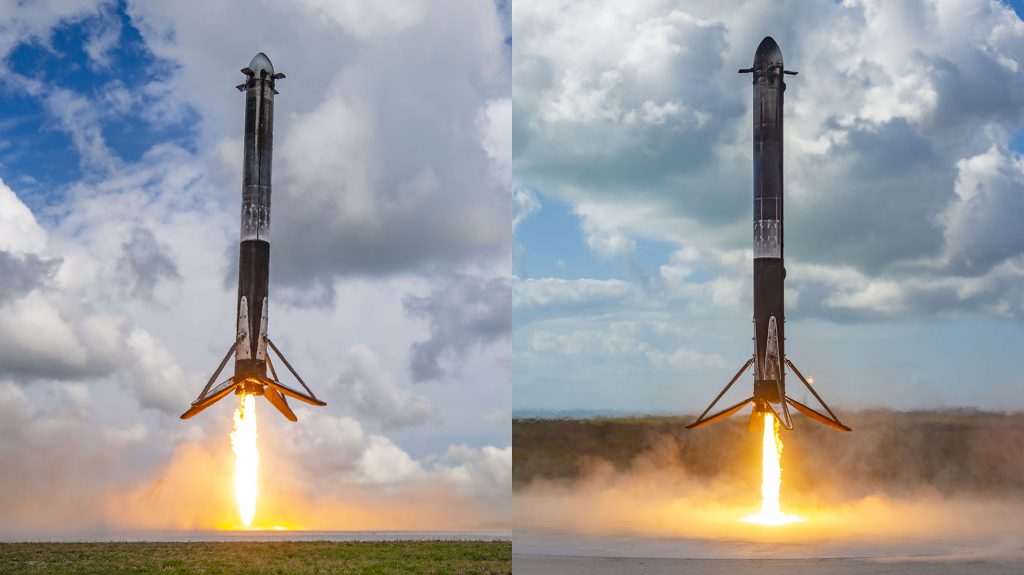
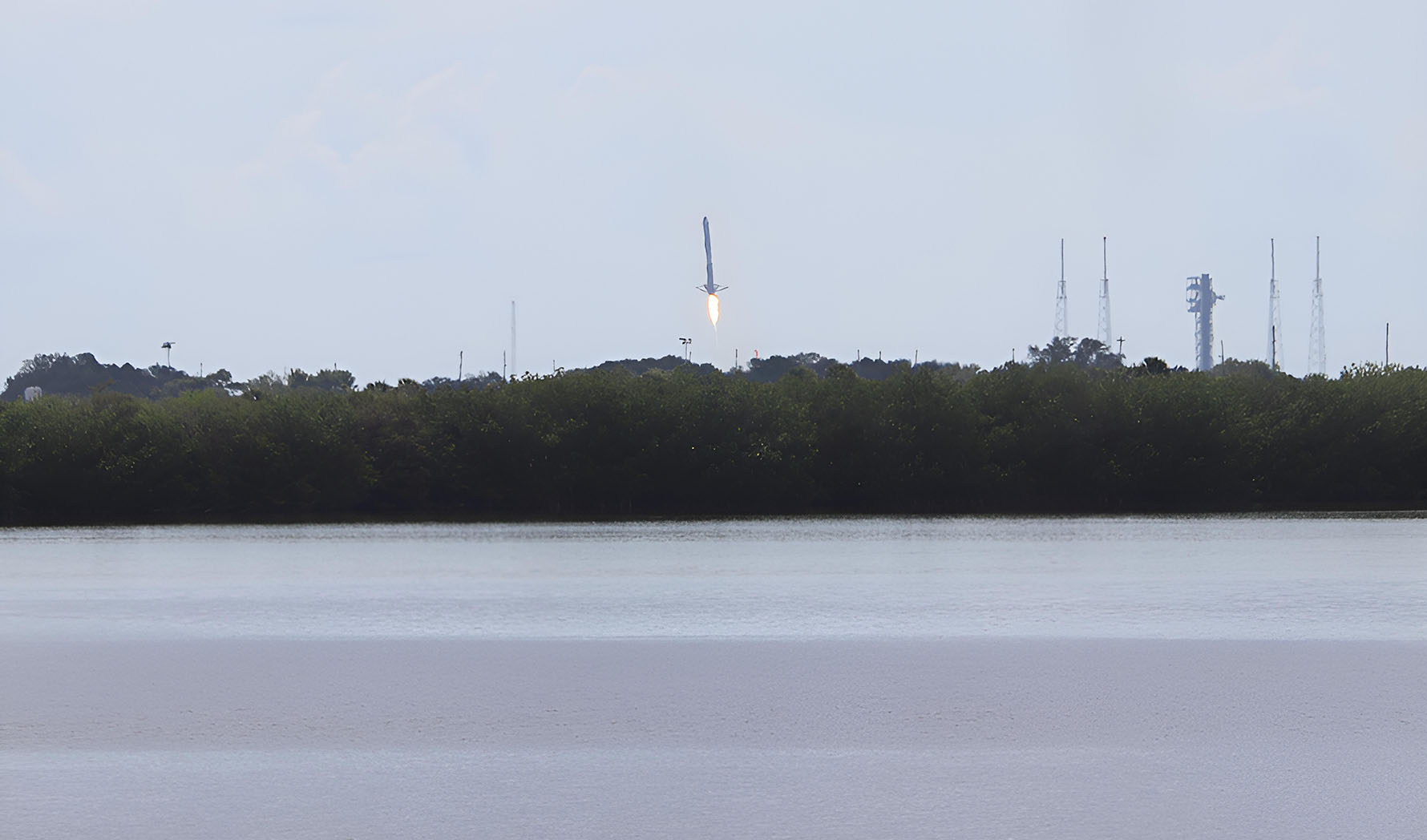
Image: Falcon Heavy side booster landings took place within about 5 seconds of each other at landing sites that were 10 miles apart. Images courtesy SpaceX.
After an 18-month gap, Falcon Heavy returned to flight today from Kennedy Space Center Launch Complex 39A, sending the ViaSat-3 F3 satellite on its way toward geostationary orbit. The mission had been scheduled for Monday, April 27, but weather forced a scrub. Today’s conditions were far more cooperative, and at 10:13 a.m. EDT, Falcon Heavy lifted off cleanly at the opening of an 85-minute launch window.
This mission carried ViaSat-3 F3, the Asia-Pacific (APAC) member of the ViaSat-3 constellation. At roughly 6.6 tons, it is a high-capacity broadband communications satellite designed to deliver more than 1 terabit per second of throughput across the APAC region once on station. The launch placed the spacecraft into a geosynchronous transfer orbit (GTO), from which it will use onboard propulsion to circularize and reach its final geostationary slot.
A Familiar Flight Profile With a Crowd-Pleasing Finish
The configuration for this mission followed a now familiar Falcon Heavy pattern: the center core was expended, while the two side boosters returned to Cape Canaveral Space Force Station. Both boosters executed successful landings—one at Landing Zone 40 (LZ-40) and the other at Landing Zone 2 (LZ-2).
For those along the Space Coast, the return of the side boosters remains one of the most distinctive elements of a Falcon Heavy launch. The dual sonic booms and closely timed touchdowns are not just a technical achievement, but a visible sign of how reusable launch systems have become an operational norm.
From GTO to GEO
The launch placed ViaSat-3 F3 into a geosynchronous transfer orbit (GTO), an elliptical orbit commonly used as a stepping-stone to geostationary orbit (GEO). In GTO, the satellite reaches geostationary altitude at its highest point (apogee) but remains much closer to Earth at its lowest point (perigee). From there, the spacecraft uses its own propulsion to raise the low point of the orbit and circularize.
A geostationary orbit sits approximately 35,786 km (22,236 miles) above Earth’s equator. At this altitude, a satellite’s orbital period matches Earth’s rotation, allowing it to remain fixed over a single longitude. This enables continuous coverage for a defined region, ideal for communications, weather monitoring, and broadcasting.
ViaSat-3 F3 will now begin the process of raising and circularizing its orbit before taking up its operational position over the Asia-Pacific region. Once there, it will join its companion satellites in providing near-global broadband coverage.
Looking Ahead
Today’s launch marks the return of Falcon Heavy to the active manifest and points to a busy year ahead. Several additional missions are planned for 2026, including the Griffin lunar lander, which is part of the Artemis program, and the Nancy Grace Roman Space Telescope.
Falcon Heavy flights are not everyday events, even on the Space Coast. They bring together scale, complexity, and a level of precision that is still worth paying attention to. Watching the side boosters return this time to LZ-40 and LZ-2 adds a dimension you don’t quite appreciate until you experience it in person.
After Monday’s scrub, today’s launch was a good reminder of how operations here really work. Launch schedules shift, weather intervenes, and then, when everything lines up, the system performs exactly as designed.
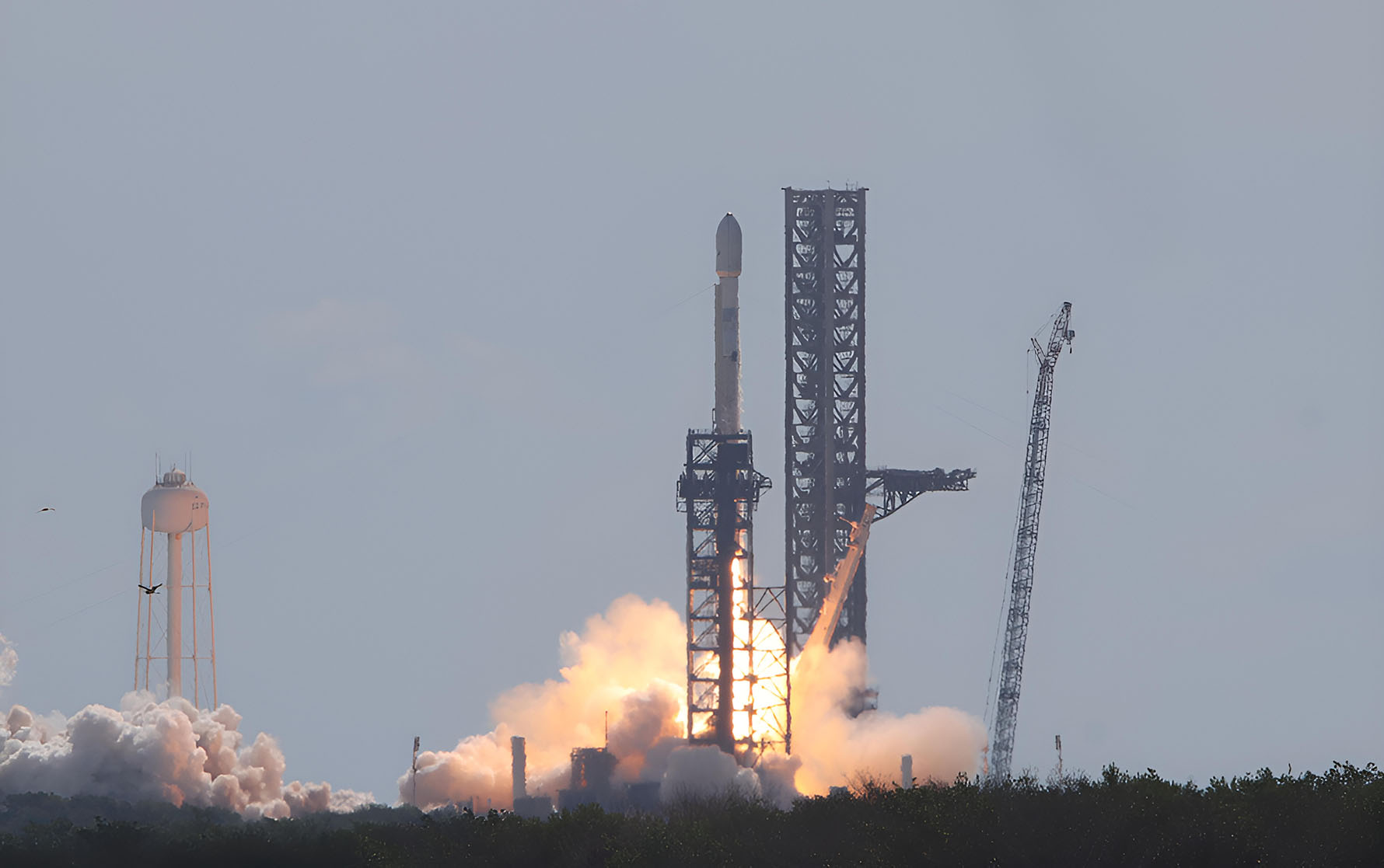
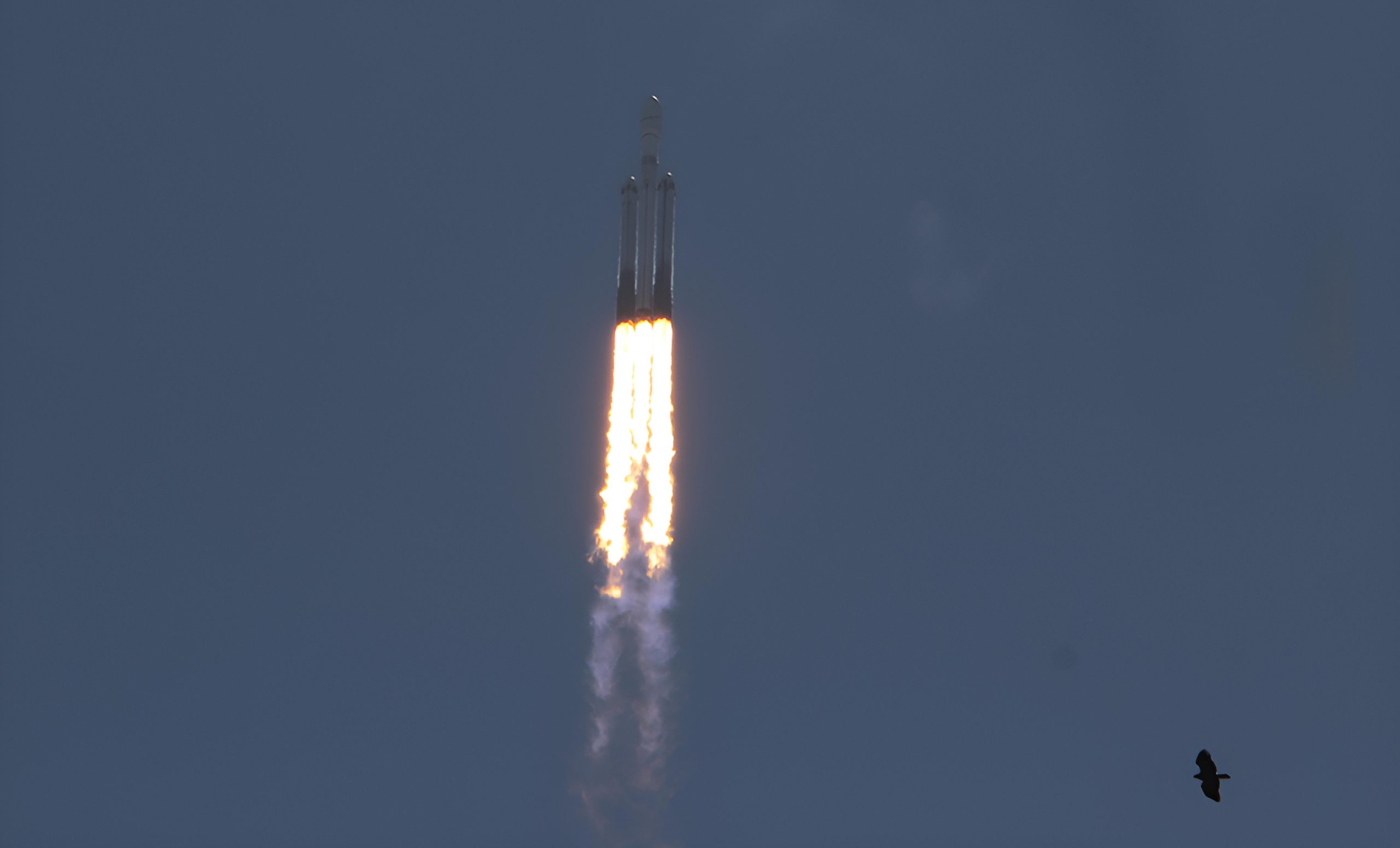
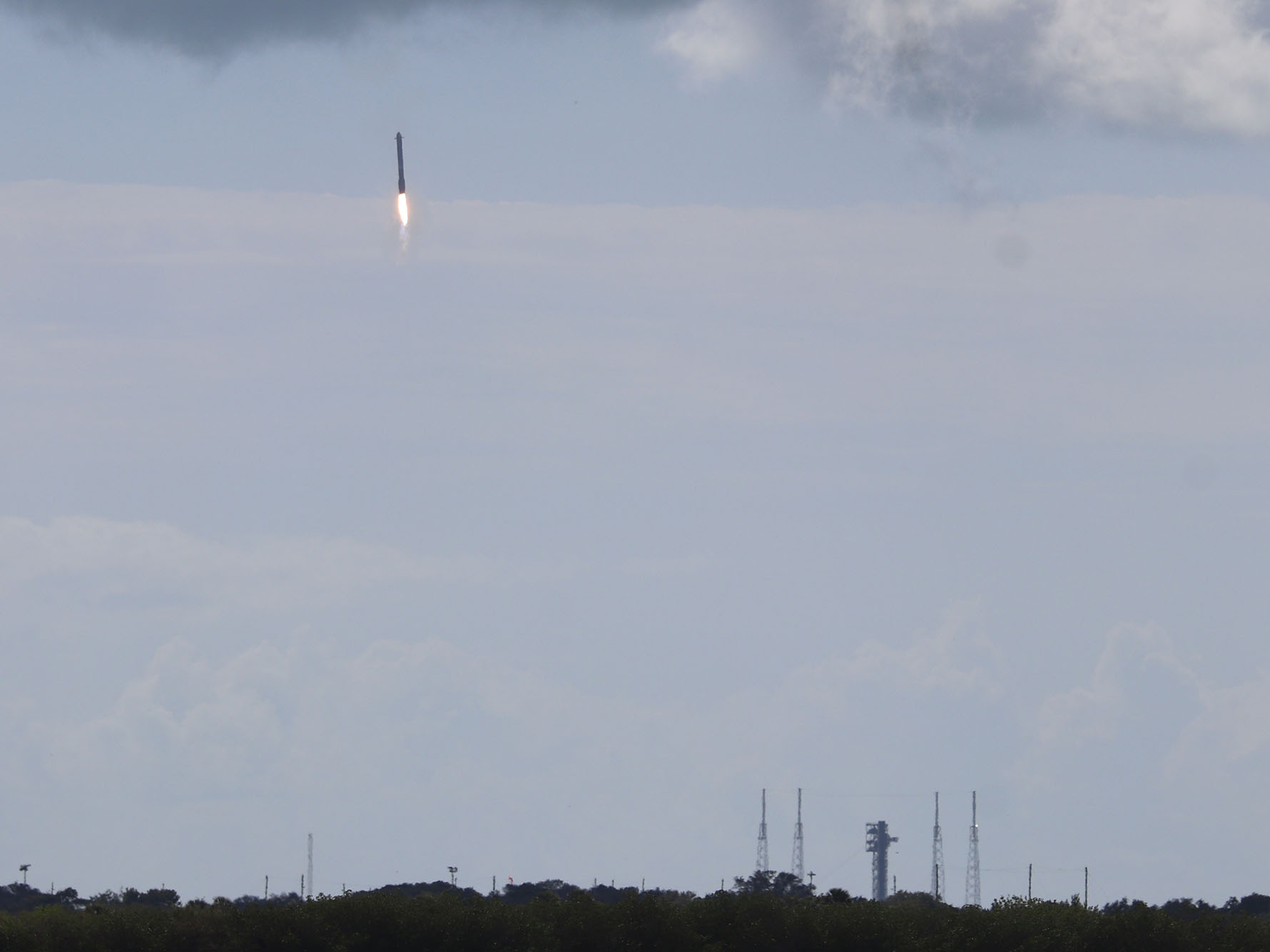
Photos below by Burt Dicht showing launch and side booster landing at LZ-40.










2 thoughts on “Falcon Heavy Returns”
Cool pictures! I’m sure the Society moved headquarters down there for many reasons, other than to have the best view to watch launches. Still, can’t complain. 🙂
Falcon Heavy can do what NG was supposed but couldn’t, for Lunar Base 1 & 2 plans laid out by NASA on 5/27. I will be giving a presentation on it at ISDC 2026 on Moon track. We do not have any other option right now.