The 44th Annual International Space Development Conference will be held in McLean, VA, June 4-7, 2026
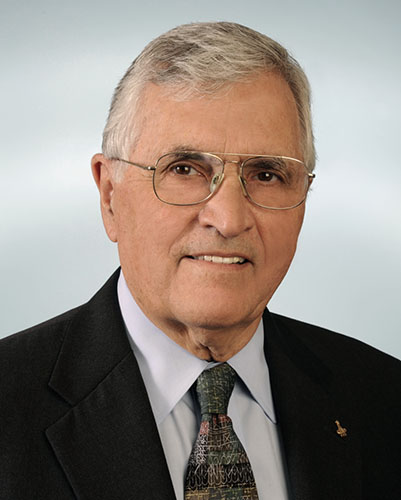
The National Space Society is pleased to announce that its inaugural Apollo Legacy Award will go to Dr. Harrison H. Schmitt at its 44th annual International Space Development Conference in McLean, VA, June 4-7, 2026. Schmitt flew on Apollo 17 in 1972 and was the only Apollo lunar explorer who was also a scientist, holding a Ph.D. in geology from Harvard University. He also served in the U.S. Senate.
Schmitt will be keynoting at the conference.
Schmitt said, “The National Space Society’s Apollo Legacy Award is a greatly appreciated tribute to the over 400,000 Americans and Canadians, as well as their families, whose dedication, initiatives, and sacrifices made the Apollo program a success during one of the most challenging periods in the history of human freedom. Fifty-seven years ago, these men and women began the movement of our species and institutions into the infinite frontier of space, continuing now with a new generation of young Americans. God speed them to further accomplishments and discoveries.”
NSS president Isaac Arthur said, “It is such a gift to have one of the few remaining Apollo astronauts, and a Moonwalker, with us for the ISDC. Dr. Schmitt was critical to NASA realizing their scientific goals on the Moon during the Space Race, having designed the geology training program for Apollo 13 through 17, and we’re honored to have him accept the inaugural NSS Apollo Legacy Award for Exceptional Achievement in the exploration of the Moon.”
The NSS Apollo Legacy Award was created to recognize individual astronauts or crews for outstanding accomplishments in the exploration of the Moon, Mars, and beyond, building on the pioneering spirit and legacy of the Apollo astronauts, Earth’s first explorers of the Moon. Fittingly, the inaugural NSS Apollo Legacy Award is being given to the last Apollo astronaut to set foot on the Moon.
Schmitt was selected as an astronaut in 1965, became a jet and helicopter pilot, and spent years helping his colleagues prepare for their own lunar voyages. Before joining the astronaut corps, he worked at the U.S. Geological Survey’s Astrogeology Center in Flagstaff, Arizona, developing field exploration techniques for the Apollo program.
Besides preparing others for work on the lunar surface, Schmitt was the first scientist-astronaut to be assigned to a backup crew, specifically for the flight of Apollo 15. He was then in line to fly on Apollo 18, but when that mission was canceled, was moved to Apollo 17, as NASA management and the scientific community felt strongly that at least one trained geologist needed to perform field work on the Moon. Schmitt then became the Lunar Module Pilot for that mission. The discoveries he made while working with his colleague Gene Cernan on the Moon were a highlight of the Apollo surface missions and have recently been documented and interpreted in his online “Diary of the 12th Man.”
After leaving NASA in 1975, Schmitt served a term as a Senator for New Mexico, chairing the Science, Technology, and Space Subcommittee. He subsequently has taught at the University of Wisconsin-Madison, has championed the future utilization of lunar resources, and chaired the NASA Advisory Council from 2005 to 2008.
NSS VP for Planetary Development Dr Pascal Lee said: “As a planetary scientist and co-chair of ISDC 2026, I am delighted that Dr. Schmitt has agreed to join us and receive this inaugural NSS Apollo Legacy Award. His voyage to the Moon and the discoveries it led to have been an inspiration to generations of scientists and explorers, and will no doubt continue to stir wonder far into the future.”