OPINION
By Grant Henriksen
NSS Policy Committee Vice-Chair and Space Regulation & Oversight Policy Lead
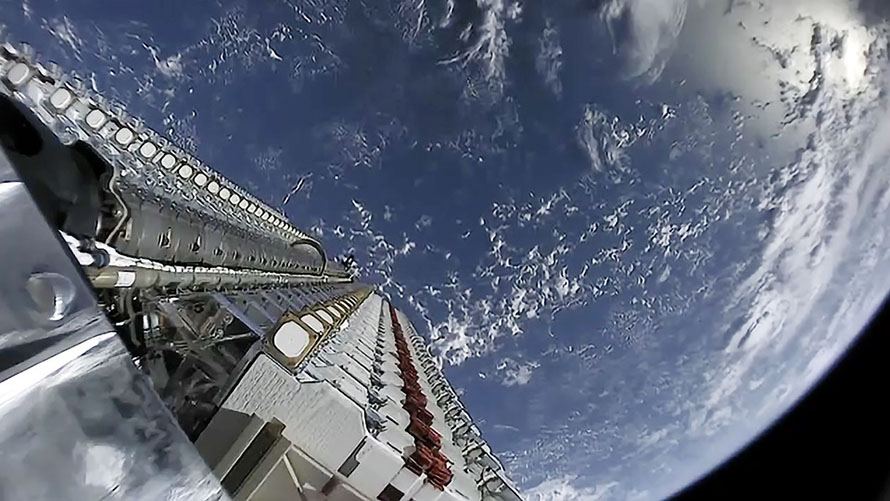
Image courtesy SpaceX: 60 Starlink satellites stacked together before deployment on May 24, 2019
Recently, a letter was sent to the Federal Communications Commission (FCC) which raised concerns about the environmental impact of satellite mega-constellations. The letter calls for the FCC to work closely with the EPA, NASA, and other regulators to ensure extensive environmental reviews are conducted.
The FCC is not the proper federal agency to coordinate or conduct space environmental protection. While the FCC plays a crucial role in managing the radio frequency spectrum and licensing satellite communications, it is not inherently equipped to address the broader environmental impacts of space activities. The FCC should abstain from regulating any non-communication related space activities. The FCC’s regulatory scope is limited to communications and does not encompass the comprehensive environmental oversight that would be required. With this year’s U.S. Supreme Court decision to end the doctrine of Chevron Deference, any action taken by an administrative agency that is outside the boundaries that Congress has created for the agency will be open to legal attack. Such a scenario would cause more regulatory uncertainty at a time when the U.S. commercial space sector already faces numerous challenges on that front.
The FCC’s expertise lies in telecommunications and spectrum management, not in environmental science or space sustainability. Effective space environmental protection requires specialized knowledge in areas such as orbital debris mitigation, space weather, and the long-term sustainability of space activities, all of which fall outside the FCC’s purview. Environmental protection in space involves a holistic approach that considers the entire lifecycle of space missions, from launch to deorbiting and disposal. This requires a multidisciplinary effort that integrates environmental science, engineering, policy, and international law—areas where the FCC does not have comprehensive authority or expertise. Additionally, environmental concerns in space are fundamentally different than those that impact the Earth’s biosphere and require a fresh start rather than simplistic application of existing Earth-focused law and regulation.
If a significant risk to the atmosphere of the Earth exists from a considerable increase in rocket launches or re-entering space vehicles, such risks can be addressed by the Environmental Protection Agency (EPA) under existing law, using the extensive experience of the EPA in addressing atmospheric pollution. The proposed involvement of the FCC in this area of regulation appears misguided.
Rushing to implement a moratorium on LEO internet satellites is not a prudent policy as it would endanger the economic, technological, and national security benefits of space activities and hurt the global competitiveness of U.S. companies. Satellite constellations like Starlink provide global internet access, especially in remote areas, fostering economic growth and technological innovation. Such satellite constellations provide valuable data for climate monitoring, disaster management, and scientific research, benefiting humanity. The space industry creates high-skilled jobs and stimulates related sectors, contributing to economic development. Halting satellite launches at a time when other nations are investing heavily in space would risk ceding technological leadership to other nations.
U.S. space companies are already developing technologies to minimize environmental impact, such as reusable rockets and satellite materials designed for safe deorbiting. Standards like the IADC Space Debris Mitigation Guidelines and U.S. Government Orbital Debris Mitigation Standard Practices are widely respected and companies are routinely adhering to the provisions found in those documents. Space companies comply with existing regulations to help ensure sustainable space operations.
Given the current constraints on the U.S. Federal administrative agencies regarding space regulation, Congress must act. NSS has supported the provisions of the Commercial Space Act of 2023. The Department of Commerce, with its Office of Space Commerce, is the right agency to regulate, authorize, and supervise novel space activities. This direction would clearly define a single responsible agency for licensing future space activities while ensuring authorization and continuing supervision as required by the Outer Space Treaty. This certainty will benefit government and commercial stakeholders and help to ensure continued U.S. leadership in space. Such authority granted by Congress would allow the Department of Commerce to consider the wide array of dimensions facing the regulation of space activities, including economic, national security, and environmental impact. Such an approach would lead to better regulatory frameworks and shared best practices across the Government.