By Burt Dicht
NSS Space Coast Correspondent
NSS Managing Director of Membership
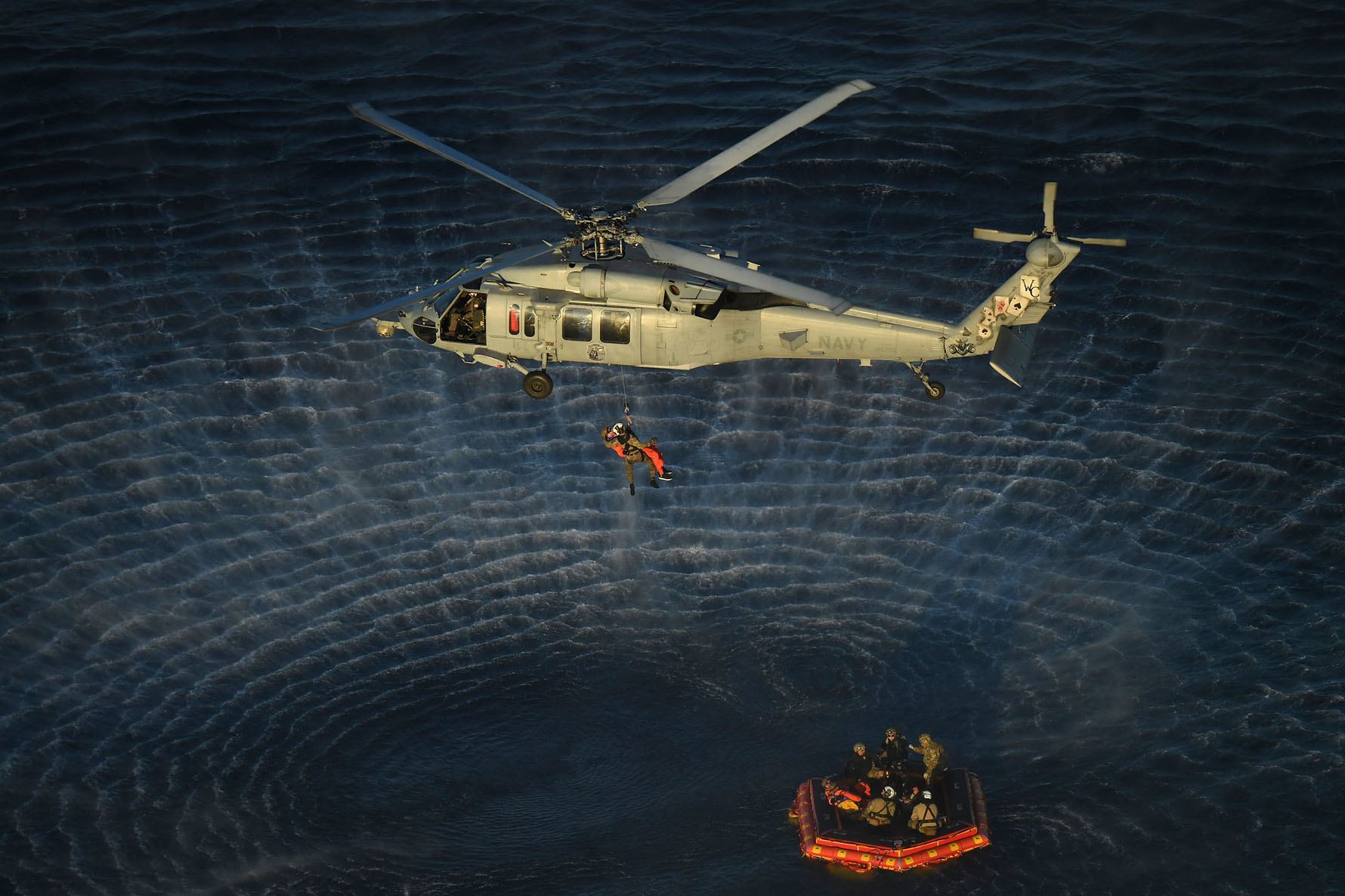
More than half a century after the last Apollo astronauts left the Moon’s neighborhood, four human beings climbed aboard an Orion spacecraft, rode a pillar of 8.8 million pounds of thrust into the Florida sky, and flew farther from home than anyone in history. When they came back nine days later, splashing down in the Pacific southwest of San Diego on April 10, 2026 — they brought with them something the world had been quietly starving for: proof that we can still do hard things, together.
Artemis II was, on paper, a test flight. In practice, it was a declaration that the next era of lunar exploration had begun.
A Crew Forged by Excellence
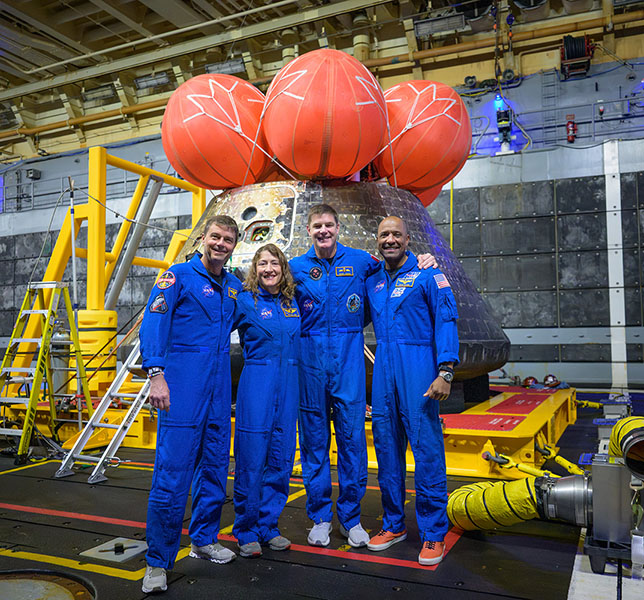
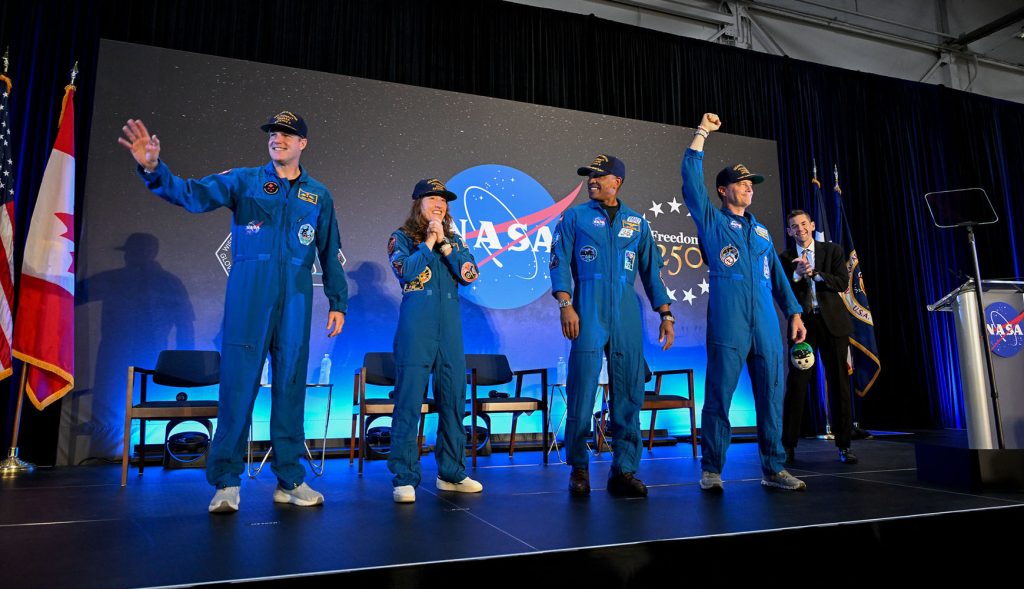
The crew of Artemis II did not look like the crews of Apollo: Commander Reid Wiseman, a naval aviator and former chief of NASA’s astronaut office; Pilot Victor Glover, a Navy test pilot and the first Black astronaut assigned to a lunar mission; Mission Specialist Christina Koch, who already held the record for the longest single spaceflight by a woman and had participated in the first all-female spacewalk; and Mission Specialist Jeremy Hansen, a Royal Canadian Air Force F-18 pilot and the first non-American ever sent beyond low Earth orbit.
This crew was selected for one reason: they were the right people for a mission of extraordinary complexity. That it also included the first woman and the first person of color assigned to a lunar mission reflects the depth and breadth of today’s astronaut corps, richer in experience, talent, and perspective than ever before.
Jeremy Hansen asked the crowd at their welcome home to look at the four of them standing together. “When you look up here,” he said, “you’re not looking at us. We are a mirror reflecting you. And if you like what you see, then just look a little deeper. This is you.”
Their bond was visible to anyone who watched. When Commander Wiseman spoke at the crew’s post-mission welcome in Houston, he turned to his crewmates and said simply: “Victor, Christina, and Jeremy, we are bonded forever.”
It was a reminder that beyond the records and headlines, four people had just shared something only a handful of humans in history can fully understand.
Seeing the Moon Through Human Eyes
For six hours on April 6, the crew took turns at Orion’s windows while the others relayed observations to the ground. It was the first time in more than fifty years that human eyes had studied the lunar surface from close range.
They saw green hues shimmering around Aristarchus crater. They described olive and brown tones across ancient plains. They viewed the immense Orientale basin on the Moon’s far side, a 600-mile impact structure never before seen directly by human eyes.
Then came one of the mission’s most remarkable moments. During a solar eclipse, as Orion aligned so that the Moon blocked the Sun, the crew observed six meteorite impact flashes on the lunar surface, brief pinpricks of light lasting only milliseconds. Scientists on the ground had not expected the crew to see even one. They saw six.
And in a moment that felt both intimate and historic, the crew proposed names for two unnamed craters they could see with the naked eye near the Orientale basin. One they called Integrity — after the name they had given their spacecraft. The other they called Carroll — in memory of Commander Wiseman’s late wife, Carroll Taylor Wiseman, who passed away in 2020. The names will be formally submitted to the International Astronomical Union. It was, quietly, one of the most human moments of the entire mission.
Even on a flyby mission, Artemis II was already returning science that will shape future lunar exploration. Back on Earth, the reaction inside NASA’s Science Evaluation Room was every bit as memorable as what the crew saw through Orion’s windows.
When the astronauts reported the meteorite impact flashes and the subtle variations in color across the lunar surface, the room erupted in excitement. There were audible screams of delight from scientists who had spent years preparing for this flyby. The lunar science lead, Dr. Kelsey Young, later said she hadn’t expected the crew to see so many impacts and that the surprise and shock were visible on her face in real time.
That joy was contagious
Watching the scientists respond with such visible excitement was a reminder that exploration is not only about machines and mission timelines. It is also about discovery — about the thrill of seeing something new and immediately understanding that it matters.
For those of us following the mission, it was a joy in itself to watch that enthusiasm unfold. You could feel the years of preparation, the professional curiosity, and the sheer wonder of science happening live. It was one of the most uplifting moments of the mission.
The Wonder of Seeing Earth
But perhaps the most profound observations were not of the Moon, but of Earth. At a record distance of more than 252,000 miles from home, the crew looked back and saw our world as Apollo crews once did: small, luminous, and alone in the blackness.
As Orion emerged from behind the Moon and communications were restored, Christina Koch’s voice came through from deep space with words that may become one of the defining reflections of the Artemis era: “When we burned toward the Moon, I said that we do not leave Earth — but we choose it. We will explore. We will build ships and visit again. But ultimately, we will always choose Earth. We will always choose each other.”
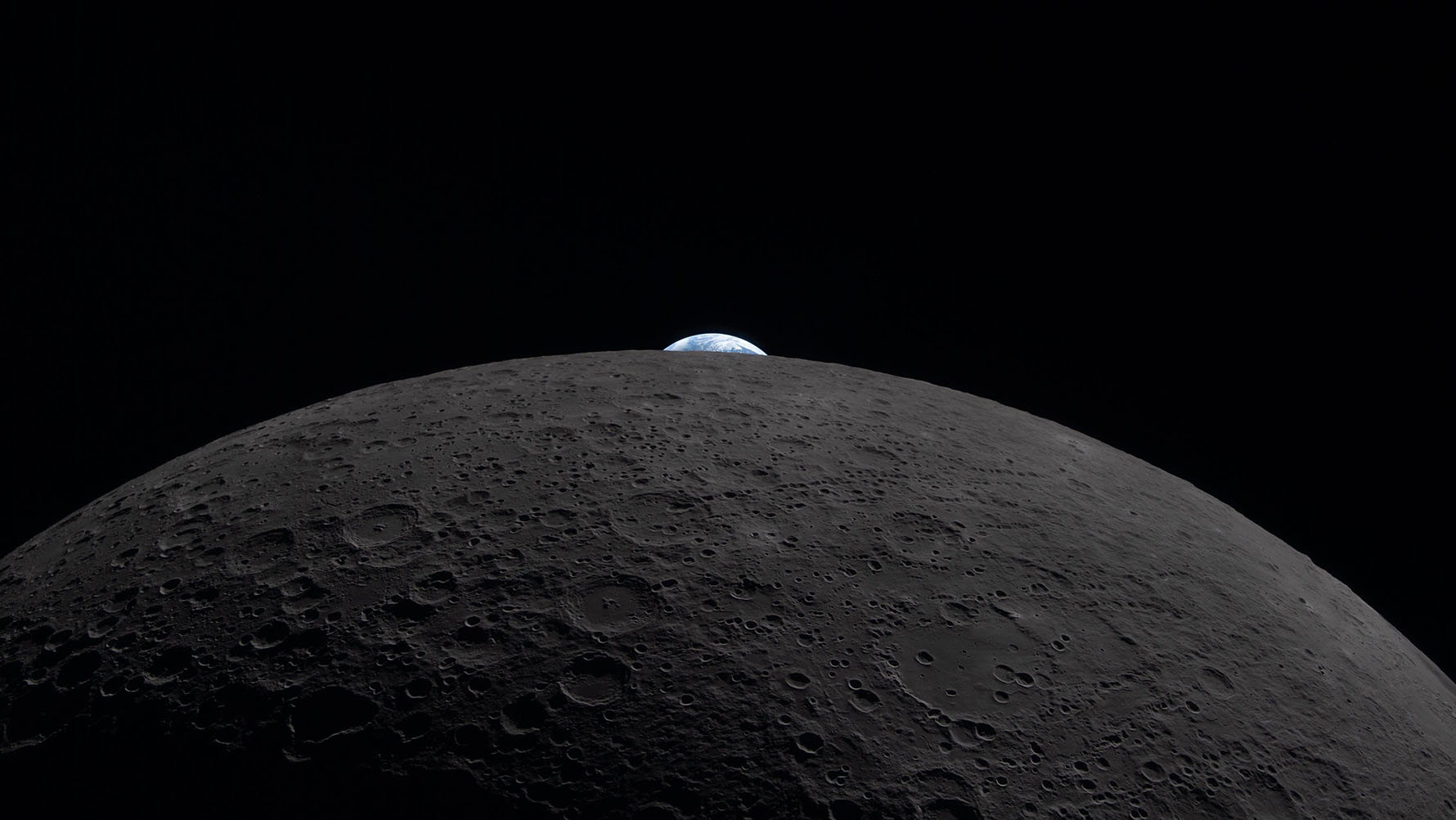
From that distance, borders disappear. The divisions that seem so large from the surface become invisible. What remains is one fragile, shining world.
That perspective may be the greatest gift of lunar exploration — not simply what we learn about the Moon, but what we rediscover about ourselves.
Testing Orion: The Machine That Must Not Fail
Artemis II was fundamentally a test flight, and Orion delivered. The trajectory was so precise that two of the planned outbound correction burns were canceled because they were unnecessary. The European Service Module performed flawlessly during translunar injection, placing Orion exactly where it needed to be.
Engineers deliberately stressed the spacecraft’s systems, from life-support performance to manual handling and laser-based optical communications, proving capabilities that future lunar missions will depend upon.
There were issues, as expected on a first crewed flight: the toilet malfunction, a water dispenser problem, and an early helium-system anomaly. That is precisely why Artemis II mattered.
A test flight is where systems are proven with real people aboard. And then came the ultimate test: re-entry, and this one carried weight that went beyond the ordinary drama of returning from deep space.
Orion’s heat shield carried a known flaw. After Artemis I, engineers had found unexpected cracking and charring across more than a hundred locations in the Avcoat material. NASA had studied the problem for nearly two years, redesigned the re-entry trajectory to reduce thermal stress, and made the difficult decision to fly Artemis II with the existing shield. There were engineers who publicly objected. The astronauts flew anyway — understanding exactly what they were accepting.
Orion struck Earth’s atmosphere at approximately 25,000 miles per hour, with the heat shield enduring temperatures approaching 5,000 degrees Fahrenheit, roughly half the temperature of the Sun’s surface. It performed. Orion splashed down on target. The heat shield held.
The Quiet Excellence of Mission Control
While the world focused on the astronauts, hundreds of engineers, controllers, and scientists in Houston were doing what Mission Control has done since Mercury and Apollo: making the impossible look routine.
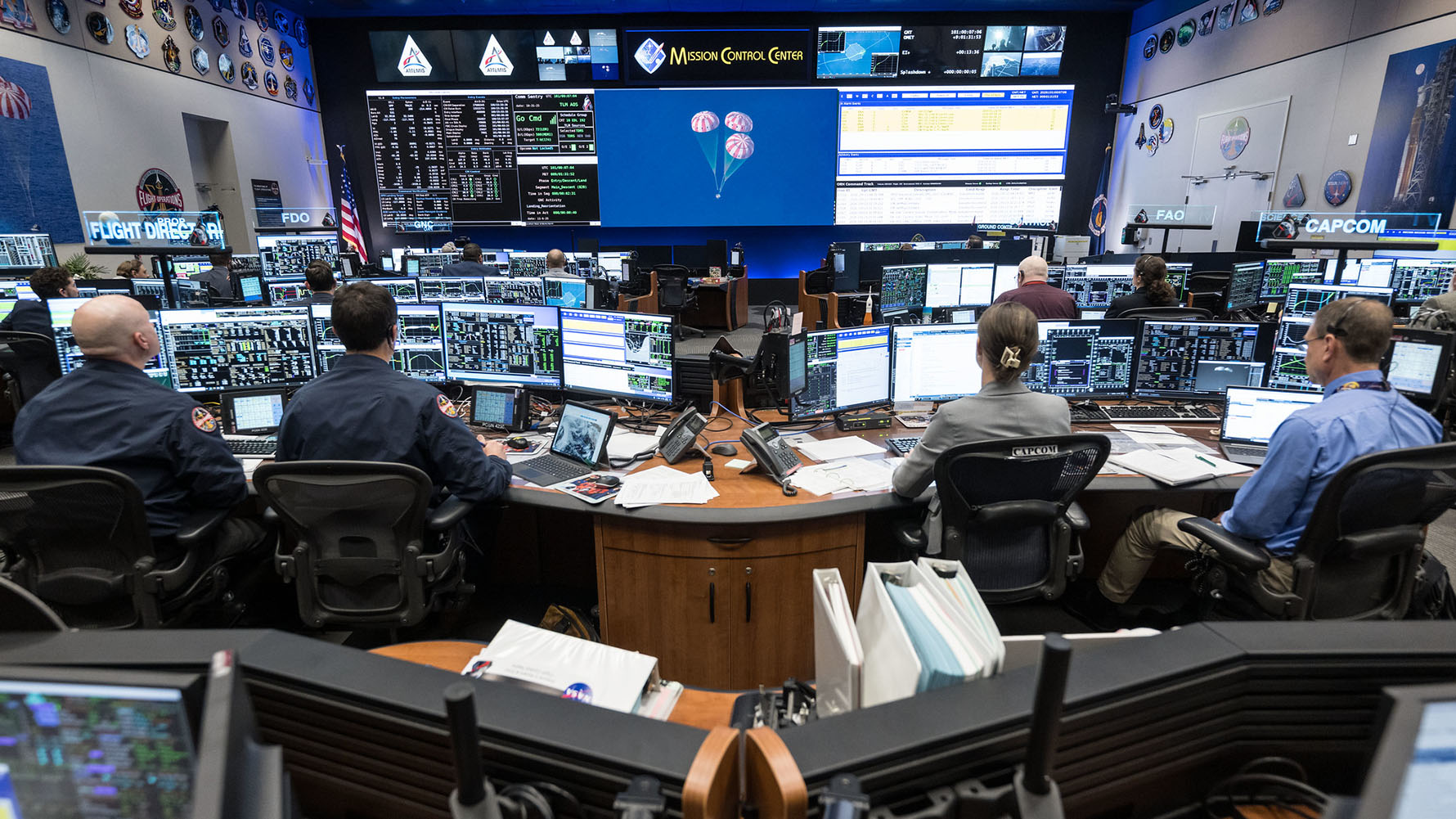
Problems were handled with the calm professionalism that has long defined NASA flight operations.
The return of the wake-up music tradition included a profoundly moving moment: a pre-recorded message from Jim Lovell — the late Apollo 8 and Apollo 13 astronaut — played for the crew on flyby day. Lovell, who passed away in 2025 at the age of 97, had recorded the message just months before his death, welcoming the Artemis II crew to his “old neighborhood” and passing the torch across generations. It was the last voice of Apollo, speaking directly to the first crew of the new lunar age. There were few dry eyes in Mission Control.
This was not simply a new mission. It was the continuation of a story more than half a century in the making.
What Comes Next
With Artemis II now safely in the history books, the work truly begins. Over the coming months, NASA will conduct an exhaustive post-flight review of every aspect of the mission. Thousands of telemetry points from Orion’s systems — propulsion, life support, communications, guidance, and thermal protection — will be carefully analyzed. The astronauts themselves will undergo extensive debriefings, providing engineers and mission planners with invaluable insight into how the spacecraft performed with a crew aboard in deep space.
Just as important, the Orion capsule itself will now become an object of intense study. From the condition of the heat shield and avionics systems to wear on crew interfaces and life-support hardware, every component will be inspected in detail.
The lessons learned from Artemis II will directly shape procedures, hardware refinements, crew operations, and mission timelines for the flights that follow. That data now feeds directly into the next major milestone: Artemis III.
Under NASA’s revised architecture, Artemis III is now planned as a 2027 Earth-orbit demonstration mission that will test rendezvous and docking operations between Orion and one or both commercial Human Landing Systems from SpaceX and Blue Origin. In many ways, it will serve as the modern equivalent of Apollo 9, proving the choreography and operational procedures required before committing astronauts to a lunar descent.
If those demonstrations proceed successfully, NASA now targets Artemis IV in 2028 as the first crewed lunar landing of the Artemis era, humanity’s first return to the lunar surface since Apollo 17.
Artemis II proved that we can once again send humans safely to lunar distance. What comes next is proving that we can land them and this time, begin building a sustained presence.
A Personal Reflection: From Apollo to Artemis
For me, this flight carried a meaning that is difficult to fully put into words.
I was part of the Apollo Generation. As a boy, I remember hearing the television in our living room on Christmas Eve 1968 and learning that the crew of Apollo 8 were in orbit around the Moon.
I was captivated.
By the time Apollo 11 Moon Landing took place, I was ten years old, and like so many of my generation, I was inspired to dream bigger than I ever had before. That dream shaped my life.
Apollo set me on the path to become an aerospace engineer and later to devote so much of my career to helping young people imagine futures for themselves in aviation and space. For more than fifty years, I have waited to see humanity once again send astronauts toward the Moon.
To witness Artemis II, to see Orion rise from Florida skies, to follow the crew’s journey around the Moon, and to watch them return safely to Earth was more than a mission milestone. It was deeply emotional. It felt like seeing history resume.
This flight reminded me why space exploration has always mattered so much. It is not only about technology or destinations. It is about possibility.
It is about inspiring the next generation in the same way Apollo inspired mine. For those of us who grew up in the shadow of Apollo, Artemis II was more than a test flight. It was the opening chapter of a new lunar age.
And after waiting more than fifty years, it was worth every moment.