
Latest Test of the Megarocket Hoped to Demonstrate a Number of New Technologies and Systems
The National Space Society congratulates SpaceX on the seventh flight of their Starship on January 16th. The flight met many of its objectives and represents significant progress toward the overall goals for SpaceX’s newest spaceflight system.
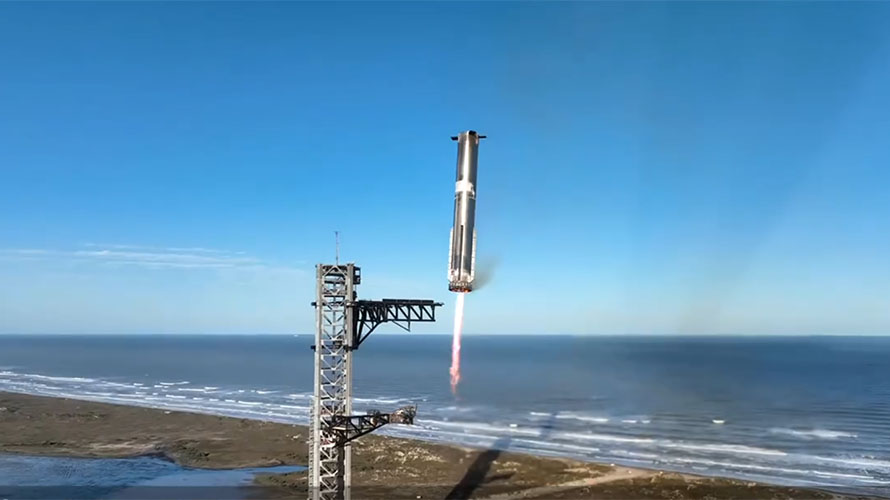
Launched at 5:37 pm Eastern Time, this flight tested the new Block 2 Starship and executed a dramatic catch of the returning first stage, called “Booster,” using the Mechazilla “chopsticks” recovery apparatus, for a second time. This technique is a key part of SpaceX’s rapid reuse strategy for quickly recovering and re-flying Starship in the future.
Although the upper stage, called “Ship,” was planned to test many new features, contact was lost about eight minutes into the flight an altitude of 77.5 miles (125 kilometers). At that time, flight controllers noticed some of the six upper stage engines going offline. No further details have been made public. SpaceX’s plan was to have the upper stage fly most of the way around the globe and execute a controlled reentry into the Indian Ocean just over an hour after launch. Unfortunately, the spacecraft fell far short of this objective, descending in a fiery, uncontrolled reentry.
”SpaceX’s 7th Starship test flight featured the first re-use of a raptor engine in the booster stage, and a spectacular second catch of the returning first stage with mechanical arms,” said Dale Skran, NSS COO and EVP. “Given the large number of changes to the Block 2 Starship, problems are to be expected as part of the SpaceX iterative development process.”
Starship was first announced by Elon Musk in 2016 and has gone through many iterations since that time. SpaceX’s philosophy has been to fly as often as possible, evaluate successes and failures, and perform rapid iterations of their designs for improved results. This has led to their Falcon 9 rocket being the world’s first reusable launch system and capturing over half the global launch market and the development of the world’s largest rocket, Starship, in record time and at lower costs than previous heavy launch systems.
Though Starship is still in the flight test phase, the system has already been selected by NASA for a lunar landing for the Artemis program, called the Human Landing System, and has captured the interest of many private customers. The Starship program has, since its inception, been designed around mass production, rapid refurbishment, and frequent re-flight.
Most notably, the time and cost of fabricating both the rocket engines and the rocket itself are exponentially less expensive than previous rocket designs. With this cheaper cost comes less expensive access to space, which is a cornerstone of the National Space Society’s goal of human settlements off-Earth. More information about these goals can be found in the NSS Roadmap to Space Settlement.
SpaceX also launched two commercial lunar landers on a Falcon 9 rocket earlier on January 15th. The first, called Blue Ghost, was built by commercial space company Firefly Aerospace as part of NASA’s CLPS (Commercial Lunar Payload Services) program and is planned to attempt a landing on the Moon in the first week of March. The second, the HAKUTO-R M2 lander, comes from the Japanese space company ispace and will arrive at the Moon in about four or five months.
Image of Starship booster catch courtesy of SpaceX.








1 thought on “NSS Congratulates SpaceX on Starship’s 7th Test Flight”
Congratulations SpaceX on successful capture of the first stage of the SuperHeavy. Good luck with the next test launch of the Block 2 Starship.