Share:

Facebook
X
Pinterest
LinkedIn
by Dave Fischer

If you want humanity to explore the Solar System, you have to test the systems you plan to use for moving around and living. And where is there a readily available harsh environment for such testing? Arizona. In the Summer it is hot and dry. In the Winter it is cold and dry (or wet, depending on the state of the Arctic storm systems).

Currently underway (31 August through 15 September) is the 13th iteration of the Desert RATS program. You can follow their exploits on the RATS’ Blog.

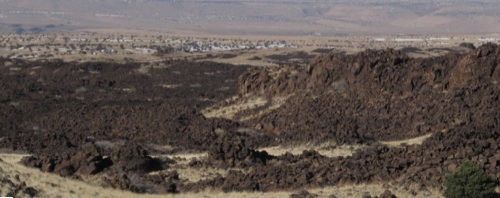
RATS Site
RATS site in Northern Arizona
Image Credit: NASA
Athlete
NASA Athlete Vehicle
(All-Terrain Hex-Legged
Extra-Terrestrial Explorer)
Image Credit: NASA
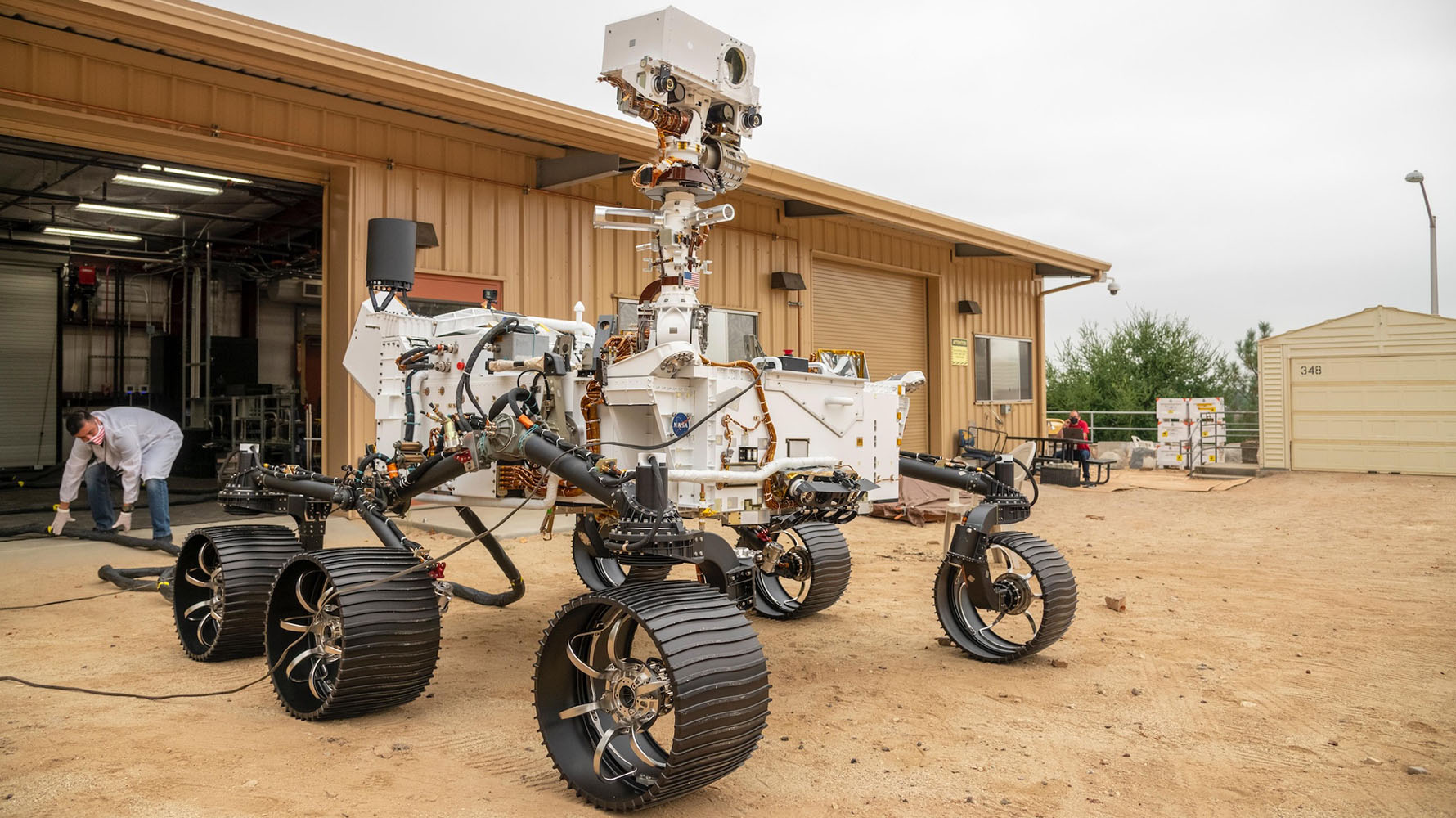
Rover
Space Exploration Vehicle
Image Credit: NASA / Regan Geeseman
NASA’s Research and Technology Studies (RATS) program is designed to gather engineers, astronauts and scientists and test technology. This year, the major objectives include:

  • Space Exploration Vehicles (pdf) – a pair of rovers that astronauts will live in for 7 days at a time
  • Habitat Demonstration Unit (interactive pdf)/Pressurized Excursion Module – a simulated habitat where the rovers can dock to allow the crew room to perform experiments or deal with medical issues
  • Tri-ATHLETEs, or –Terrain Hex-Legged Extra-Terrestrial Explorer – two heavy-lift rover platforms that allow the habitat, or other large items, to go where the action is
  • Portable communications terminals
  • Centaur 2 – a possible four-wheeled transportation method for NASA Robonaut 2
  • Portable Utility Pallets, or PUPs for short – mobile charging stations for equipment
  • A suite of new geology sample collection tools, including a self-contained GeoLab glove box (pdf) for conducting in-field analysis of various collected rock samples.

During this mission, there will be four crew members living in the two rovers. Their traverse routes will include driving up and down steep slopes and over rough terrain at various speeds. The crew will also demonstrate docking and undocking with the PUPs and the habitat. Other objectives for the rovers include demonstrating the differences in productivity for crew members and their ground support that come with different communication methods, and evaluating different operational concepts for the trips the rovers make.

Let us know what you think. What do you want to know about? Post a comment.

Share:

Facebook
X
Pinterest
LinkedIn
Picture of By National Space Society

By National Space Society

Leave a Comment

Don't Miss a Beat!

Be the first to know when new articles are posted!

Search
Categories

Follow Us On Social Media

JOIN THE
GREATEST ADVENTURE

Give The Gift Of Space: Membership For Friends and Family

Book Review

Archives


Hilton McLean Tysons Corner, McLean, Virginia
June 4 - 7, 2026

Recent Blog Posts

NSS continued its commitment to developing the next generation of space leaders through two programs created specifically for university students and early-career professionals: Speed Mentoring...
The National Space Society’s annual International Space Development Conference concluded on June 7 and was widely praised by attendees, with one of the best domestic...
Apogee Books has reissued its volume on Surveyor for the program’s 60th anniversary. The book is a wonder, containing a veritable treasure trove of documents...
Each year, the “NSS 30 Under 30” program will honor 30 individuals under the age of 30 who are making meaningful contributions across the full...

The National Space Society invites you to the next Space Forum Thursday, June 18, 2026, 8:00 pm to 9:15 pm EST NOTE NEW TIME! The...

For the first time, the space elevator track at ISDC expanded to two sessions: the morning dedicated to powering the space elevator and the afternoon...
The energy around the National Space Society’s Young Professionals (YP) initiative was on full display at this year’s International Space Development Conference® (ISDC®), with strong...
At the Johnson Space Center today, Artemis II commander Reid Wiseman symbolically handed the baton to Randy Bresnik, who will lead the four-person Artemis III...

Your Doorway to New Worlds