| by Dave Fischer
|
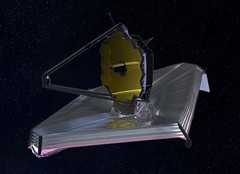
| The James Webb Space Telescope (JWST) is an infrared observatory, and a partial successor to the Hubble Space Telescope. JWST does not view visible light because light from the earliest universe has shifted toward the infrared (red shift).
Infrared sensitivity is required in order to see further back in time toward the beginning of the universe than either Hubble or ground based observatories.The James Webb Space Telescope is a joint venture between NASA, the European Space Agency (ESA) and the Canadian Space Agency (CSA). In all, fifteen countries are making contributions to JWST. The are four main components to the scientific mission:
JWST is scheduled for launch in 2014 aboard an Ariane 5 rocket. It will take up residence at the Sun-Earth Lagrange point 2 (SEL-2). SEL-2 is 1,500,000 km beyond the Earth from the Sun (the Earth-Moon L2 is only 61,500 km beyond the Moon). The location was chosen in order to be able to shield the telescope from the infrared radiation of the Sun and the Earth. |
| Currently, SEL-2 is occupied by the Wilkinson Microwave Anisotropy Probe (WMAP), which was launched 30 June 2001, and the Herschel and Planck observatories, which were launched together on an Ariane 5 on 14 May 2009.
The image at left is a cutaway diagram the the Ariane 5 rocket, illustrating how the JWST will fold up inside the payload fairing. With the large screen behind it, the JWST will be about 21 m in width. It will stand about three stories high. The main telescope mirror, which measures 6.5 m in diameter, is too large to launch in one piece. Instead, it consists of 17 individual mirror segments mounted on a frame which will be folded inside the fairing of the Ariane 5 at launch. Once it arrives at SEL-2, it will unfold, as this animation shows. There are four instruments in the Integrated Science Instrument Module designed to conduct the investigations on board the James Webb Space Telescope: |
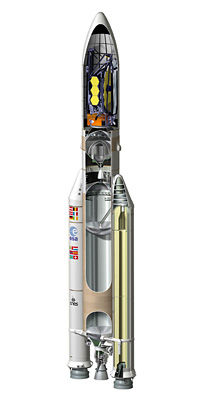 Image Credit: European Space Agency </td align=”left”> |
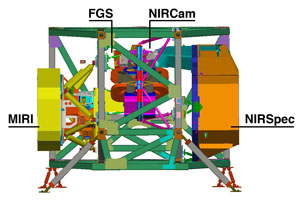 Image Credit: NASA |
|
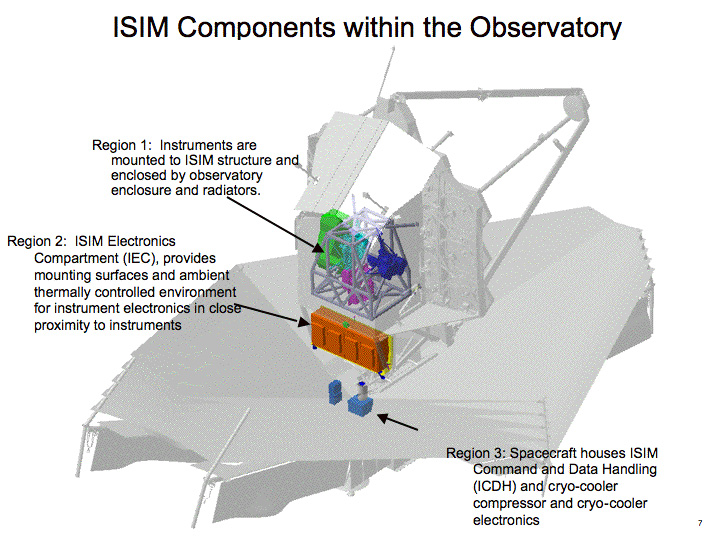
| The image below shows the locations of the four instruments in the Integrated Science Instrument Module (ISIM). Below, the image shows the location of the instrument package within the JWST.
The Mid-Infrared Instrument (MIRI) is an imager/spectrograph that covers the wavelength range of 5 to 27 micrometers. The camera provides wide-field broadband imagery, and the spectrograph module provides medium-resolution spectroscopy over a smaller field of view compared to the imager. The nominal operating temperature for the MIRI is 7K. Additional information can be found at the MIRI website, Space Telescope Science Institute. The Near Infrared Camera (NIRCam) is an imager with a large field of view and high angular resolution. The NIRCam covers a wavelength range of 0.6 to 5 micrometers. More on NIRCam. The Near Infrared Spectrograph (NIRSpec) measures the simultaneous spectra of more than 100 objects in a 9-square-arcminute field of view. This instrument provides medium-resolution spectroscopy over a wavelength range of 1 to 5 micrometers and lower-resolution spectroscopy from 0.6 to 5 micrometers. See the Space Telescope Science Institute information on NIRSpec. The Fine Guidance Sensor (FGS) sensor is used for both “guide star” acquisition and fine pointing. See information from the Space Telescope Science Institute about FGS. |
See also:
The Wikipedia article on JWST.
NASA home page for JWST.
ESA home page for JWST.
CSA home page for JWST.
Make your own Paper Model of the JWST.
YouTube and JWST.
Let us know what you think. What do you want to know about? Post a comment.