Category: Nonfiction
Reviewed by: Casey Suire
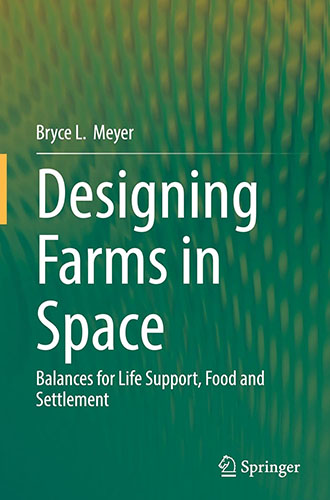
Title: Designing Farms in Space: Balances for Life Support, Food and Settlement
Author: Bryce L. Meyer
Format: Hardcover/Kindle
Pages: 478
Publisher: Springer
Date: January 2026
Retail price: $189.67/$159.99
ISBN: 978-3032043948
Find this book
In the 2015 film The Martian, astronaut Mark Watney becomes stranded on the Red Planet following a dust storm. Millions of miles away from Earth, Watney, a trained botanist, famously survives on Martian-grown potatoes. While The Martian was just a movie, the film raises an intriguing question. How is farming in space supposed to work?
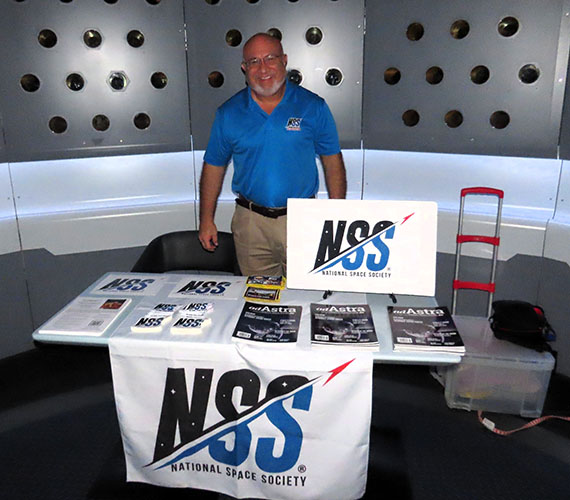
Bryce Meyer, Chief Editor of the NSS Space Settlement Journal and an NSS Space Ambassador, recently published a book titled Designing Farms in Space. Meyer is an expert on space agriculture. Readers will quickly get the impression that he is quite passionate about farming, both on Earth and in space. His father wrote the book’s foreword, and there are also pictures of the family farm in Illinois.
All space settlement advocates should be passionate as well. Growing an ample supply of food is an obvious necessity for a self-sufficient space settlement. A constant stream of resupply missions, such as those to the International Space Station, would be too expensive to support a growing space city.
Meyer’s academic textbook is loaded with numerous photographs, diagrams, charts, and graphs. There are chapters on subjects such as farm machines, animal and fungi production, plant and algae production, and space menus. The farming techniques outlined in the book can be applied to lunar, Martian, or rotating space settlements. Due to the nature of the topic, the book’s audience will primarily be staunch supporters of space settlement. Meyer contends his book “should be readable by any technically interested adult with some college or late high school student, who may have some very basic knowledge of current events in space.” If you dislike numbers, don’t worry. Meyer limits the amount of math in his book.
After “glop goodies on a ride to Mars,” astronauts will want a more appetizing menu once they reach their destination. One interesting section in the book is “Menus and Meals: Beyond Glop.” It involves many tasty selections popular on Earth, such as meat, beer, wine, and coffee in space. My personal favorite, pizza, is also discussed. Meyer expresses a fondness for “tofu fried in peanut oil, dipped in peanut and soy sauce.” Earlier in the book, he cites goat vindaloo as another favorite. He also sometimes uses humor in his book. For example, lunar settlers might want wine or beer “to celebrate a victory in moon ball.”
A lot more work is still required to make space farms a reality. One passage in the book is titled, “If I Had Lots of Money Right Now and Wanted Space Farms Soon, What Research Would I Fund?” Here, Meyer outlines a dozen key research areas he is interested in studying. He notes that new space farm technologies will also improve life on Earth.
For Meyer, the ambitious goal is “trillions of happy, smiling babies, everywhere.” To do so will “require at least 100 Earth equivalents in space.” Humanity will never be a true space-faring civilization unless space agriculture is mastered. An excellent meal is needed for both survival and morale. Future space settlers won’t want or deserve to eat glop.
© 2026 Casey Suire