Category: Nonfiction
Reviewed by: Mark Lardas
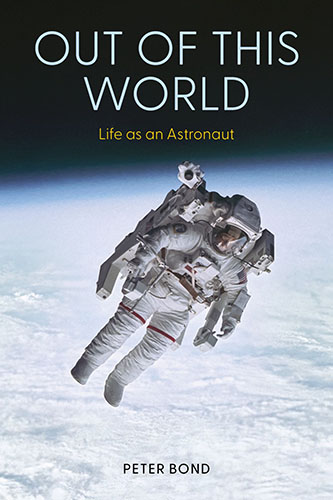
Title: Out of This World: Life as an Astronaut
Author: Peter Bond
Format: Hardcover/Kindle
Pages: 224
Publisher: Reaktion Books
Date: August 2026
Retail price: $35.00/$31.90
ISBN: 978-1836391999
Find this book
Humans have been traveling to space for 65 years. Spaceflight seems routine nowadays. Yet, although the annual number of spacefarers has been increasing over the last ten years, it remains rare. Fewer than 800 humans have been to outer space, whether the boundary is defined by the U.S. Air Force or the Kármán Line.
This book examines human spaceflight. It reviews its history, highlights the accomplishments and tragedies, and describes the equipment used. It also looks at living in space, what space travelers experience, and how they work. It shows what humans can accomplish by being in space.
Bond opens by discussing early spaceflight pioneers. He starts with the groundbreaking role played by Konstantin Tsiolkovsky, a self-taught Russian rocket pioneer. Tsiolkovsky established the basic principles required to place a satellite into orbit. Bond progresses through the work of Goddard and Oberth. Then he presents U.S. and Soviet rocketry programs of the 1950s. He concludes with the first satellite launches through Sputnik II, which put a dog in orbit, and the final uncrewed test flights that preceded the first men in space.
Next, Bond covers human spaceflight. He touches on early programs like Mercury and Vostok and continues through present-day efforts by SpaceX, Blue Origin, Virgin Galactic, and the Chinese. Some space agencies, like the European Space Agency (ESA), lack a crewed spacecraft and fly missions with either NASA or Roscosmos. India’s space agency, ISRO, is preparing for its first human spaceflight. Additionally, the role of payload specialists and space tourists through NASA and Soviet programs is examined.
Another chapter looks at preparation for spaceflight. This examines the selection process and crew training, from the beginning of human spaceflight to the present. It follows the evolution of crew selection and training over the 65 years of human spaceflight, including simplified training for payload specialists and space tourists.
Additionally, Bond explores the challenges of protecting humans from the vacuum of space. He looks at the development of spacesuits, from the first pressure suits used on Earth to extravehicular activity (EVA) suits capable of operating outside a spacecraft. Spacewalks, including free-flight EVAs, are discussed, along with the challenges of space construction and satellite repair.
Two chapters examine living in space and crew health and happiness. These sections cover activities like dining, hygiene, trash disposal, repairs, and maintenance. Other topics are how humans deal with problems such as physiological issues, microgravity, space radiation, isolation, and stress. The evolution of space medicine is explored. Bond also discusses the role played by space stations.
Next, Bond looks at scientific activities conducted by humans, autonomous satellites, and robotics. This discussion is the one most weighted towards current activities. He also looks at lunar exploration, past and present. There is an extensive discussion of the Apollo program. Oddly, the Moon race aspect, vivid for those then alive, is ignored, as if the Soviets never attempted to reach the Moon. It is followed by Bond’s exploration of return-to-the-Moon activities by the U.S. and China. The U.S. effort includes collaboration by the Japanese and ESA. China is largely going at it alone. Bond also examines commercial space’s role in returning humans to the Moon.
Bond closes his book by presenting the perils of space. He provides a look at every fatal and near-fatal event involving human spaceflight, from the Apollo 1 fire to the Columbia disaster. Each event came with lessons learned, modifying future human spaceflight. He also looks at escape systems. Bond explores five U.S. and four Soviet/Russian incidents. These stories are a reminder that space travel is, and remains, inherently dangerous.
The book concludes in 2025. Despite this, some statements are already outdated. For example, Lunar Gateway, described in the book, was cancelled after the book was written but before publication. Furthermore, Bond states only two space missions were cut short due to crew health problems. In January 2026, NASA cut short an ISS expedition due to a crew health problem. This is not a criticism of Bond’s research. Rather, it shows how any book covering ongoing events gets overtaken by time.
Bond punctuates his points with numerous illustrations. These underscore the issues and accomplishments discussed in each chapter. He also presents a two-page bibliography for those seeking to delve deeper into specific topics. Anyone seeking a short but comprehensive introduction to human spaceflight would do well to start with this book.
© 2026 Mark Lardas