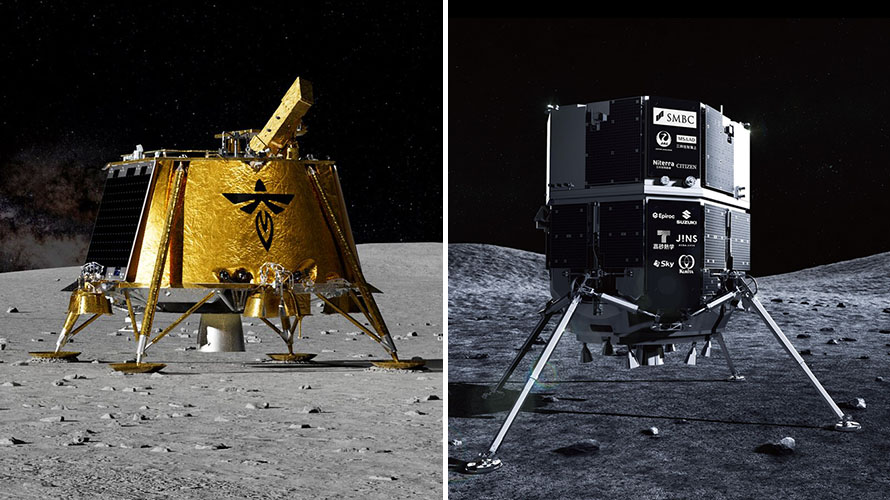
Image: Artist renditions of Blue Ghost and Resilience lunar landers (no, they won’t be landing next to each other). Courtesy Firefly Aerospace and ispace.
By Burt Dicht
NSS Managing Director of Membership
“We’re going to the Moon.” This powerful tagline from Firefly Aerospace resonates deeply as the company achieves a significant milestone in commercial lunar exploration. On January 15 at 1:11 a.m. EST, Firefly’s Blue Ghost lunar lander launched aboard a SpaceX Falcon 9 rocket from Launch Complex 39A (LC-39A) at the Kennedy Space Center. But this historic mission wasn’t alone—inside the Falcon 9’s payload fairing was a second lunar lander, Resilience, developed by the Japanese space exploration company ispace. Together, these missions are advancing the growing lunar economy and humanity’s return to the Moon.

After separating from the Falcon 9 at 2:17 a.m. EST, Blue Ghost established communications with Firefly’s Mission Operations Center in Cedar Park, Texas, at 2:26 a.m. EST. By 5:30 a.m. EST, the spacecraft’s commissioning phase was completed. This process included verifying key systems, increasing data transfer rates, achieving a power-positive attitude, and performing initial health checks.

Blue Ghost Mission 1, named Ghost Riders in the Sky, is part of NASA’s Commercial Lunar Payload Services (CLPS) Program, which supports the Artemis campaign to establish a long-term human presence on the Moon. In a conversation I had with Dr. Nicola Fox, NASA’s Associate Administrator for the Science Directorate, she praised the program’s innovation:
“The CLPS program is designed to drive innovation as these emerging space companies develop new approaches to delivering payloads to the Moon while providing critical science needed for future missions, especially the return of astronauts to the lunar surface.”
Blue Ghost will spend approximately 25 days in Earth orbit, four days in lunar transit, and 16 days in lunar orbit, enabling the team to conduct robust health checks on each subsystem, calibrate the propulsion system in preparation for critical maneuvers, and begin payload science operations. Upon landing in Mare Crisium (Sea of Crises), Blue Ghost will operate 10 NASA payloads for a complete lunar day (about 14 Earth days) and support several science and technology demonstrations, including lunar subsurface drilling, sample collection, X-ray imaging, and dust mitigation.
The Falcon 9’s second lunar passenger Resilience, marks the second attempt by ispace to achieve a Moon landing after its 2023 mission fell short. CEO Takeshi Hakamada reflected on their journey:
“A Moon landing is no longer a dream but has become a reality. A success would be a huge, huge step forward for ispace.”
Resilience separated from the Falcon 9 thirty minutes after Blue Ghost and is scheduled to touch down on Mare Frigoris (Sea of Cold) in the May to June timeframe. Carrying $16 million worth of customer payloads, including six science and technology demonstrations, Resilience features the Tenacious Micro Rover, equipped with a high-definition camera and a small shovel for sample collection and imaging.
These dual missions demonstrate the strength of commercial partnerships and global collaboration in advancing lunar exploration. Firefly Aerospace’s Blue Ghost and ispace’s Resilience symbolize humanity’s growing capability to develop and sustain a thriving lunar economy.







1 thought on “Building the Lunar Economy: Two Bold Missions, One Shared Vision”
With apologies to Masefield: “I must go back to the Moon again, To the lonely Moon in the sky, And all I ask is a powerful Ship, and a Star to steer her by…” 50 years is a bit long to wait for the follow up.