Category: Nonfiction
Reviewed by: Ted Spitzmiller
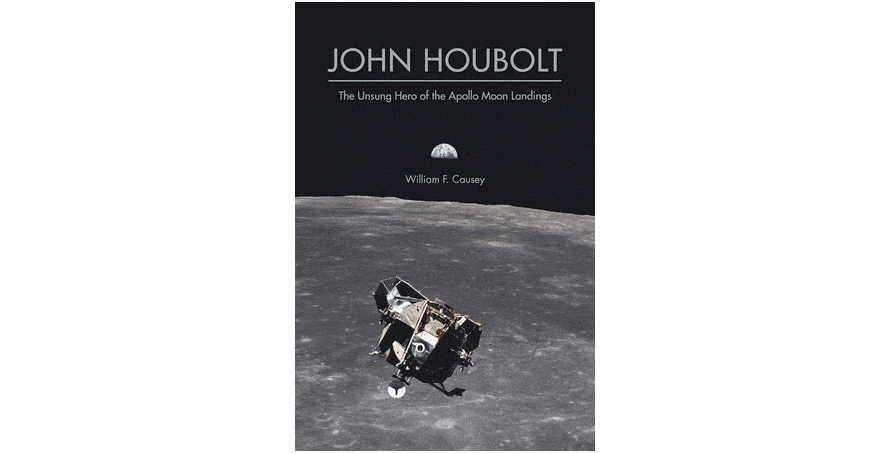
Title: John Houbolt – The Unsung Hero of the Apollo Moon Landings
Author: William F. Causey
NSS Amazon link for this book
Format: Hardcover/Kindle
Pages: 347
Publisher: Purdue University Press
Date: March, 2020
Retail Price: $29.98/$16.19
ISBN: 978-1557539465
While this book may have John Houbolt’s name as its title, the author, William F. Causey skillfully and coherently weaves together many participants and their roles in selecting the method for the lunar landing in 1969. It isn’t until Chapter Five that Houbolt (a Ph.D. engineer who worked for NACA since 1944) enters the picture as a member of a NASA working group.
The prologue fittingly describes Apollo 11 astronauts Armstrong and Aldrin’s launch from the Moon’s surface into lunar orbit to rendezvous with the Command Module—the only unrehearsed aspect of the mission. Although many authors have portrayed this event, Causey was able to select several seldom described aspects that set the tone and expectations of this book.
I recently reviewed Rob Godwin’s Manned Lunar Landing and Return (MALLAR), which relates to the central focus of this book—the birth of the satellite rendezvous technique. Being quite familiar with many of the individuals and events of the Apollo Program, I eagerly advanced through the pages to see what possible surprises the author could lay before the knowledgeable reader—and there were many. An interesting side note is that Houbolt’s wife Mary was one of the first female mathematical “computers,” as revealed in the book (and movie) Hidden Figures.
Causey notes that Wernher von Braun began pushing a manned lunar mission as early as 1949. He does an excellent job reviewing the von Braun connection with Walt Disney, and the first study of future space flight (then considered science fiction) by the National Advisory Committee for Aeronautics (NACA) in 1952.
The surprise launch of the first Earth satellite—Sputnik in 1957—by the Soviet Union, which began the space race of that era, is reviewed. That event was the impetus of moving NACA from a small research-oriented group to a large program-based organization, the National Aeronautics and Space Administration (NASA), to address the national concern for the perceived Soviet threat. The author handles describing the initial difficulties encountered by such a massive change clearly and concisely.
The various personalities at NASA (and the aerospace industry) struggle with the possible “modes” by which a spacecraft might travel to the Moon, land, and return—an obvious objective of the space race. These modes are characterized as Direct Ascent, Earth Orbit Rendezvous (EOR), and Lunar Orbit Rendezvous (LOR).
It was a series of simple calculations made by Houbolt that established the viability of the LOR mode. It was based on a scheme—suggested by a colleague—of leaving the heavy Earth reentry spacecraft (Apollo Command Module) in lunar orbit and using a lightweight lunar lander. The unknowns of the untried rendezvous technique caused many to oppose LOR. There were other reasons for some to advocate Direct Ascent and EOR that are also addressed.
It was in mid-1959 that Houbolt recognized that the future of spaceflight would depend on the ability to have two spacecraft rendezvous and dock, and he worked to solve the theoretical problems. Causey fills in several hazy areas (for this space historian), and his writing is clear and unambiguous. It’s as though he had been present at the meetings he describes. The author has an uncanny ability to sort through the plethora of reported conversations and the participant’s reactions and show the resulting impact of the many decisions that were made in those pivotal years of 1961-62.
The book records a concise history of the mode decision. With 60 years now having past, choices made during that period—and the reasoning for them—can be difficult to track. Thus, the author’s exceptional ability to effectively parse research is critical. The description of the search for someone to head NASA during the Kennedy Administration (resulting in James Webb) is an example.
Causey notes many foremost individuals believed that a lunar landing could be achieved within 10 years. This was pivotal to President Kennedy’s decision in May 1961, to commit the United States to put a man on the Moon “…before this decade is out.” The author does an admirable job of bringing together all the key factors and people involved. NASA was confident it could achieve that objective even though it had yet to decide which mode to use and only had 15 minutes of human space flight experience—Alan Shepard’s sub-orbital flight a few weeks earlier.
As the time grew near for a final mode decision in the spring of 1962, studies performed by Chance Vought (a builder of high-performance Navy fighters of that era) enter the narration briefly. But interestingly, the central figure in that company’s contribution to the rendezvous procedure, Conrad Lau, is never mentioned. He is the main theme of Godwin’s book cited earlier, which contends that Vought’s MALLAR report played a key role in the mission mode decision. Godwin also notes that a year before Houbolt began his push, LOR was presented by von Braun to NASA’s Chief of Space Flight Programs Abe Silverstein—though it was not von Braun’s favored mode.
The author’s description of the size and weight for either a Direct Ascent or EOR “lunar lander” reveals it would have been an unwieldy vehicle to attempt to land on the relatively unknown surface of the Moon. The intensity of Houbolt’s belief in the use of LOR to obviate that problem caused him to circumvent the NASA “chain-of-command” and send two passionate letters (six months apart) directly to Robert Seamans, then the Associate Administrator of NASA, imploring the selection of LOR.
Of the hundreds of books written about the Apollo program, these two are the first (that I have encountered) to address the complex problems associated with the decision to use LOR. [Update: It slipped my mind that John Logsdon’s 2010 book John F. Kennedy and the Race to the Moon also covered this.]
Elements within the Kennedy administration were still solidly behind Direct Assent or EOR—and opposed to LOR—right up to decision day. While there were other proponents of LOR who preceded Houbolt, none were as insistent nor positioned to influence that decision as effectively as was he.
This is an outstanding book and should be read by every space flight enthusiast.
© 2020 Ted Spitzmiller
Please use the NSS Amazon Link for all your book and other purchases. It helps NSS and does not cost you a cent! Bookmark this link for ALL your Amazon shopping!






2 thoughts on “Book Review: John Houbolt – The Unsung Hero of the Apollo Moon Landings”
The reviewer suggest that Bill Causey’s book is the first detailed description of the final decision to use the LOR mode for Apollo. I guess he is not familiar with my “John F. Kennedy and the Race to the Moon” (Palgrave Macmillan, 2010) (pp. 144-149), where the NASA-White House conflict over the LOR decision is described – much less my 1971 article “Selecting the Way to the Moon: The Choice of the Lunar Orbital Rendezvous Mode,” which appeared in the journal Aerospace Historian. I don’t want to diminish Causey’s excellent and more detailed book, but he was not the first to tell the LOR story.
My apologies John, yes, your book (of which I have a copy) did cover the issue. Now where did I put it?