
By Burt Dicht
NSS Managing Director of Membership
NSS Space Coast Correspondent
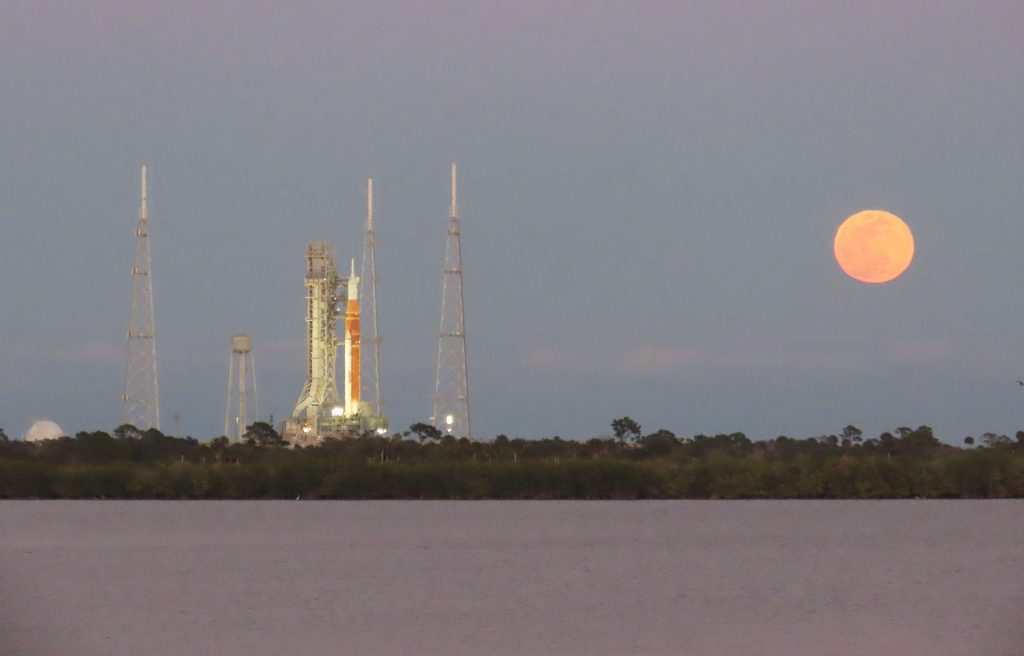
Above: Artemis II on the launch pad with the Moon its target. Photo by Burt Dicht.
The rocket is on the pad. The crew will be suiting up soon and will then depart for the launch site. The countdown clock is ticking down to a 6:24 p.m. EDT launch, with a window that extends to 8:24 p.m. (If the launch does not occur today, additional opportunities exist on April 2–6 and April 30.) When the Space Launch System ignites, four astronauts will begin a ten-day journey around the Moon and back. We have been waiting 53 years for the Artemis program to return humans beyond low Earth orbit.
This primer covers everything you need to know; how we got here, the machines that will carry the crew, the four people who will fly them, and what Artemis II is designed to prove.
The Long Road Back: From Apollo to Artemis
When Gene Cernan stepped off the lunar surface on December 14, 1972, no one imagined it would be the final human footstep on another world for more than half a century. The Apollo program ended not because the technology failed, but because political will and budget priorities shifted back toward Earth. The Moon fell silent.
The intervening decades were not idle. The Space Shuttle program flew 135 missions, the International Space Station became a permanent human outpost in low Earth orbit, and commercial spaceflight was born. But deep space, beyond the ISS, beyond Earth’s protective magnetic field remained beyond reach for humans.
The Artemis program was formally announced in 2019, taking its name from Apollo’s twin sister in Greek mythology. Its goal is ambitious: return humans to the Moon, this time not simply to visit, but to establish a sustained presence that will serve as the proving ground for eventual human missions to Mars. Under NASA’s recently updated mission architecture, that vision now places even greater emphasis on building a permanent lunar surface base and increasing the cadence of missions in the years ahead. Just as importantly, Artemis now carries a renewed sense of urgency as the United States seeks to maintain leadership in deep space exploration amid an accelerating lunar race with China.
THE MACHINES: SLS AND ORION
The Space Launch System (SLS)
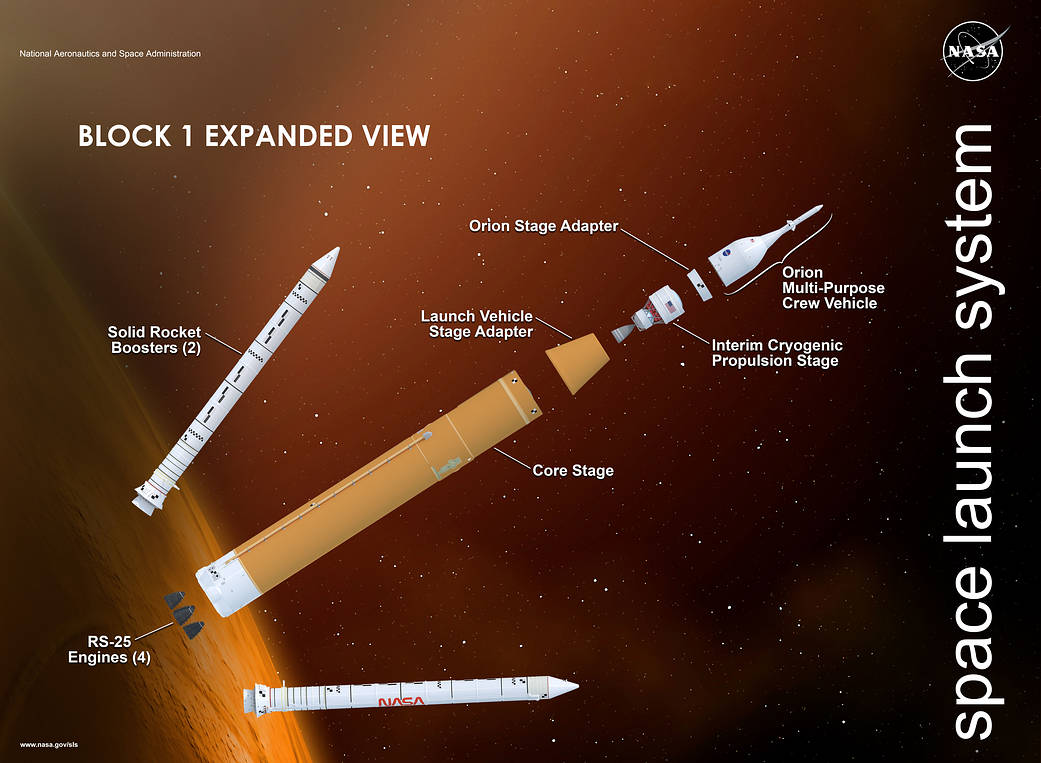
The Space Launch System is the most powerful rocket NASA has ever built and currently remains the backbone of the Artemis architecture. Under NASA Administrator Jared Isaacman’s recent program updates, NASA has reaffirmed SLS as the heavy-lift launch vehicle for the accelerated lunar campaign and the development of a sustained lunar presence on the Moon.
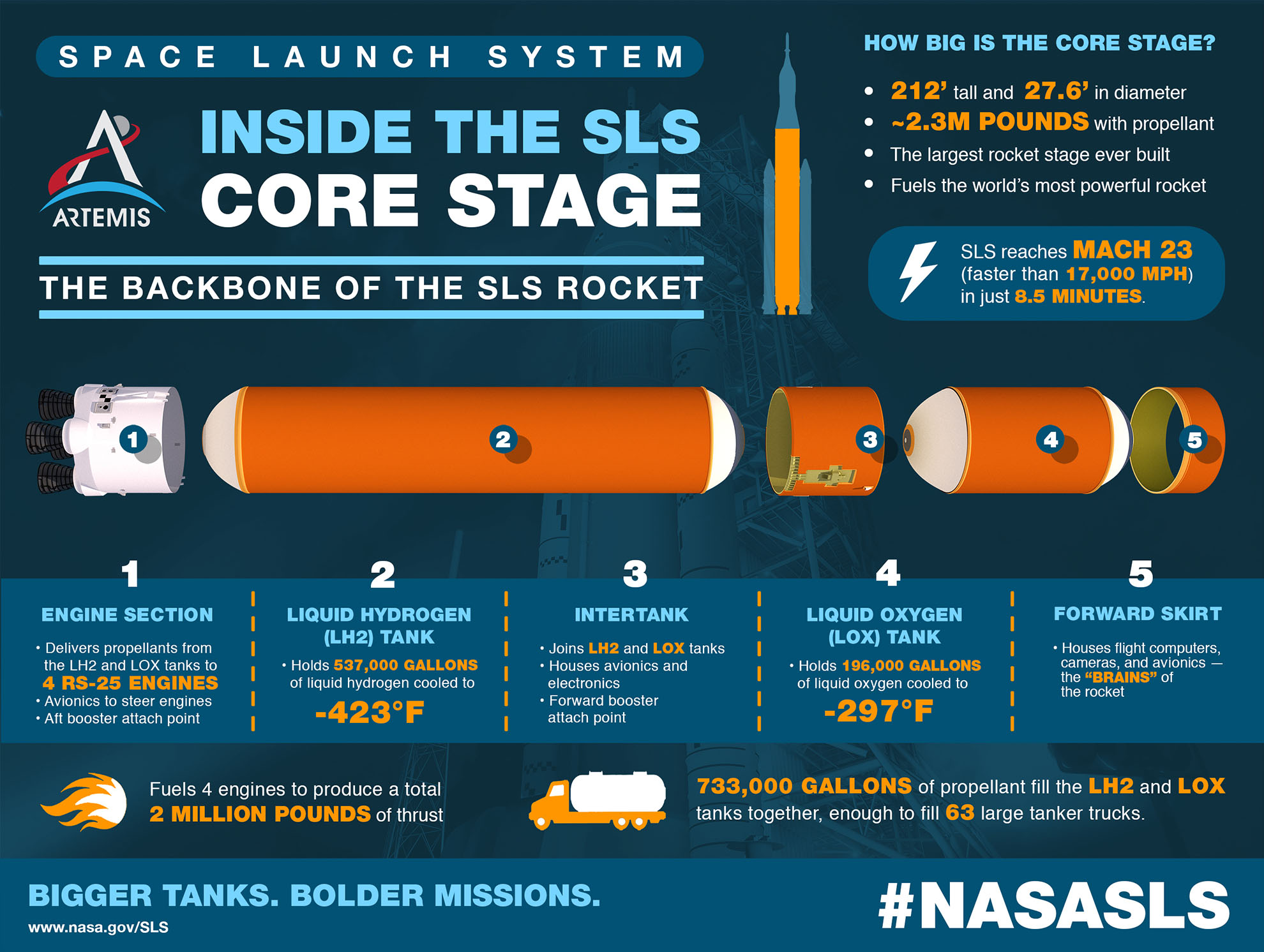
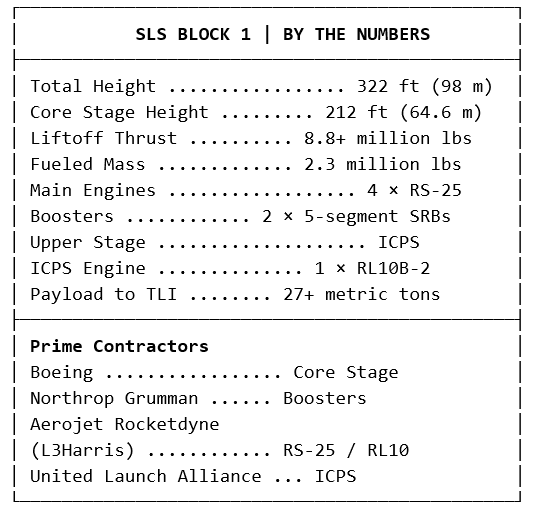
For Artemis II, SLS flies in its Block 1 configuration — a stack of four RS-25 engines powering the core stage, flanked by a pair of five-segment solid rocket boosters. These engines are upgraded versions of the Space Shuttle Main Engines, creating a direct engineering link between the Shuttle era and humanity’s return to deep space. Boeing serves as the prime contractor for the core stage, Northrop Grumman builds the solid rocket boosters, and the RS-25 engines are produced by Aerojet Rocketdyne, now part of L3Harris Technologies.
The Rocketdyne name is deeply woven into America’s human spaceflight history, from the Saturn V engines of Apollo to the Space Shuttle Main Engines and now the RS-25s powering Artemis.
At liftoff, the combined system generates more than 8.8 million pounds of thrust, surpassing even the legendary Saturn V in raw power. SLS Block 1 is capable of sending more than 27 metric tons on a translunar trajectory.
Launch Sequence
The launch sequence begins with the four RS-25 main engines igniting approximately six seconds before liftoff, building to full power. If all systems remain nominal, the twin solid rocket boosters ignite at T-0, delivering the majority of the thrust for the first two minutes of flight.
Booster separation occurs at roughly 3,100 miles per hour and an altitude of approximately 30 miles. The core stage then continues firing for about eight minutes before separating, placing Orion into a highly elliptical Earth orbit.
Interim Cryogenic Propulsion Stage (ICPS)
Once the core stage has completed its burn and separated, the Interim Cryogenic Propulsion Stage takes over. Built by United Launch Alliance and derived from the proven Delta IV upper-stage design, the ICPS serves as the final propulsion element of the SLS Block 1 configuration. Powered by a single RL10 engine produced by Aerojet Rocketdyne, now part of L3Harris Technologies, it performs the critical translunar injection burn that sends Orion out of Earth orbit and onto its free-return trajectory around the Moon. While smaller than the massive core stage and boosters, the ICPS is the stage that quite literally points the mission toward deep space.
Orion and the European Service Module
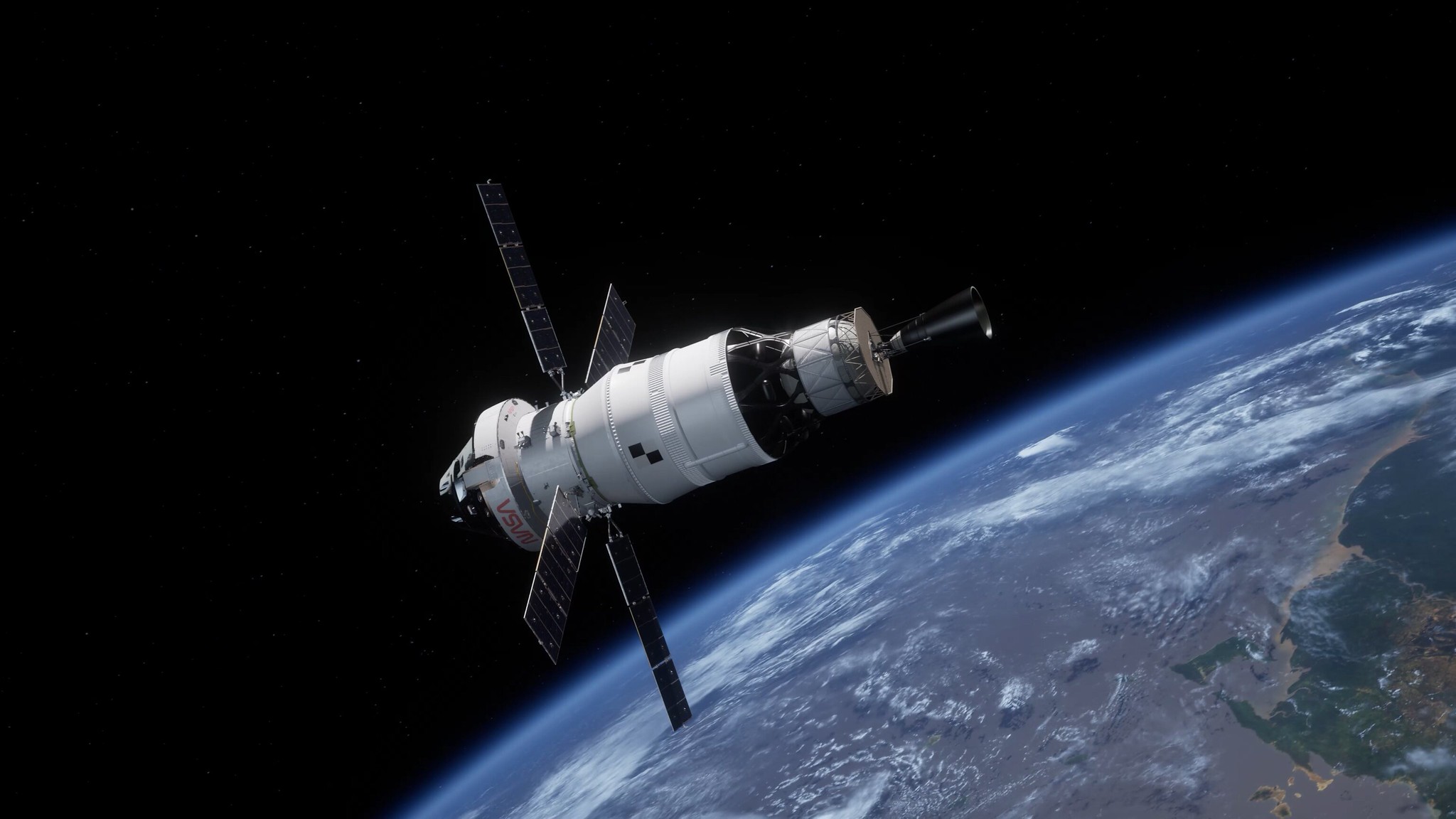
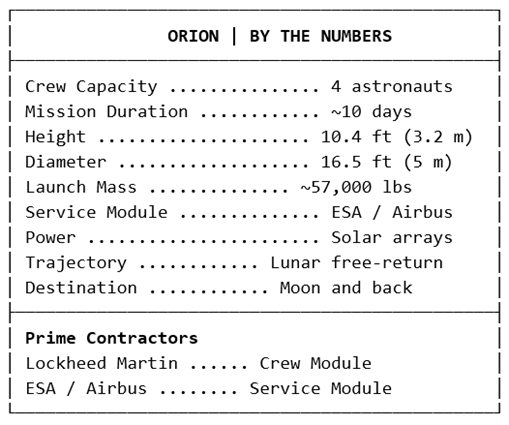
Orion is NASA’s deep-space crew vehicle — purpose-built for missions beyond low Earth orbit in a way the Space Shuttle never was. The spacecraft consists of three primary elements: the crew module, where the astronauts live and work; the European Service Module (ESM), provided by the European Space Agency and built by Airbus, which supplies propulsion, electrical power, thermal control, air, and water; and the launch abort system, capable of pulling the capsule to safety in the event of an emergency during ascent.
The ESM is a critical part of the spacecraft. It houses the main engine used for major orbital maneuvers, smaller reaction control thrusters for attitude adjustments, and four solar array wings that generate electrical power throughout the mission. In many ways, it serves as the spacecraft’s engine room and utility section, sustaining the crew while Orion travels far beyond Earth orbit.
For Artemis II, Orion will carry fully operational life-support systems for the first time with astronauts aboard — a critical test objective in itself. The crew module is approximately 16.5 feet in diameter, providing an interior volume roughly comparable to a compact camper van in which four astronauts will live and work for up to ten days.
The spacecraft features advanced guidance and navigation systems that draw on star trackers, optical navigation cameras, inertial measurement units, and sun sensors to maintain its precise trajectory through deep space and during the lunar flyby.
One engineering note looms over the mission: following the reentry of Artemis I, inspectors found unexpected erosion in Orion’s AVCOAT ablative heat shield. Years of additional analysis followed. NASA and Administrator Jared Isaacman ultimately concluded in January 2026 that the existing heat shield can safely protect the crew under conditions exceeding anything expected during Artemis II reentry, although design refinements are planned for Artemis III and later missions.
The Artemis II Crew

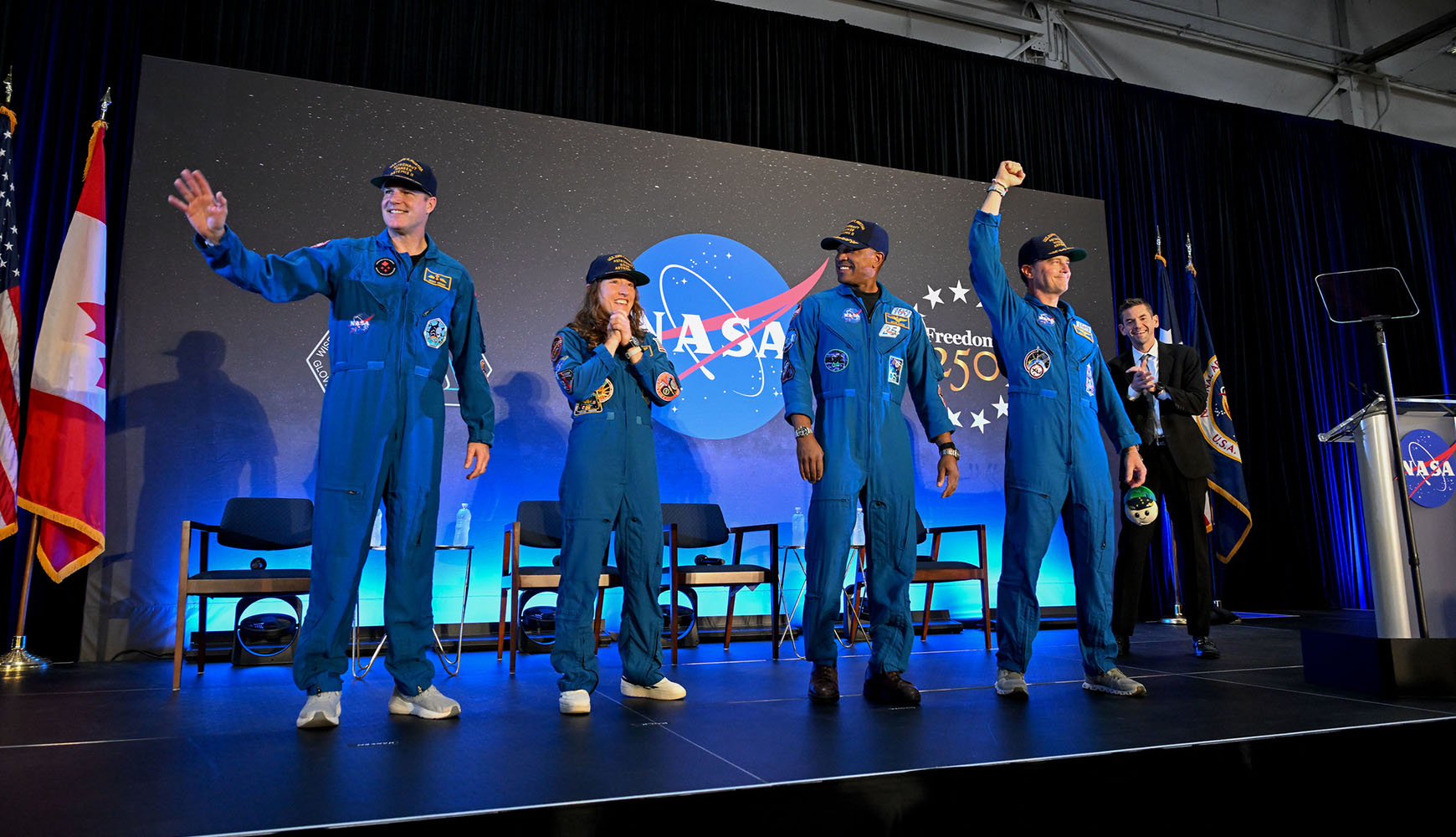
Reid Wiseman is commander of NASA’s Artemis II mission. The Baltimore native previously served as flight engineer aboard the International Space Station for Expedition 41 from May through November of 2014. During the 165-day mission, Wiseman and his crewmates completed more than 300 scientific experiments in areas such as human physiology, medicine, physical science, Earth science and astrophysics. They set a milestone for station science by completing a record 82 hours of research in a single week. He also served as chief of the Astronaut Office from December 2020 to November 2022.
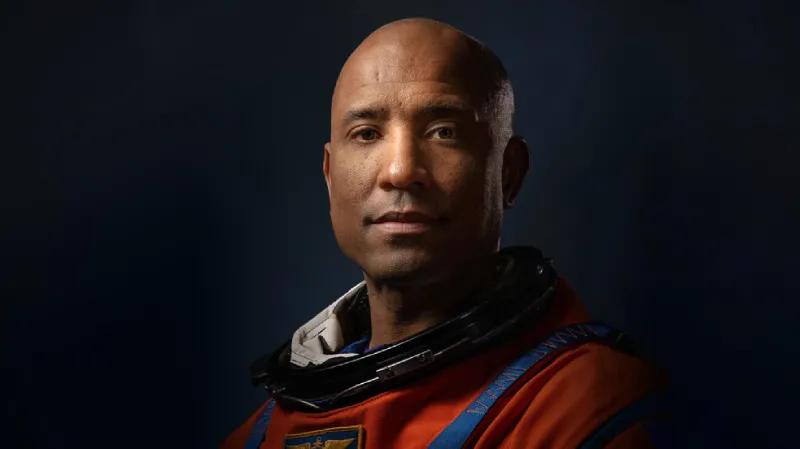
Victor Glover has been assigned to be pilot of NASA’s Artemis II mission around the Moon. Glover was selected as an astronaut in 2013 while serving as a Legislative Fellow in the United States Senate. He most recently served as pilot of the Crew-1 Dragon spacecraft which flew to the International Space Station, where he also was flight engineer for Expedition 64/65. The California native earned an undergraduate engineering degree, is a naval aviator, and was a test pilot in the F/A‐18 Hornet, Super Hornet, and EA‐18G Growler.
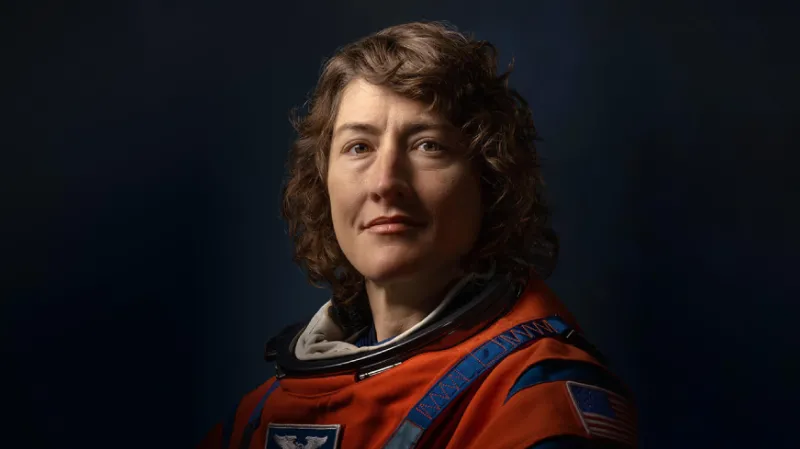
Christina Koch is an explorer and engineer who became astronaut in 2013 and will serve as a mission specialist for NASA’s Artemis II mission. Her previous experience in spaceflight was living and working on the International Space Station for almost all of 2019 in Expeditions 59, 60, and 61. Koch spent a total of 328 consecutive days in space and participated in the first all-female spacewalks. She served as branch chief of the Assigned Crew Branch in the Astronaut Office and did a rotation as assistant for technical integration for the center director at NASA Johnson. Prior to becoming an astronaut, Koch’s experience spanned both space science mission instrument development and remote scientific field engineering in the Antarctic and Arctic.
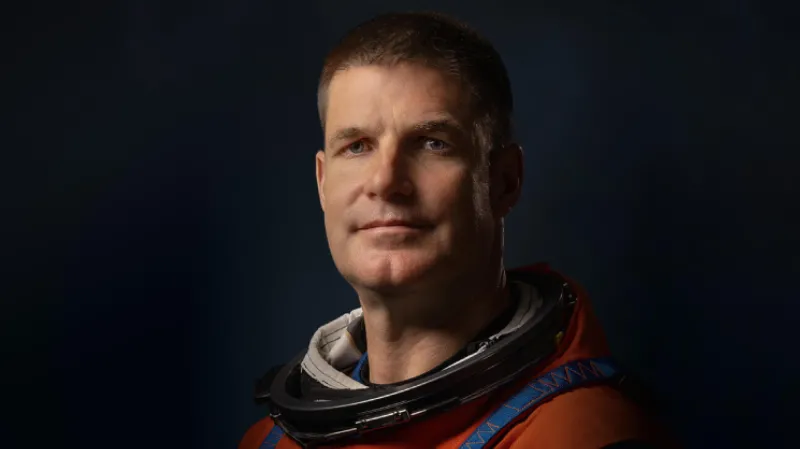
Born in London, Ontario, Canada, Colonel Jeremy Hansen is a Canadian astronaut and a former fighter pilot. He has extensive experience in mission operations and leadership roles. He has been assigned as a mission specialist for the Artemis II mission, which will make him the first Canadian to fly around the Moon. Hansen was selected as an astronaut in 2009 and completed astronaut candidate training in 2011. He worked as capcom at NASA’s Mission Control Center in Houston and participated in international training missions, including ESA’s CAVES program in 2013 and NASA’s NEEMO 19 underwater mission in 2014. He also took part in several field geology training expeditions, including in Canada’s High Arctic.
Mission Objectives: A 10-Day Shakedown of Deep Space
Artemis II is fundamentally a crewed test flight, a systematic demonstration that every system required for sustained human presence beyond Earth orbit works as designed with astronauts aboard. Its closest historical analogue is Apollo 8: the first crewed mission to the Moon, which orbited it in December 1968 and validated the hardware, operations, and procedures that made the Apollo 11 landing possible just seven months later.
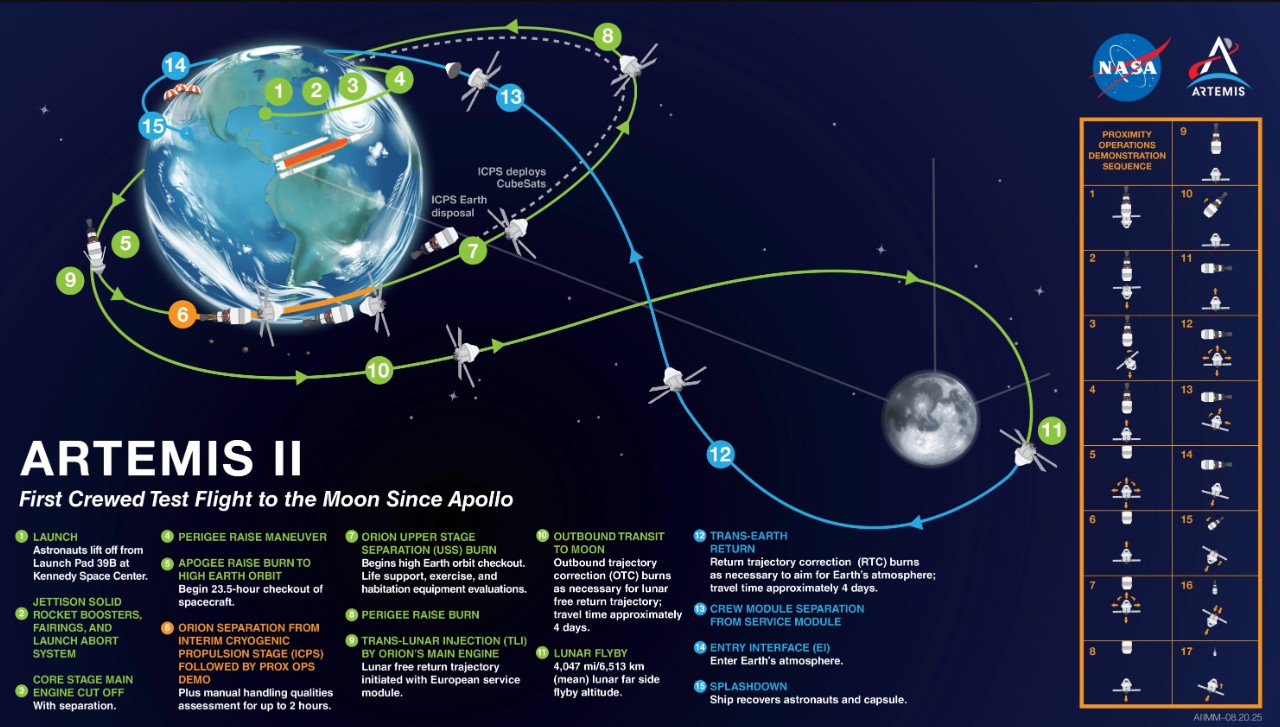
The trajectory places the crew on a free-return path. After launch from Florida, the astronauts will spend the first two days in Earth orbit checking out Orion’s systems and conducting mission demonstrations. The European Service Module will then perform the translunar injection burn that sends the spacecraft toward the Moon.
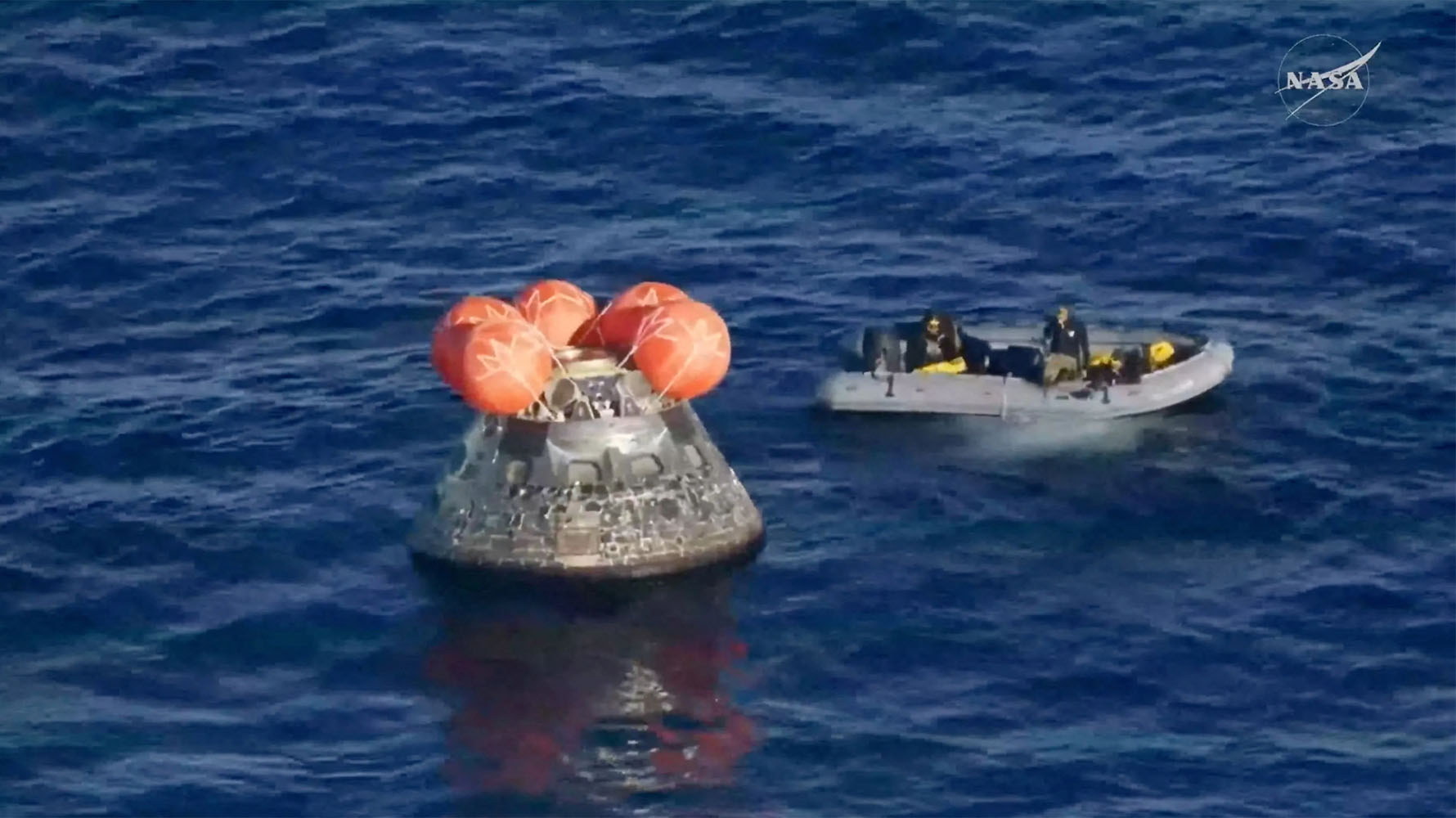
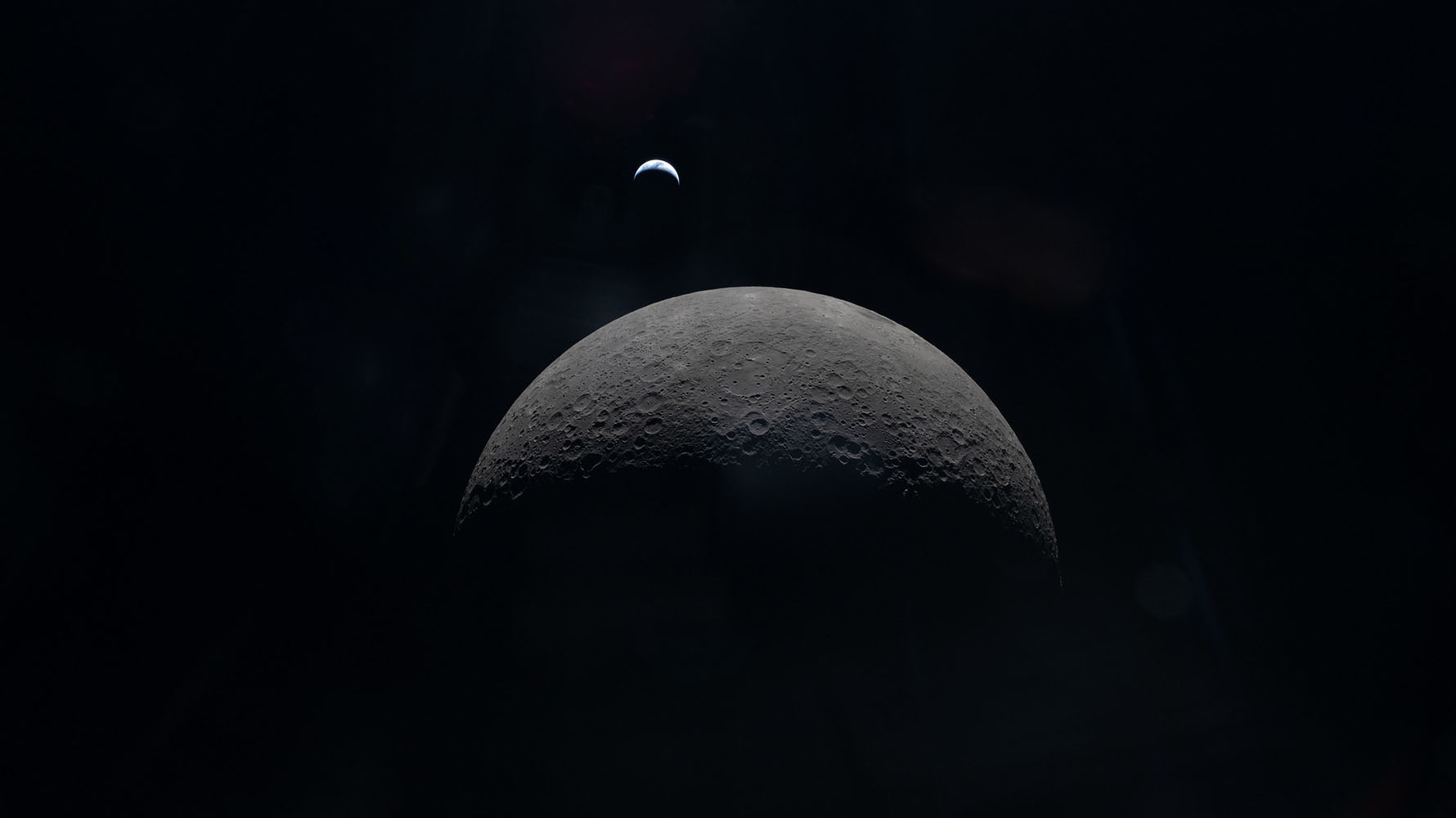
Orion will pass around the far side of the Moon — briefly losing communications with Earth — and reach a point approximately 4,700 miles beyond the lunar surface before beginning the return leg home. Splashdown is targeted in the Pacific Ocean off the coast of San Diego.
- Verify Crew Systems in Deep Space
Confirm that Orion’s life support, thermal control, navigation, communications, and crew interfaces function as designed with four humans aboard — systems that have never before carried people beyond Earth orbit.
- Test Emergency Procedures
Validate crew abort and emergency protocols in the actual environment of deep space, where radiation exposure, communications delays, and spacecraft operations differ meaningfully from both simulations and previous uncrewed flights.
- Perform Orion Systems Demonstrations
Shortly after reaching orbit, Christina Koch and Jeremy Hansen will unstrap to configure and test life-support systems while Reid Wiseman and Victor Glover monitor launch and spacecraft performance. The crew will also conduct a manual targeting and spacecraft control demonstration, an important validation of Orion’s human-machine interface and piloting characteristics.
- Extend Human Deep-Space Experience — and Gather Data
At its farthest point, Artemis II is expected to surpass the record for the greatest distance from Earth traveled by humans, previously set by Apollo 13 at 248,655 miles. The crew will also test the Orion Optical Communications System (O2O), a next-generation high-rate communications link capable of downlinking data at up to 260 megabits per second.
- Conduct Science Investigations
From their unique vantage point in deep space, the crew will support several science investigations, including the AVATAR study, which uses organ-on-a-chip technology to examine how increased radiation exposure and microgravity affect human health at the cellular level.
Firsts and Unique Milestones of Artemis II
While Artemis II will “only” conduct a lunar flyby, the mission is notable for a remarkable number of technical and historical firsts that make it one of the most significant human spaceflight missions in more than half a century.
Historic Firsts
- Artemis II will be the first crewed flight of NASA’s Space Launch System (SLS) and Orion spacecraft, validating the complete deep-space transportation system with astronauts aboard following the successful uncrewed Artemis I test flight.
- It will also mark the first human mission beyond low Earth orbit since Apollo 17 in 1972, ending a gap of more than 50 years since astronauts last traveled into deep space.
- Artemis II will be the first crewed mission of the Artemis campaign, directly paving the way for Artemis III orbital rendezvous and systems demonstrations, with Artemis IV now targeted as the first potential lunar landing mission of the new era..
Record-Setting Crew and Trajectory
The four-person crew itself represents several historic milestones.
- Victor J. Glover will become the first person of color to travel beyond low Earth orbit.
- Christina Koch will become the first woman to travel beyond low Earth orbit.
- Jeremy Hansen will become the first non-U.S. astronaut to travel to the Moon’s vicinity.
- The planned free-return trajectory will take Orion approximately 4,700 miles beyond the lunar surface, placing the crew on course to surpass the distance record set by Apollo 13 as the farthest humans have ever traveled from Earth.
Mission Profile Differences from Apollo
Unlike the Apollo lunar orbit missions, Artemis II is designed as a 10-day systems test in deep space.
- There will be no lunar orbit insertion and no landing attempt. Instead, the mission is focused on validating spacecraft systems, crew habitability, navigation, communications, and guidance and control under actual deep-space conditions.
- A particularly interesting feature is the multi-burn translunar profile. Orion will first spend approximately 24 hours in high Earth orbit before conducting the burn sequence that sends it toward the Moon on a free-return trajectory.
- While conceptually similar to Apollo-era free-return paths, this trajectory is being used intentionally as part of a carefully designed flight-test profile rather than as a contingency option.
Technology Demonstrations
Artemis II will also debut several technologies in crewed deep-space flight.
- One of the most notable is the Orion Artemis II Optical Communications System (O2O), which uses a 4-inch telescope and laser communications link to ground stations in California and New Mexico.
- This system is expected to support downlink rates of approximately 260 Mbps, an extraordinary leap from Apollo-era communications capability and an important precursor for future lunar and Mars missions.
- The mission will also provide the first crewed in-flight validation of Orion’s life-support, thermal control, crew interfaces, and long-duration deep-space operations, helping close the final major certification gap before surface missions.
Why Artemis II Matters
The Artemis program was never intended to be simply a symbolic return to the Moon. Its purpose is far more ambitious: to establish the systems, technologies, and operational confidence needed for a sustained human presence beyond Earth. Under NASA Administrator Jared Isaacman’s newly announced strategy, that vision has become more sharply focused. With the Lunar Gateway concept now set aside, NASA’s emphasis has shifted toward a surface-first approach centered on building a permanent human presence on the Moon. Existing investments and technologies are being redirected to support lunar surface operations, commercial cargo delivery, and the infrastructure required for longer-duration missions that will ultimately support future exploration beyond the Moon.
That is why Artemis II matters so profoundly. This mission will not land on the Moon, but it must prove something even more fundamental. It must demonstrate that Orion can safely carry astronauts into deep space and bring them home. It must validate life support, navigation, communications, and human performance in the deep-space environment. Most importantly, it must prove that the exploration architecture now taking shape is technically sound and ready for the missions that follow.
For more than half a century, one question has remained unanswered. Since Apollo 17 left the Moon in December 1972, humanity has not ventured beyond low Earth orbit. Can we go back? Artemis II will answer that question. On April 1, 2026, four astronauts will begin humanity’s first journey beyond low Earth orbit in more than 50 years. When Orion swings around the far side of the Moon and begins its return to Earth, it will carry more than a crew. It will carry proof that the United States and its international partners are ready to begin the next era of deep-space exploration.
For me, this mission carries a deep personal meaning. Like so many of my generation, I was inspired by Apollo, and that inspiration helped me on the path to becoming an engineer. I have waited more than 50 years to witness my first new moonshot, and seeing Artemis II prepare to fly is both exciting and profoundly moving. It is a reminder that bold exploration still has the power to inspire new generations, just as Apollo inspired mine. More than a return to deep space, Artemis II represents the beginning of a new future, and I am genuinely excited for what lies ahead.
How to Follow the Mission
Artemis II is a mission that deserves to be experienced in real time, and NASA will provide extensive public coverage from launch through splashdown.
Live coverage of launch day activities will be available through NASA+ (https://plus.nasa.gov/) NASA’s free streaming service, as well as on the official NASA website and the agency’s social media channels. Coverage is expected to begin several hours before liftoff, with the current launch opportunity set for April 1, 2026, at 6:24 p.m. EDT.
Throughout the 10-day mission, NASA will provide regular updates on crew activities, key mission milestones, and Orion’s journey around the Moon. One of the most engaging resources will be NASA’s real-time mission tracker, which allows the public to follow the spacecraft’s position and major events as the mission unfolds.







2 thoughts on “Artemis II Primer: The First Moonshot in 53 Years”
Very nice article.
Interesting and well put together.
Remember well getting up at 3am to watch Armstrong and Aldrin set foot on the Moon.