 |
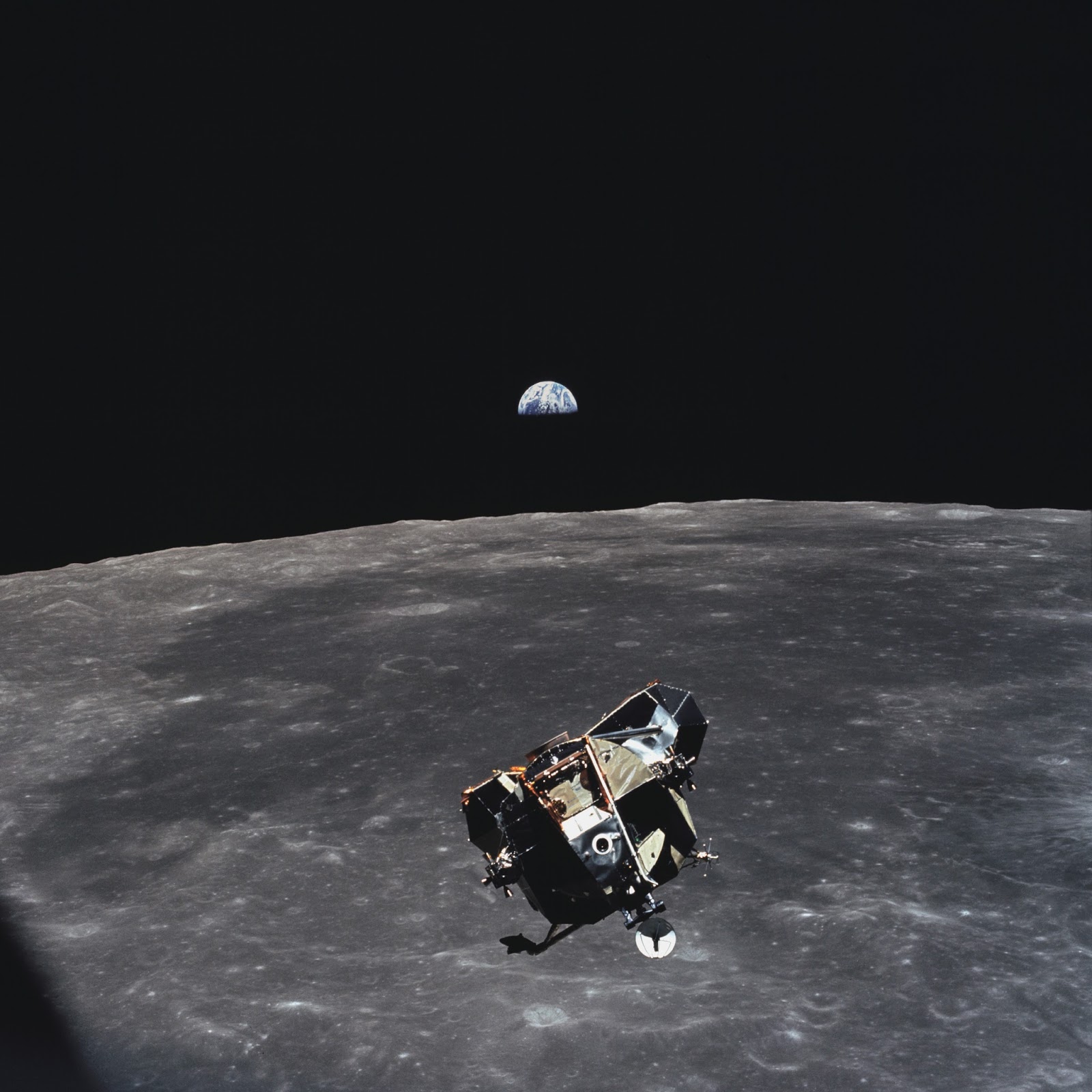
| Lunar Lander, The Real Life Version, NASA photo from July 21, 1969: “The Apollo 11 Lunar Module ascent stage, with astronauts Neil A. Armstrong and Edwin E. Aldrin Jr. aboard, is photographed from the Command and Service Modules (CSM) during rendezvous in lunar orbit. The Lunar Module (LM) was making its docking approach to the CSM. Astronaut Michael Collins remained with the CSM in lunar orbit while the other two crewmen explored the lunar surface. The large, dark-colored area in the background is Smyth’s Sea, centered at 85 degrees east longitude and 2 degrees south latitude on the lunar surface (nearside). This view looks west. The Earth rises above the lunar horizon.” |
The “launching to space” and “landing on another world” angles of gaming have a heritage stretching as far back as the days of Apollo. While I generally don’t likeWikipedia as a source, there is a decent article that explains the origins and development of these types of games, which usually involved navigating a lander of sorts among rocky portions of a world. Beginning in 1969, the golden year of the first Moon landing, those interested in computer-based gaming were looking to land their own Armstrongs and Aldrins upon the lunar surface. One of the earliest versions was even called Rocket, and had a quaint, if mercilessly blunt, “Game Over” screen.
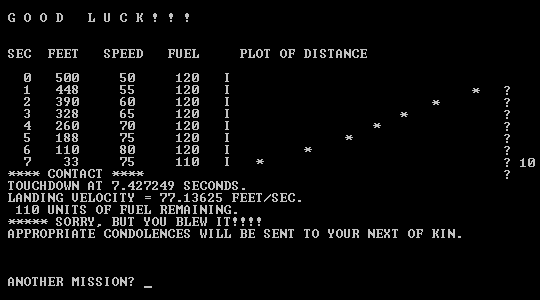 |
| Gurl, you messed up: Rocket’s “Game Over” screen. Source: http://www.technologizer.com/2009/07/19/lunar-lander/3/ |
Commercially released in August 1979, the arcade game Lunar Lander –which used coins to replenish the lander’s fuel stores – was released, to soon be followed by another (very popular) space-related game called Asteroids. Lunar Lander was based on a 1973 game called Moonlander, which according to the Arcade History website, was “written by Jack Burness in 1973 as a demo for the DEC GT40 vector graphics terminal (based on a PDP-11/05 CPU). This game used a light pen to control thrust and rotation.”
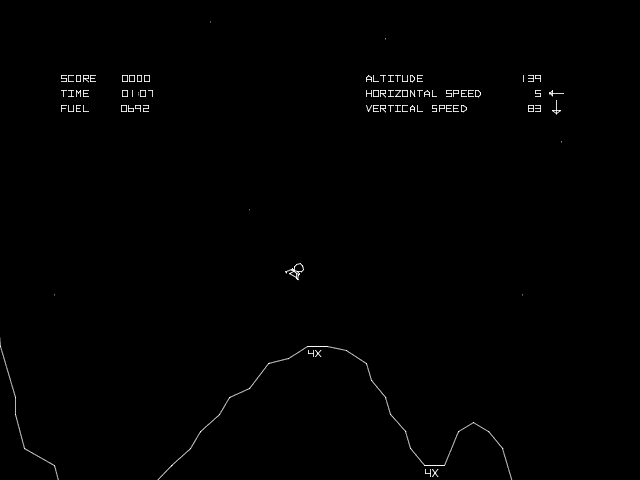 |
| Pretend you’re Dave and Jim, about to set Falcon down upon Hadley Rille. Screenshot from the arcade game Lunar Lander, 1979 (http://en.wikipedia.org/wiki/File:Lunar_Lander.png) |
While countless variants of this game have been created in ensuing decades, Lunar Lander, with its Apollo vibes and its simple LEM with a “flaming” engine, has a certain “of its time” charm. It’s not as exciting or visually stunning as more modern space simulators such as Orbiter and Kerbal Space Program, but it’s still stellar (okay, dumbest pun ever).
Read more about the Lunar Landergame and its various incarnations here and here.
What the game looked like. Video from Old Classic Retro Gaming on YouTube.
Emily Carney is a writer, space enthusiast, and creator of the This Space Available space blog, published since 2010. In January 2019, Emily’s This Space Available blog was incorporated into the National Space Society’s blog. The content of Emily’s blog can be accessed via the This Space Available blog category.
Note: The views expressed in This Space Available are those of the author and should not be considered as representing the positions or views of the National Space Society.