Important National Security Payload Successfully Reaches Geosynchronous Orbit
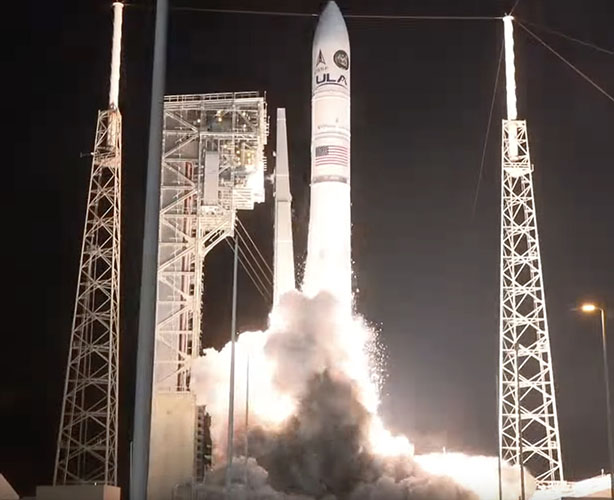
On Tuesday, August 12, United Launch Alliance launched its new Vulcan rocket for the third time, carrying its first national security payload for the US Space Force, the Navigational Technology Satellite, known as NTS-3. It was the first satellite of this type launched by the U.S. military in 48 years. A second unspecified satellite was also carried aloft.
This critical payload carries a new positioning, navigation, and timing technology suite aboard, and hosts experiments to protect military satellites from jamming and spoofing technologies being developed by potential adversaries, a very real threat in the current orbital environment.
Dale Skran, NSS COO/SVP said, “NSS is delighted to see a fully successful operational launch of Vulcan, providing both the USSF and commercial companies a technologically dissimilar vehicle to assure continuous U.S. access to space. The NTS-3 satellite will test a wide range of systems to enable future GPS and other satellites to be more robust to jamming and more reliably available in remote areas.”
The rocket was powered by two Blue Origin BE-4 engines that were augmented by four solid boosters. The upper stage was the venerable ULA Centaur which added two more high-power hydrogen/oxygen rocket engines to the mix, RL-10 variants built by Aerojet Rocketdyne. All this contributed to this Vulcan being the most powerful yet, capable of lofting 10,600 pounds directly to geostationary orbit. Other versions will be capable of carrying up to 47,200 pounds of payload to low Earth orbit and 25,600 pounds to a geostationary transfer orbit. Notably, with the Vulcan, ULA has moved away from utilizing Russian RD-180 rocket engines as it had used on the Atlas V.
NSS CEO Karlton Johnson added, “The successful launch of Vulcan on this critical national security mission underscores the importance of diversified and resilient launch capabilities for America’s future in space. The deployment of NTS-3 represents a pivotal step toward enhancing navigation systems that can withstand emerging threats and maintain operational continuity in contested environments. NSS applauds this achievement as a demonstration of how innovation and mission assurance work together to secure the nation’s leadership in the space domain.”
The seven-hour ascent was the longest yet attempted by ULA, carrying the satellite over 22,000 miles to the high-altitude orbit. The NTS-3 satellite is also capable of being reprogrammed once in orbit, an additional layer of defense against attack or malfunction.
The previous launch of the Vulcan, in October 2024, saw an anomaly during ascent, when at 39 seconds into flight one of the solid rocket boosters suffered damage to its nozzle. The rocket continued onward to reach a successful orbit, earning it certification by the Space Force.
NSS welcomes a second launch provider into the U.S. marketplace and looks forward to long-term success for Vulcan similar to that enjoyed by ULA’s previous launcher, the Atlas V.