By Burt Dicht
NSS Managing Director of Membership
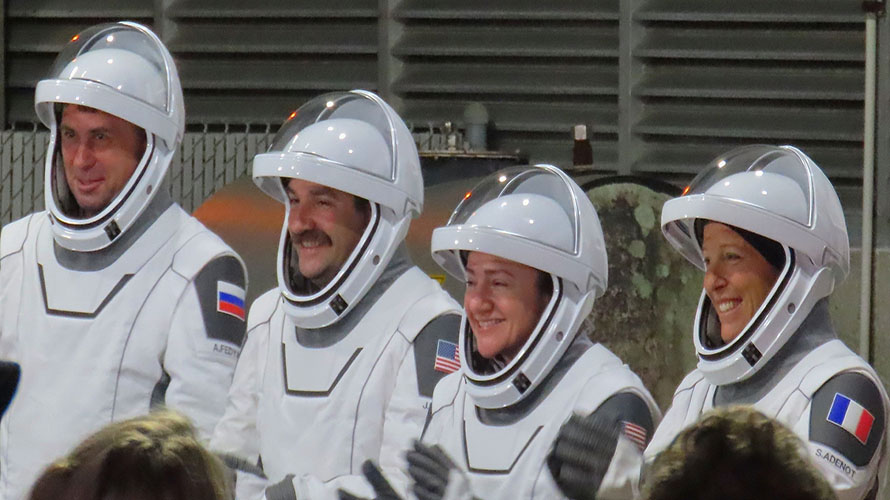
Image: Crew-12 emerges from the Operations & Checkout Building at KSC, as they prepare for the drive to SLC-40. From left Andrey Fedyaev, Jack Hathaway, Jessica Meir, and Sophie Adenot (Image Credit: Burt Dicht)
It was an unusually active week on Florida’s Space Coast. For a short period of time, three rockets stood on three different launch pads, each supporting a very different mission.
On February 12, a Vulcan Centaur built by United Launch Alliance launched from Space Launch Complex 41 at Cape Canaveral Space Force Station (CCSFS) at 4:22 a.m. Eastern. The multi-manifest national security mission placed payloads directly into geosynchronous orbit more than 22,000 miles above Earth.
At Launch Complex 39B, hardware for Artemis II continues processing for its upcoming lunar mission, as early as next month.
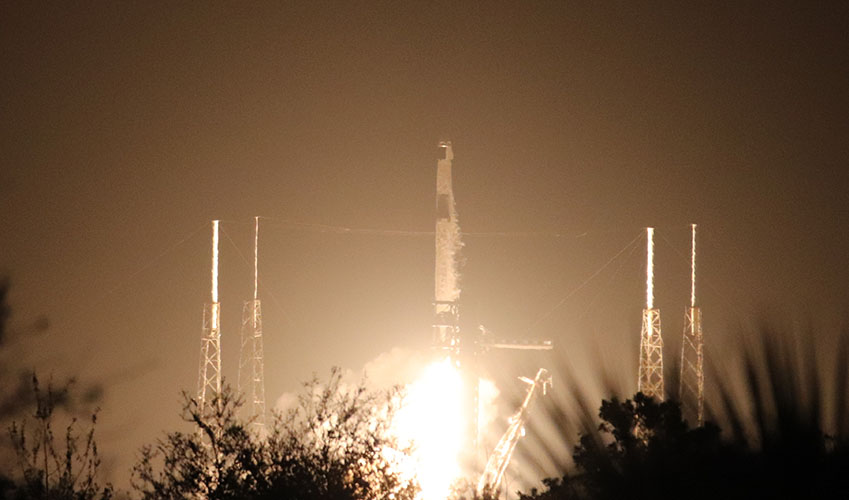
And early this morning, February 13, activity shifted to Space Launch Complex 40. At 5:15 a.m. ET, a Falcon 9 launched Crew Dragon Freedom on NASA’s SpaceX Crew-12 mission to the International Space Station (ISS).
The launch illuminated the horizon as Falcon 9 accelerated toward orbit. Night launches are always spectacular. The exhaust plume forms a brilliant sphere of flame that rapidly climbs, gaining both speed and altitude before narrowing into a bright arc across the early morning sky. Seconds later, the sound and vibration of the nine Merlin engines reached us at the media site.
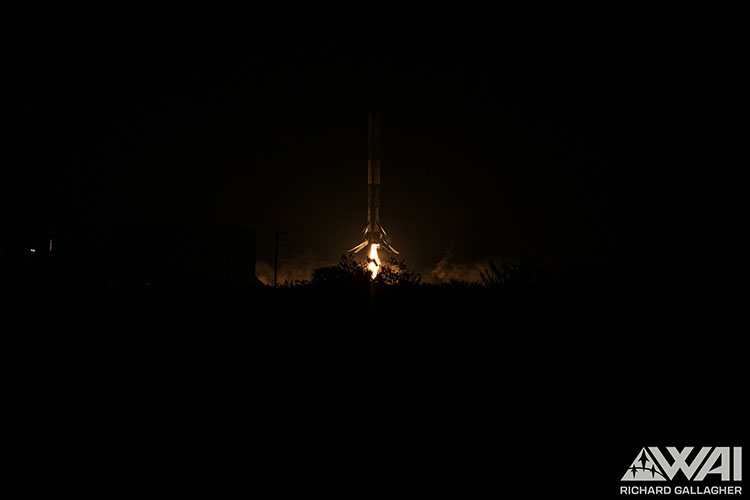
After stage separation, the first stage booster returned to CCSFS. The booster landed within the Space Launch Complex 40 perimeter, and moments later the twin sonic booms shook the space coast. This marked the first time SpaceX has launched and landed a booster from the same launch complex in Florida. It is another example of how reusable operations have become integrated into routine launch activity.
The Crew-12 make-up is another demonstration of the international cooperation which sustains the ISS. Crew-12 consists of four astronauts from three space agencies:
- Jessica Meir, NASA, Commander, on her second spaceflight
- Jack Hathaway, NASA, Pilot, on his first mission
- Sophie Adenot, Mission Specialist from the European Space Agency (France), on her first mission
- Andrey Fedyaev, Mission Specialist from Roscosmos, on his second mission
Crew-12 is scheduled to dock with the ISS at 3:15 p.m. EST on Saturday, February 14. They will join the three crew members already aboard the station.
This mission has added operational importance. Normally, ISS crew rotations include an overlap period. The incoming crew arrives before the departing crew leaves, allowing for a structured handover. That did not occur this time. Crew-11 returned early due to a crew illness, leaving only three astronauts aboard the station. The ISS can operate safely with three crew members, but research capacity and scheduling flexibility are reduced.
With the arrival of Crew-12, the station returns to full staffing. That restores:
- Full research capability
- Greater operational redundancy
- Flexibility for maintenance
- Normal long-duration expedition scheduling
In practical terms, the station resumes its full operational tempo. This is important as the research has important implications for NASA’s planned missions to the Moon and beyond. NASA’s SpaceX Crew-12 will spend its long-duration stay on the ISS tackling a suite of investigations aimed at keeping humans healthy on future deep-space missions. Their research focuses heavily on how the body adapts to altered gravity, with studies of fluid shifts, venous blood flow, and balance that will refine risk models for lunar and Martian explorers. They will also examine pneumonia-causing bacteria in microgravity to better understand how infections can lead to long-term heart damage, work that could inform improved treatments for patients on Earth.
In the realm of space medicine, the crew will test a compact system that manufactures sterile IV saline from station water, a step toward on-demand medical supplies instead of launching heavy consumables from the ground. Rounding out their science portfolio, Crew-12 will support plant biology experiments that monitor crop health and probe how plants partner with nitrogen-fixing microbes in microgravity—knowledge critical for closed-loop life support and sustainable food production on future Moon and Mars outposts.
With this successful launch, the Dragon Program continues to achieve impressive milestones. Crew-12 represents:
- The 56th Dragon launch (crewed and uncrewed)
- The 20th human spaceflight mission
- The 51st mission to dock with the ISS (crewed and uncrewed)
At the post-launch press conference, I asked NASA administrator Jared Isaacman about the possibility of two crewed launches occurring within days of each other.
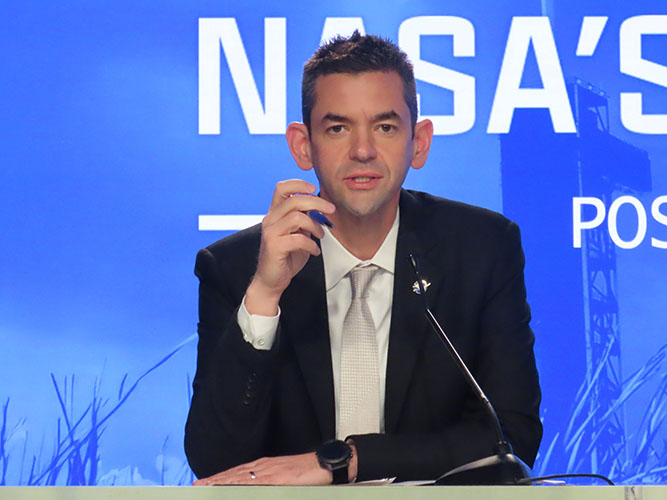
Had the earlier schedule held, Artemis II would have launched just days ahead of Crew-12. While the dates shifted, the proximity raised a broader question. As launch cadence increases, how prepared is NASA to manage multiple crewed missions in close succession?
Isaacman said it is “a good problem to have.” He stated that NASA is prepared for that scenario and expects that such overlaps may occur in the future.
Historically, closely spaced U.S. crewed launches have been rare. During the Space Shuttle program, two orbiters were sometimes on separate pads at the same time, but their launch dates were separated by weeks. The only true near-simultaneous U.S. crewed launch occurred in December 1965, when Gemini 7 was already in orbit and Gemini 6A launched to rendezvous with it.
That comparison highlights how the cadence of human spaceflight is evolving.
For much of the past sixty years, crewed launches were isolated national events separated by months or years. This week demonstrated something different. National security launches, lunar preparation, and routine crew rotation to low Earth orbit all occurred within days of each other.
Crew-12 was not a one-off milestone. It was part of a steady operational rhythm.
A reusable booster has launched and landed from the same pad. Another crew is in orbit, and the ISS will now be back to full staffing. Research continues. And NASA leadership is planning for a future in which overlapping human spaceflight missions may become normal rather than exceptional.
That shift, from rare event to managed cadence — may be the most significant development of all.