
31 January 2013. Copyright European Space Agency (ESA). Reproduced with permission.
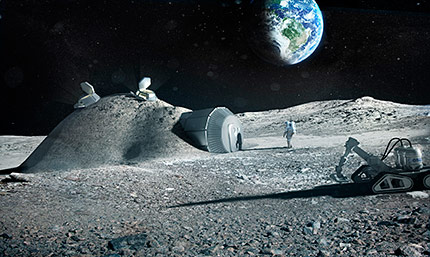
Setting up a lunar base could be made much simpler by using a 3D printer to build it from local materials. Industrial partners including renowned architects Foster + Partners have joined with ESA to test the feasibility of 3D printing using lunar soil.
“Terrestrial 3D printing technology has produced entire structures,” said Laurent Pambaguian, heading the project for ESA.
“Our industrial team investigated if it could similarly be employed to build a lunar habitat.”
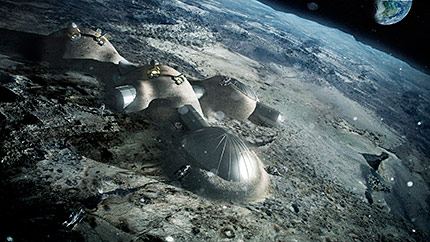
Foster + Partners devised a weight-bearing ‘catenary’ dome design with a cellular structured wall to shield against micrometeoroids and space radiation, incorporating a pressurised inflatable to shelter astronauts.
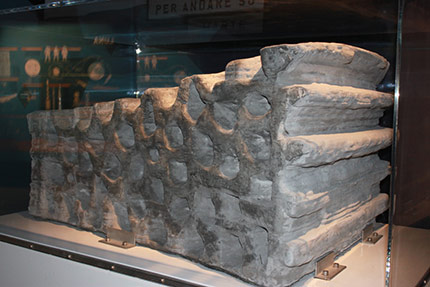
A hollow closed-cell structure – reminiscent of bird bones – provides a good combination of strength and weight.
The base’s design was guided in turn by the properties of 3D-printed lunar soil, with a 1.5 tonne building block produced as a demonstration.
“3D printing offers a potential means of facilitating lunar settlement with reduced logistics from Earth,” added Scott Hovland of ESA’s human spaceflight team.
“The new possibilities this work opens up can then be considered by international space agencies as part of the current development of a common exploration strategy.”
“As a practice, we are used to designing for extreme climates on Earth and exploiting the environmental benefits of using local, sustainable materials,” remarked Xavier De Kestelier of Foster + Partners Specialist Modelling Group. “Our lunar habitation follows a similar logic.”
The UK’s Monolite supplied the D-Shape printer, with a mobile printing array of nozzles on a 6 m frame to spray a binding solution onto a sand-like building material.
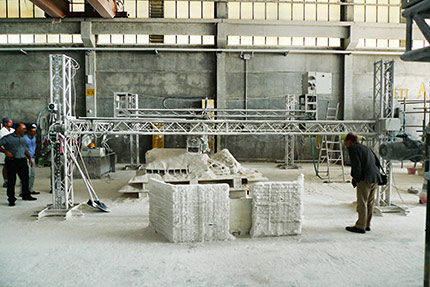
3D ‘printouts’ are built up layer by layer – the company more typically uses its printer to create sculptures and is working on artificial coral reefs to help preserve beaches from energetic sea waves.
“First, we needed to mix the simulated lunar material with magnesium oxide. This turns it into ‘paper’ we can print with,” explained Monolite founder Enrico Dini.
“Then for our structural ‘ink’ we apply a binding salt which converts material to a stone-like solid.
“Our current printer builds at a rate of around 2 m per hour, while our next-generation design should attain 3.5 m per hour, completing an entire building in a week.”








3 thoughts on “Building a Lunar Base with 3D Printing”
excellent article, writing for 3d printing is often very hard to get right! top points here
We are used to using different platforms to facilitate conventional construction, which can automate construction management or construction documentation. And it’s more complicated with the construction of a lunar base, but even here humanity has created a technology to master. It is remarkable that, in practice, the successful use of 3D printing gives us new opportunities to explore the boundaries of our planet.
Thank you for sharing such an insightful and forward-thinking initiative! The concept of leveraging 3D printing technology with lunar soil to construct a lunar base is not only innovative but also a testament to how terrestrial solutions can inspire advancements in space exploration.
The collaboration between ESA, Foster + Partners, and Monolite demonstrates the power of interdisciplinary efforts in addressing complex challenges like extraterrestrial habitat construction. The catenary dome design and the use of cellular structures for strength and radiation protection are brilliant adaptations for the lunar environment.
It’s fascinating to see how the lessons learned from designing for extreme conditions on Earth can be applied to otherworldly settings. Using local materials to reduce logistics from Earth aligns perfectly with sustainability principles, even in space. Kudos to the entire team for pushing the boundaries of architecture and technology!