Category: Nonfiction
Reviewed by: Casey Suire
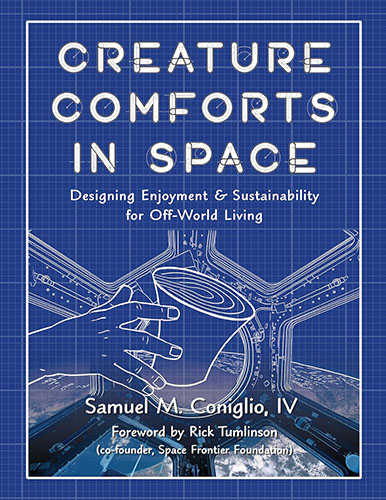
Title: Creature Comforts in Space: Designing Enjoyment and Sustainability for Off-World Living
Author: Samuel Coniglio
Format: Paperback/Kindle
Pages: 162
Publisher: BookBaby
Date: June 2024
Retail price: $33.00/$9.99
ISBN: 979-8218246402
Find this book
The beginning of this book states the obvious about space: “Living out there is uncomfortable at best, and deadly at worst. It is a hostile environment that will kill you if you make a mistake.” The astronaut lifestyle has plenty of challenges. There are the detrimental effects of microgravity, the hazards of radiation, lack of air, space sickness, cabin fever, and other serious dangers. What is a budding astronaut supposed to do?
First-time author Samuel Coniglio tackles this question with Creature Comforts in Space. As the title implies, what if astronauts could bring some of the pleasures and comforts of living on Earth to space? What if off-world explorers could take a relaxing hot shower, indulge in snacks like cookies or bacon, drink a fresh cup of coffee, or even enjoy a cocktail? What if astronauts had a gymnasium, clean and comfortable clothing, and a great bed? The challenges associated with such cosmic luxuries are addressed in this book.
Coniglio’s work is about the human factor in spaceflight, a topic that he believes needs more attention and research from space advocates. This isn’t a book about reusable rockets, advanced propulsion concepts, attitude control systems, or spacecraft power systems. Creature Comforts in Space is about space-based refrigerators, freezers, kitchens, air-conditioners, and even bathrooms. The book doesn’t argue in favor of any particular destination for human space settlement; it just argues that humans living in space should have the most enjoyable experience possible.
One nice thing about this book is that Coniglio is an active participant in the case for astronauts having comforts in space. He isn’t an author who simply talks about what other individuals have contributed to this field. Coniglio explains how he designed the Zero Gravity Cocktail Glass. In other sections of the book, he proposes more ideas for astronaut pleasure. For instance, he includes his concept for a space shower. Coniglio’s work experiences include a stint at McDonnell Douglas, where he was a technical writer involved in documenting payload processing systems for both the space shuttle and the International Space Station. During this period, he was also involved in the Delta Clipper program. In 2004, he photographed the X Prize winning flights of SpaceShipOne. Coniglio is also a former Vice President of the Space Tourism Society.
Furthermore, the acknowledgements section of the book is an all-star cast of space talent. In writing this book, Coniglio has worked with NASA’s Don Pettit, ESA’s Samantha Cristoforetti, and private astronaut Christopher Sembroski. Others include Frank White, author of The Overview Effect, and space activist Rick Tumlinson.
The chapter titled “Food and Drink” is quite interesting. Due to fluid shifts caused by microgravity, many astronauts reported changes in taste during spaceflight. For this reason, many space travelers and their swollen tongues enjoy spicy foods while in orbit. Bread is prohibited in space due to the problem of floating crumbs that could damage equipment. Tortillas are used instead. In 2019, astronauts did bake chocolate chip cookies on the International Space Station. However, the station crew didn’t actually eat the cookies. As with bread, the cookie crumbs would have gone everywhere inside the station. Coniglio notes that more work is needed to design an oven that works in space.
Other innovative ideas include constructing single person spacecraft (SPS) in place of bulky spacesuits, using a “water wall” as a radiation shield, and 3D printing astronaut clothing. In addition, there is an interesting discussion about artificial gravity spacecraft. Many of the issues associated with living in space could be eliminated if astronauts had gravity. Coniglio, however, notes that there are challenges with building such a system. To date, nobody has used artificial gravity in space yet.
Many of the creature comforts outlined in the book still need a solution. Like artificial gravity, many ideas show promise but still need additional research to become reality. Luckily for future space settlers, Coniglio and others are trying to figure out how to live in space without leaving behind the pleasures of home. A very important topic indeed as humans march forward in space.
© 2024 Casey Suire