
Story and photos by Burt Dicht
NSS Managing Director of Membership
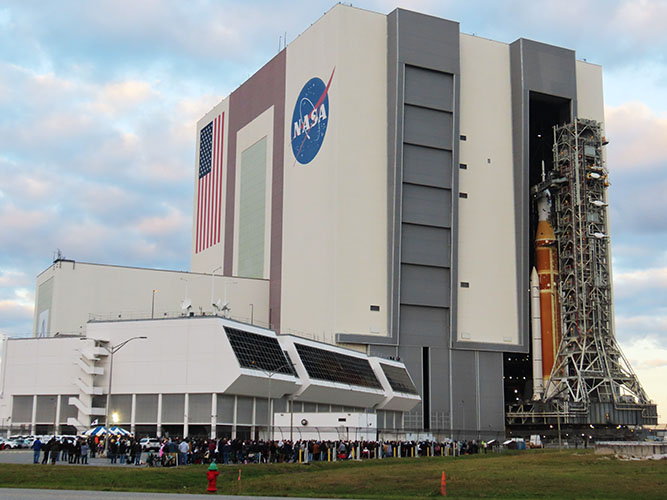
Image above: Artemis II rolls out of High Bay 3 of the Vertical Assembly Building (VAB)
I am a member of the Apollo Generation. I was ten years old when Apollo 11 landed on the Moon, an event that captured my imagination and quietly shaped the course of my life. For my generation, Apollo was more than a program—it was proof of what was possible when vision, engineering, and national will aligned. Today, a new generation stands on the threshold of its own Moon program. Appropriately, it is called Artemis, the sister of Apollo, carrying forward that same spirit of exploration into a very different era. With the rollout of the Artemis II rocket on January 17, we are once again positioning humans for a journey back to the Moon—this time not as a singular moment, but as the opening step in a sustained return, fifty-three years after humanity last walked upon the lunar surface.
Rollout weekend is always an exciting milestone. It marks the transition from assembly and testing to launch preparations and brings into focus the teams who will carry the mission forward. Activities began on Friday, January 16, with the Artemis II Rollout and Mission Overview News Conference.
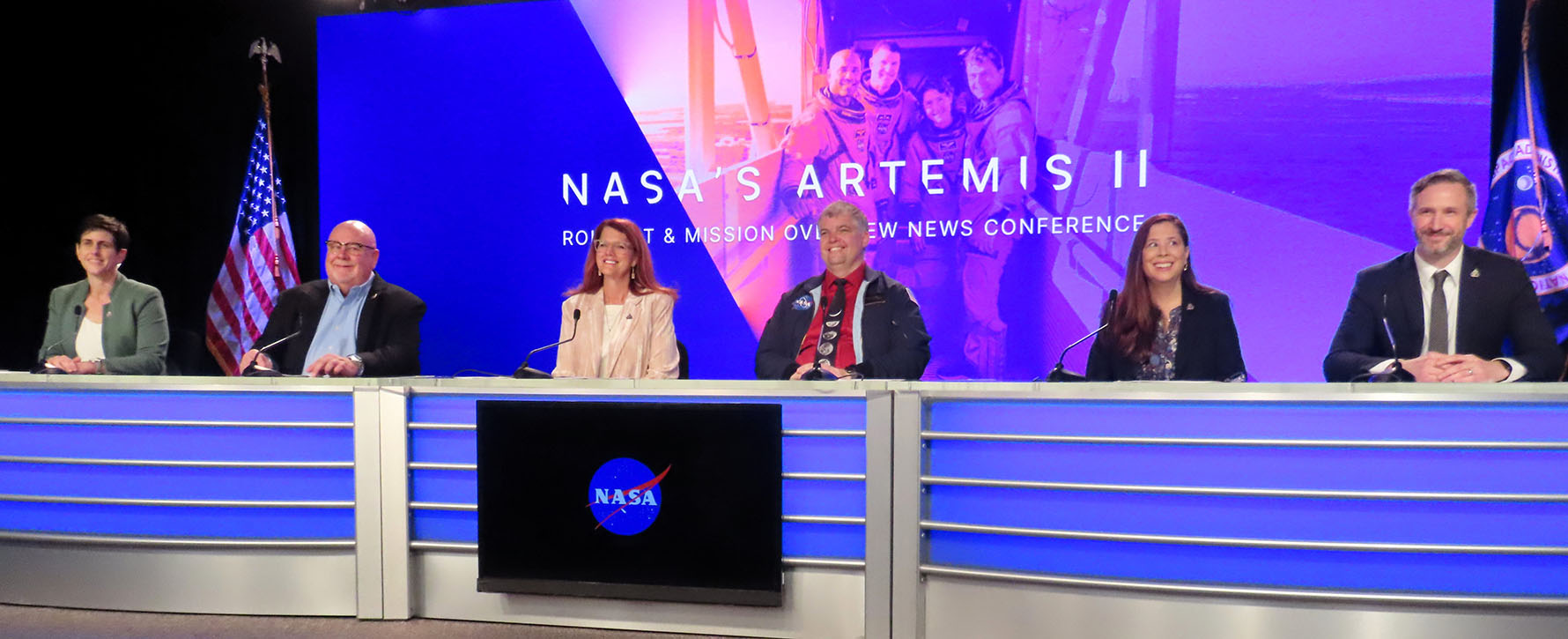
The press conference featured (2nd from left to right):
- John Honeycutt, Artemis II Mission Management Team chair
- Charlie Blackwell-Thompson, Artemis launch director, Exploration Ground Systems
- Jeff Radigan, Artemis II lead flight director, Flight Operations Directorate
- Lili Villarreal, landing and recovery director, Exploration Ground Systems
- Jacob Bleacher, chief exploration scientist, Exploration Systems Development Mission Directorate
Together, these speakers represent a coordinated leadership structure that spans the entire mission lifecycle—from rollout and launch, through deep-space flight, to ocean recovery. Each leader provided an overview of their responsibilities and then addressed questions from the assembled media.
John Honeycutt leads the 15-member Mission Management Team, which integrates technical data across NASA and its partners, manages risk, and ensures the mission is ready to proceed at every major decision point. He emphasized that his foremost responsibility is ensuring the crew returns home safely, making clear that Artemis II will not fly until the team is fully confident in the vehicle, systems, and procedures.
Charlie Blackwell-Thompson and her Launch Control Team oversee final vehicle processing, countdown operations, and the go/no-go decisions that culminate in liftoff from Kennedy Space Center. Asked about lessons learned from Artemis I, she highlighted improvements in cryogenic propellant loading, particularly hydrogen systems. During Artemis I, hydrogen leaks created significant challenges; since then, teams have refined procedures, hardware interfaces, and operational sequencing to improve reliability and reduce risk for a crewed mission.
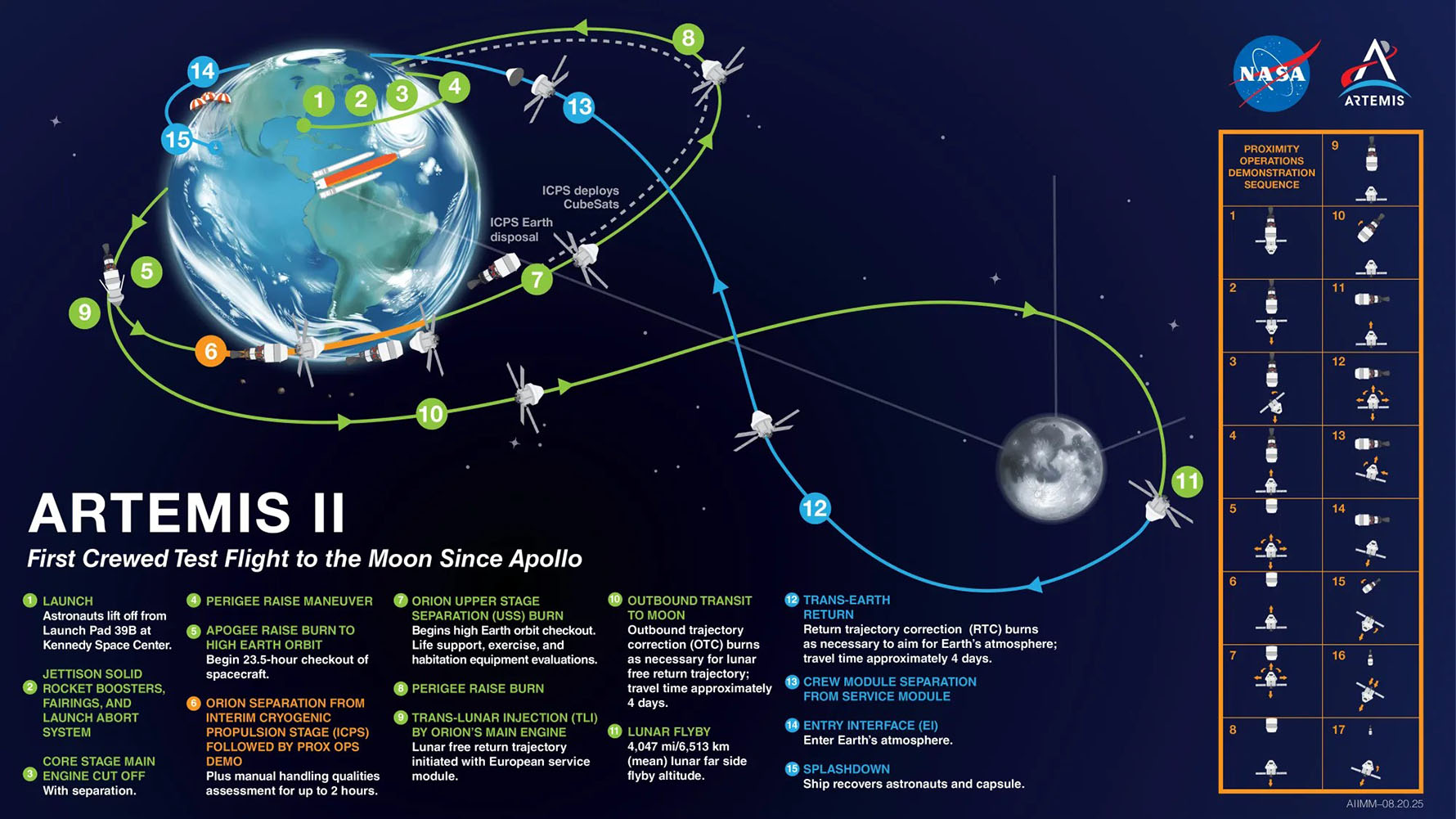
Once Artemis II leaves the pad, responsibility transitions to the Flight Control Team, led by Jeff Radigan in Mission Control in Houston. His team will manage the spacecraft throughout its multi-day mission, overseeing navigation, propulsion, life support, and crew operations as Orion travels roughly 240,000 miles from Earth and executes a lunar flyby. Radigan outlined key mission milestones, noting that Orion will spend approximately 24 hours in high-Earth orbit while the crew and Mission Control conduct a comprehensive systems checkout before committing to Trans-Lunar Injection (TLI). The mission profile is below.
The mission concludes under the leadership of the Recovery Team, directed by Lili Villarreal. Her team is responsible for safely retrieving Orion and its crew following high-speed reentry and Pacific Ocean splashdown. Villarreal explained that after splashdown—approximately 60 miles off the California coast—a joint NASA–Department of Defense team will secure the spacecraft. Four U.S. Navy divers will extract the crew to an inflatable raft, after which the astronauts will be hoisted by helicopter to a Navy ship. The Orion capsule will then be brought aboard the ship’s well deck for return to port. The goal is to have the crew in the ship’s medical bay within about two hours of splashdown.
While Artemis II is primarily a crewed test flight of the Orion spacecraft, it also includes important science objectives. As chief exploration scientist, Jacob Bleacher is responsible for integrating science priorities into Artemis mission planning. One such investigation is AVATAR—A Virtual Astronaut Tissue Analog Response. This human-health experiment flies “organs-on-chips” created from each astronaut’s own cells, serving as biological stand-ins to study how deep-space radiation and microgravity affect human tissues during the roughly ten-day lunar flyby mission. The data will support more personalized health protection strategies and inform medical planning for future long-duration missions to the Moon and, ultimately, Mars.
Artemis II began its four-mile journey from the Vehicle Assembly Building to Launch Complex 39B at 7:04 a.m. on Saturday, January 17. Crawler Transporter-2 moved its 11-million-pound package—the rocket atop the Mobile Launch Platform and launch tower—at a speed of 0.8 miles per hour. Artemis II arrived at LC-39B at 6:42 p.m.
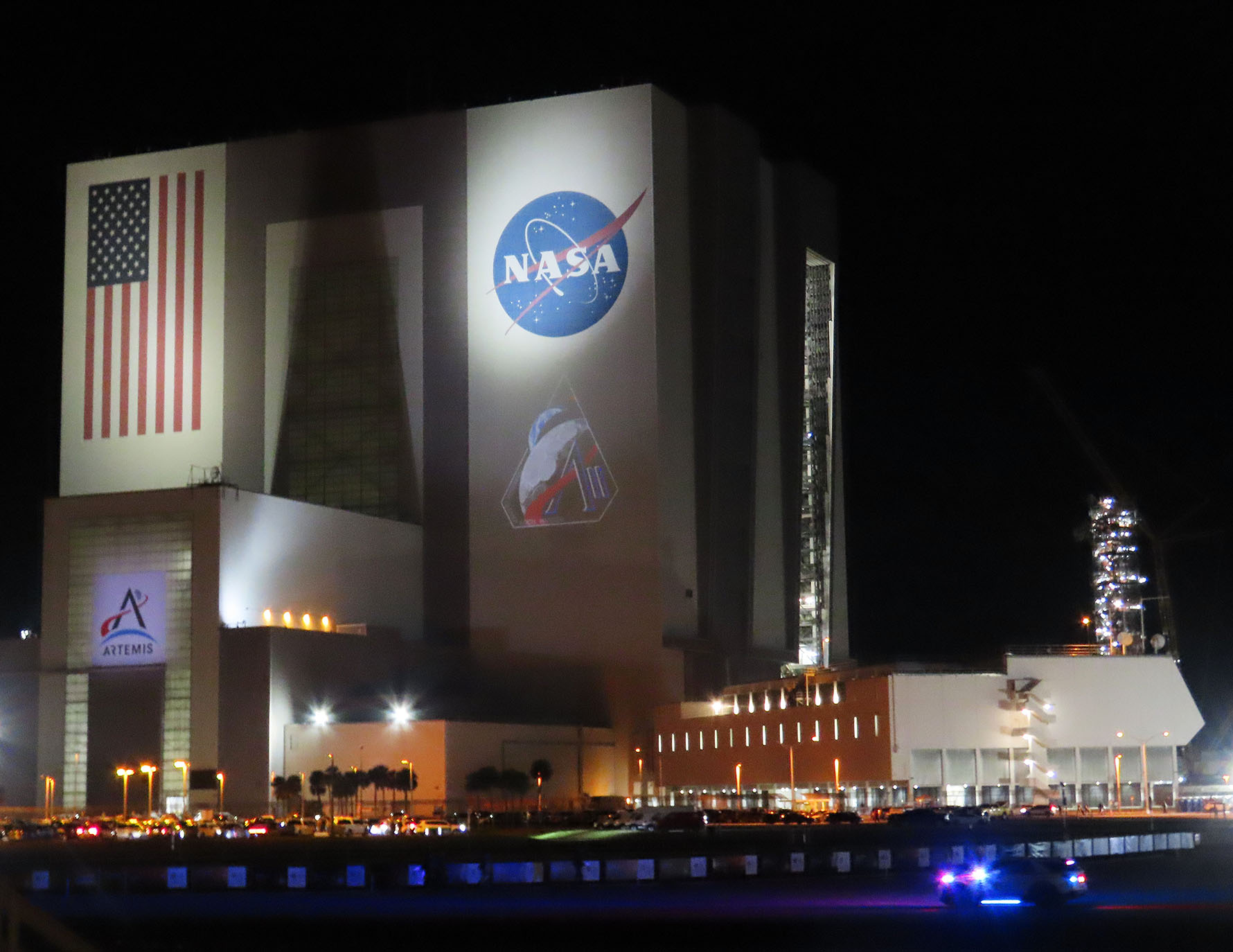
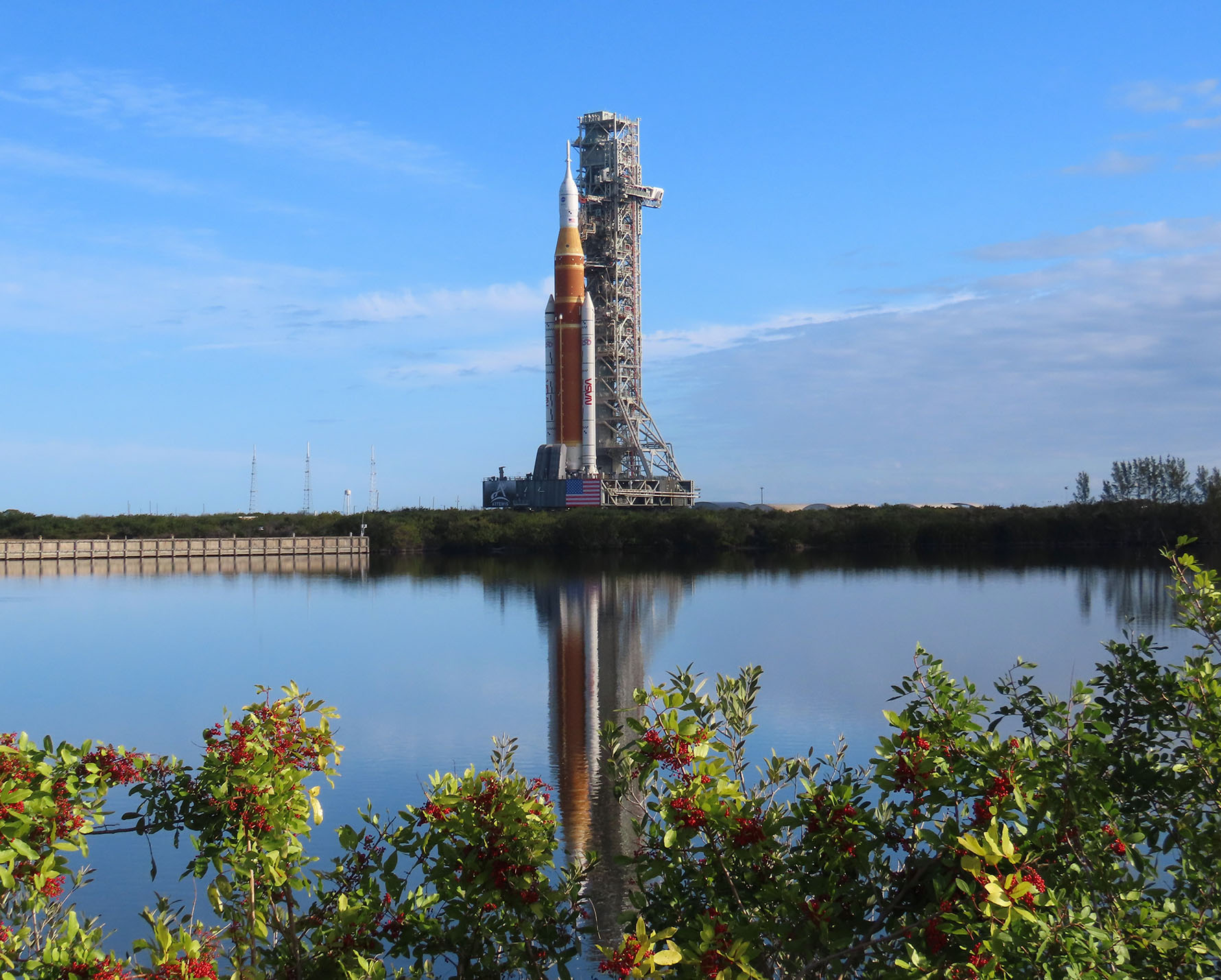
With the vehicle now at the launch pad, the mission enters the critical pre-launch preparation phase leading up to liftoff. Engineers and technicians will begin connecting ground support equipment, including power, communications, environmental control ducts, and cryogenic propellant feeds for fueling the core and upper stages, while powering up pad systems for the first time. Over the following days, teams will perform final checks, system tests, and validations of both the rocket and Orion spacecraft.
A major milestone in this period is the wet dress rehearsal, currently scheduled for February 2, during which the Space Launch System will be fully fueled and taken through a complete countdown sequence—essentially a full practice run for launch day without leaving the pad. This rehearsal is designed to exercise procedures and hardware and to identify any issues that must be resolved before the actual launch attempt.
This launch-pad phase—bridging rollout and launch—focuses on verifying systems, validating interfaces, and synchronizing teams across mission management, launch control, and flight operations. These preparations are part of the countdown campaign that culminates in a launch window opening no earlier than February 6, 2026, when NASA leadership will assess hardware, software, weather, and personnel readiness for the final go/no-go decision for the first crewed lunar mission since Apollo.
The Artemis II crew—shown below from left to right, commander Reid Wiseman, pilot Victor Glover, and mission specialists Christina Koch and Jeremy Hansen—were at the Kennedy Space Center to watch the rollout. They were joined by NASA Administrator Jared Isaacman for a special media event, with the Artemis II rocket providing a striking backdrop. The astronauts answered questions ranging from training and risk to the inspiration of Apollo and how their families are preparing for the mission ahead.
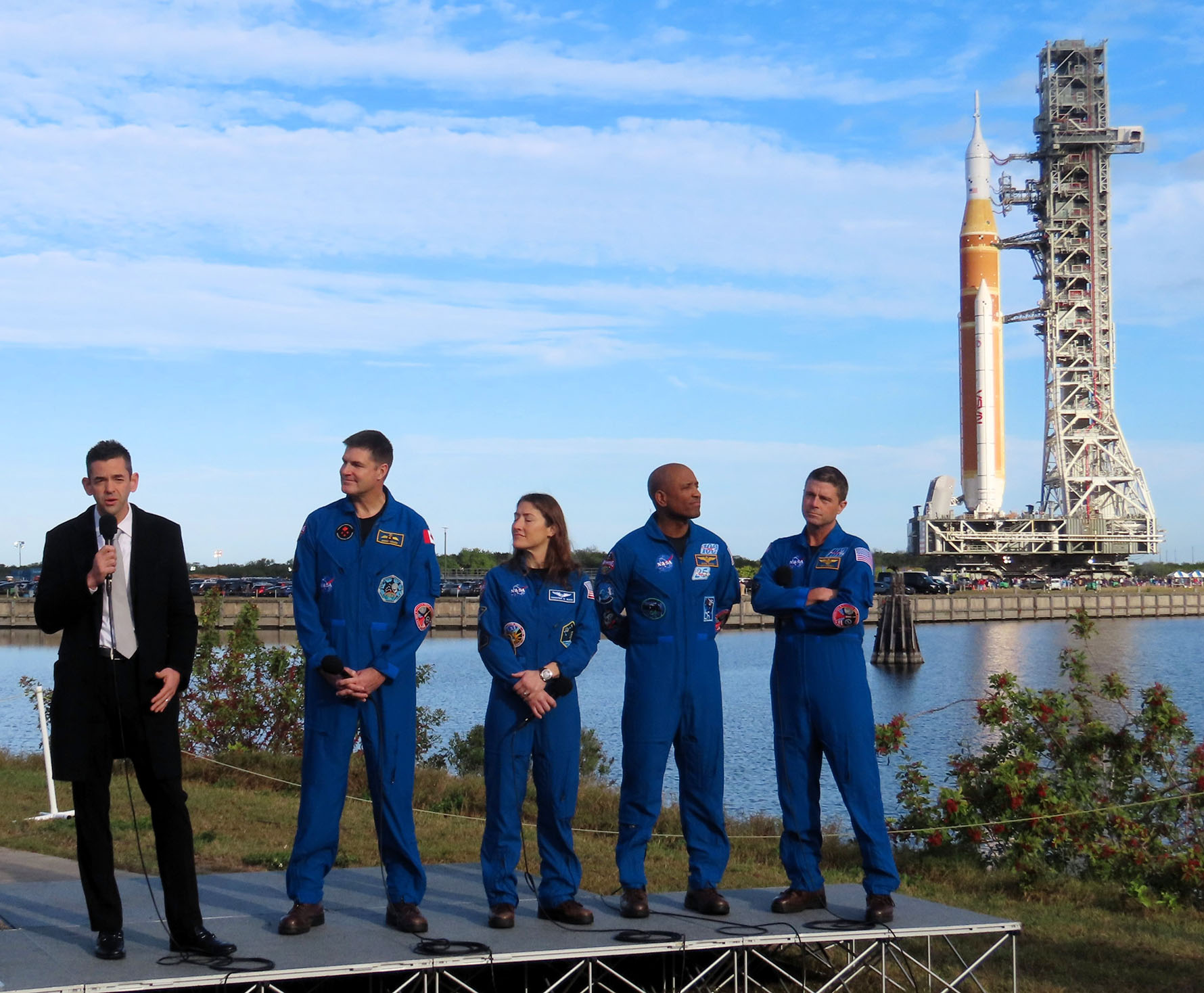
What came through was a well-trained, committed, and excited crew—one looking forward to a historic flight that will begin a new era of U.S. human space exploration and lay the groundwork for the sustained settlement of the Moon.









1 thought on “A Moonshot for a New Generation”
Thank you! This is what we ought to be seeing and hearing. I continue to pray that we would see humans land on the Moon by the end of this decade. God bless NASA. -Dr. Sammy