
By Dale Skran
Copyright 2019
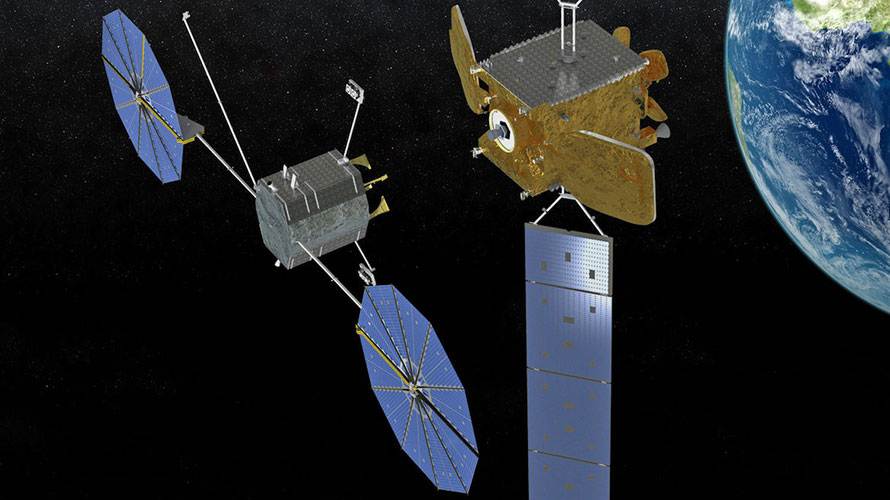
On October 9th, a Russian Proton lofted Northrup Grumman’s first satellite life-extension vehicle from Baikonur Cosmodrome in Kazakhstan. The Mission Extension Vehicle (MEV) is designed to extend the life of satellites by providing propulsion and attitude control. An MEV is illustrated in the center of the image above.
The 2.3 kg MEV-1 will take 3.5 months to reach geosynchronous orbit using electric propulsion. There it will connect to the Intelsat-901 satellite, which has been in orbit for 18 years, and move it a few hundred miles higher to a test orbit.
After a few months of testing, the combined vehicle will move back to a normal geosynchronous orbit and resume operations. The current plan is to use the MEV-1 to extend the life of Intelsat-901 for five years, but the MEV is designed to last 15 years and can be detached from the initial target satellite to extend the life of additional satellites.
The MEV can clamp onto existing features of a communications satellite such as the exhaust nozzle. This allows for the life of an older satellite that was not designed for on-orbit servicing to be extended. Vehicles designed for on-orbit servicing have special connections to allow for refueling, as well as modules that are easy to replace.
This is the first time that a spacecraft has been used to extend the life of a geosynchronous satellite, and heralds a new age of satellite servicing, with resultant lower costs for space operations.





1 thought on “Satellite Life Extension Becomes a Real Thing”
If the MEV-1 is successful in boosting the orbit of Intelsat-901, a new era of satellite life extension will have begun. Boosting the orbits of operating satellites will save millions of dollars in all aspects of Earth observation science, communications, navigation, and defense systems. This will allocate more funding for other areas of NASA, NOAA, and Department of Defense space capabilities. The same kind of MEV-1 concept would work as an orbital energy booster for the ISS and future commercial space stations, extending their operational lifetimes and allocating money for manned Lunar and Martian orbital and surface operations.