Category: Fiction
Reviewed by Peter Spasov
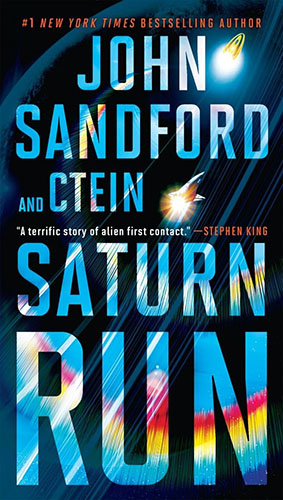
Title: Saturn Run
Author: John Standford and Ctein
NSS Amazon link for this book
Format: Hardcover, paperback, Kindle, audiobook
Pages: 592
Publisher: G.P. Putnam’s Sons
Date: October 2015, reissued February 2017
Retail Price: $28.00/9.99/9.99/
ISBN: 978-1101987520
This swash-buckling adventure begins when a disdained research assistant notices an anomaly during a telescope calibration procedure. A large object decelerates in the vicinity of Saturn, thus is unmistakably an extraterrestrial spaceship. The race is on between the USA and China. And this ‘disdained’ assistant is more than he appears. John Sandford is already an established veteran of the action adventure genre with co-author Ctein providing the ways and means of the technology. Their novel reminds one of Michael Crichton plus Andy Weir’s The Martian.
Saturn Run focuses on the imminent technology and the human ingenuity to travel to Saturn in 2067. And what an impressive plan it is. The Americans have a space station which they will rapidly retrofit into a ship with a crew of ninety in order to reach Saturn within five months of launch from Earth orbit—and do this retrofit within two years. They will to do this in a hypothetical era when no human has yet set foot on Mars!
Four ion-drive engines, each requiring 2.5 gigawatts, will generate a combined total to two hundred thousand newtons of thrust to carry several thousand of tons of water as fuel. Two nuclear reactors will provide the power, which itself is not difficult, the characters say—but the big issue is how to cool such powerful reactors in the vacuum of space and prevent meltdown. Ctein has worked out a clever solution. Technically-minded readers will need to judge for themselves as to how likely it could work in practice. Furthermore, the Americans have to complete this retrofit project within twenty one months! I love the phrase, “the bleeding edge of insanity.”
Meanwhile China is already building a large ship to colonize Mars. They too quickly retrofit the ship for the same purpose but choose to use nuclear thermal rockets. Thus two technologies compete.
The novel goes into details concerning the orbital mechanics, rocketry, radiation, debris collisions and space medicine. The star of this endeavour is the Variable Specific Impulse Magnetoplasma Rocket (VASIMR), a real-life technology being developed by the Ad Astra Rocket Company.
There are plenty of incidents to illustrate issues of space travel. An astronaut uses a synthetic adhesive based on that used by barnacles for ship repairs. Structures can self-heal to an extent when needed after micrometeoroid impacts. A chapter gives a humorous physics lesson when someone is trapped by a falling vending machine in one-tenth gravity provided by centrifugal rotation. A cat frolics in this lower gravity. We also learn about some of the intricacies of computer hacking. Other sections speculate on the nature of possible extraterrestrial life or on aspects of space law.
After a series of adventures involving sabotage, accidents, heroism and betrayal, we learn what is found at Saturn: the design for a highly advanced anti-matter drive. Thus, ironically, human ingenuity for interplanetary travel ends up being about taking alien technology in order to reach the stars.
In this story of suspense and international rivalry, the USA-China conflict is not the crass ‘good us’ versus the ‘evil them’ but is a battle of wits and intrigue between closely matched rivals. Both have valid reasons to mistrust the other. There is honour plus deceit on both sides, yet the perspective is definitely American. Only one chapter out of sixty five shows the Chinese point of view. Yet the story overdoes wrapping oneself in the patriotic flag, in my opinion. Perhaps the authors chose strife because conflict is more exciting than collaboration, but they also address obligations to rescue those in distress.
Although characters may have flaws and quirks, many still appear cookie cutter. The authors report more about characters instead of allowing the reader to witness their struggles. We learn about post-traumatic stress disorder, but don’t get an immersive experience of what it is like. Flippant dialog provides reading entertainment as well as being a legitimate means of coping with a dangerous environment of outer space, but it sometimes appears overdone.
Both authors have eclectic interests in art and photography in particular. This shows up in visual descriptions as well as speculations such as the importance of musical ability. An off-beat subplot involves a betting pool turning into an intricate trading market. The bet is when two characters will copulate.
The novel includes a supplemental section titled Author’s Note. Here Ctein explains the major technology elements in the story, such as how hours were spent to calculate VASIMR performance and orbital trajectories using a spreadsheet and the freely available Windows Orbiter program. It wouldn’t surprise me if someone publishes a paper analyzing the feasibility of the scenarios. This book won’t be for everyone due to the emphasis on the science behind the fiction, but space-technology enthusiasts will find much to savor and appreciate in Saturn Run.
© 2018 Peter Spasov
Please use the NSS Amazon Link for all your book and other purchases. It helps NSS and does not cost you a cent! Bookmark this link for ALL your Amazon shopping!