Category: Nonfiction
Reviewed by: David Brandt-Erichsen
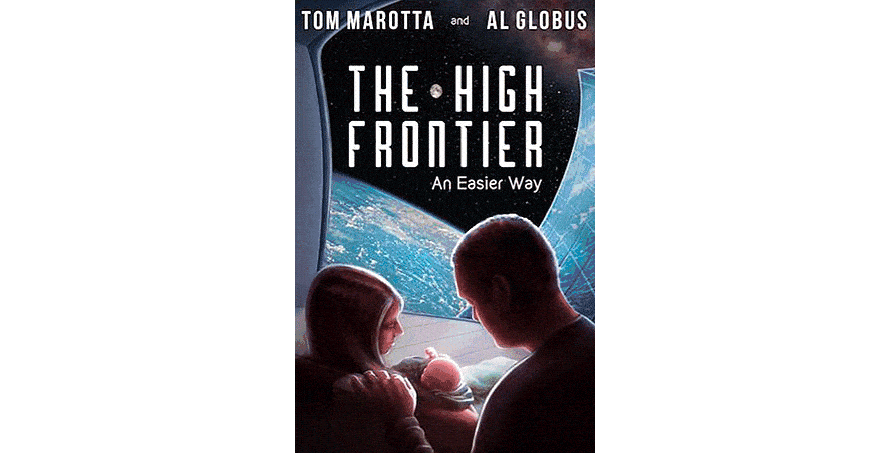
Title: The High Frontier: An Easier Way
Author: Tom Marotta and Al Globus
NSS Amazon link for this book
Format: Paperback, Kindle
Pages: 114
Publisher: CreateSpace
Date: July 2018
Retail Price: $22.99/$4.99
This book can be considered a worthy update to Gerard K. O’Neill’s seminal 1977 book The High Frontier (reviewed here), and the authors should be commended on making a major contribution to the subject. Gerard’s widow Tasha O’Neill even gave permission to use the title.
O’Neill envisioned large orbital space settlements, built from non-terrestrial materials, which could eventually be located anywhere in the solar system and built in sufficient numbers that the total land area would greatly exceed the total land area of planetary surfaces including Earth and Mars.
But the problem has always been (and remains)—how do we get from here to there? There is an enormous gap between where we are now and the first orbital space settlements, and even after 40 years there are as yet no concrete plans to actually proceed with building any.
This book provides new ideas on a stepwise approach that can help bridge that gap.
The book is written in a lively, highly readable style which is easily accessible to the non-technical reader, yet sufficient detail is still present to satisfy those who want to know exactly how the authors have reached their conclusions. Author Tom Marotta is an analyst in the Office of Commercial Space Transportation at the Federal Aviation Administration. Al Globus is on the Board of Directors of the National Space Society, has worked in various capacities at NASA Ames Research Center, and has conducted the annual NASA Ames Space Settlement Contest for 6th to 12th grade students since 1994.
Besides presenting an excellent overview of the subject, the book presents major new ideas from studies for which Globus was principal author:
1. The original studies in the late 1970s assumed a rotation rate of 2 RPM for orbital space settlements, a conservative number chosen to prevent motion sickness. Globus’ studies of the literature since then conclude that this number was too conservative and that a rotation rate of 4 RPM or even higher could be used. This means that “starter” orbital settlements can be considerably smaller, less massive, and hence less expensive than previously thought.
2. The original studies assumed that over 90% of the mass of an orbital space settlement would consist of radiation shielding. Globus’ studies of radiation data from the International Space Station and a NASA online radiation calculation tool called OLTARIS, however, revealed one special location where radiation is low enough that no radiation shielding at all would be required: Equatorial Low Earth Orbit (ELEO), about 500 miles up. Radiation shielding here is provided courtesy of Earth’s magnetic field.
The combination of these two factors means that a “starter” orbital settlement in ELEO could be built (1) with a feasible number of launches of SpaceX’s upcoming Starship, and (2) along an evolutionary path leading from space tourism to small space hotels to larger space hotels to smaller settlements—a stepwise approach where each step, with a little luck, could be economically viable.
Note that such ELEO settlements differ from the original O’Neill concept in two significant ways: (1) they do not require non-terrestrial materials (hence, although cheaper, they don’t open up the resources of the solar system), and (2) they cannot be moved outside of Earth’s magnetic field (hence they don’t truly “escape the bonds of Earth”). But they are a step along the path, gaining experience, developing a space economy, and making subsequent steps easier to accomplish.
I highly recommend this book, not only for its new information but for its engaging style which includes human-interest profiles of some of the people who are making this happen, from Russian rocket pioneer Konstantin Tsiolkovsky to NSS Secretary Anita Gale.
© 2018 David Brandt-Erichsen