Category: Nonfiction
Reviewed by: Ted Spitzmiller
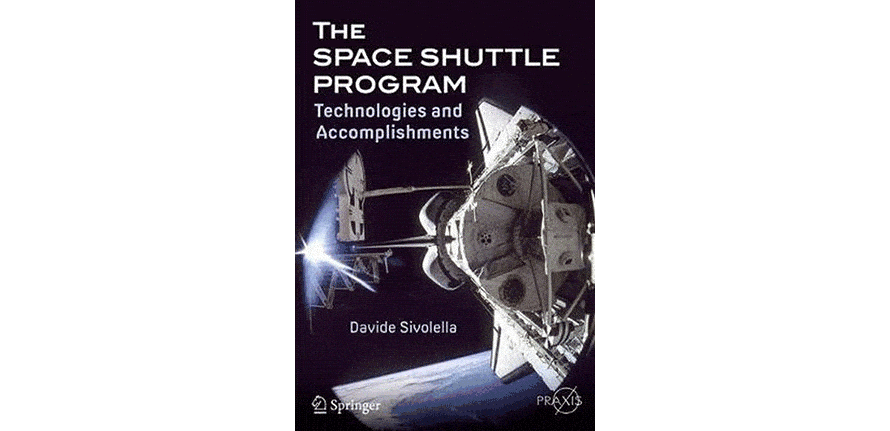
Title: The Space Shuttle Program: Technologies and Accomplishments
Author: Davide Sivolella
NSS Amazon link for this book
Format: Paperback/Kindle
Pages: 360
Publisher: Springer/Praxis
Date: June 2017
Retail Price: $44.99/$44.99
ISBN: 978-3319549446
Davide Sivolella has a passion for astronautics that led to a bachelor’s and master’s degree in aerospace engineering from the Polytechnic of Turin (Italy). Since 2009 he has been employed as a specialist in aircraft structural repairs for civil airliners in the United Kingdom. He thinks of aircraft as spacecraft that fly low and slow. His first book To Orbit and Back Again: How the Space Shuttle Flew in Space was born from a life-long passion for the space shuttle program.
While previous books about the space shuttle focused on its development and technology, this one looks at the shuttle in terms of employing its special characteristics in operational use. To that end, the book is excellent.
In the first chapter, “A Remarkable Flying Machine,” the author reviews the early development planning and the compromises made that ultimately painted NASA into a corner, elevated the complexity and risk, and escalated the maintenance costs. The author notes on several occasions how funding limitations continued to force technological advances to overcome apparent restrictions.
The second chapter entitled “Launch Platform” highlights the ability to carry satellites into low Earth orbit (LEO) and to launch payloads beyond the shuttle’s limited 300-mile apogee. Sivolella does an excellent job of conveying these capabilities. He effectively notes how the creators of the shuttle envisioned its use to build a space station and service LEO unmanned satellites—and the need to provide for geosynchronous orbits and ultimately for interplanetary missions. He then documents the still-birth of the space tug, a feature that would never be fulfilled because of funding limitations. The lack of a space tug led to the Inertial Upper Stage (IUS) and the Payload Assist Module (PAM) upper stages. The description of the Centaur unit, its high risk and ultimate demise, is well handled.
NASA’s political push for the shuttle to be the “only” means for satellite launches is also effectively discussed. It was this imperative that led to management downplaying risk factors that ultimately resulted in the “normalization of deviancy” that led to both the Challenger and Columbia disasters.
The third chapter on “EVA Operations” highlights the development of the spacesuits, which I found especially interesting with all the detail and insider quotes. It left me with a better appreciation for the engineering of the human body after reading what it took to enable the sensory, control and usability of the hand to be transmitted through a glove.
The author’s selection of numerous quotes elevates the value and integrity of the information throughout the book, and the occasional use of quotes as subtitles provides a degree of intrigue for the reader.
Chapter 4, “Learning to Build a Space Station,” will take the reader on a long and arduous journey, filled with lots of pitfalls, that finally resulted in the International Space Station. I found it full of great information that I hadn’t read elsewhere.
“Satellite Servicing” is the focus of Chapter 5. The topic includes a discussion of how NASA and its contractors worked around many of the limitations of the shuttle to accomplish miracles, especially with the Tracking Data Relay Satellite deployments and Hubble servicing missions.
Chapters 6 through 12 provide more examples of shuttle missions that drove creative new space capabilities and pushed the boundaries of what humans could accomplish in space.
Chapter 13, “The Legacy of The Shuttle Program” is the final chapter, and the author takes issue with the statement made in 2005, by then NASA Administrator Michael Griffin, who called the program “a mistake.” While the scope of this book does not provide for an in-depth analysis of the turns and twists of the Space Shuttle Program’s development, readers might consider the shuttle books by both Heppenheimer and Jenkins to get a more balanced understanding of its funding and early political and operational focus to better evaluate Griffin’s statement and the author’s rejection of it.
I recommend this book as a must read for space enthusiasts. Even though I have read extensively about the space shuttle program, the author’s use of original sources such as memoirs, interviews, and original press kits, in conjunction with his deep knowledge of the shuttle operating systems, provided many new insights as well as valuable examples of human ingenuity in the face of ever-present political and funding constraints placed on space ambitions.
© 2018 Ted Spitzmiller
Please use the NSS Amazon Link for all your book and other purchases. It helps NSS and does not cost you a cent! Bookmark this link for ALL your Amazon shopping!