OPINION
By Burt Dicht
NSS Space Coast Correspondent
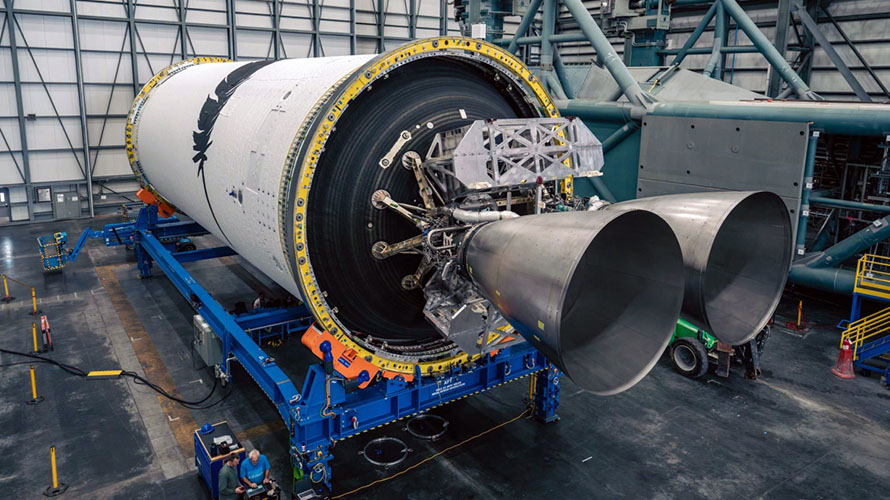
Image: New Glenn Second Stage (Credit: Blue Origin)
When Blue Origin’s New Glenn 3 mission (NG-3) suffered an upper-stage failure, the reaction on social media was immediate and, in many ways, familiar. Commentary quickly emerged based on limited information, with some concluding that Blue Origin is not ready for this class of launch, that Artemis could be at risk, or that a single provider model would be preferable.
As an engineer, I find that kind of reaction understandable—but often incomplete. It doesn’t fully reflect how complex aerospace systems evolve. Failure in spaceflight is not an aberration. It is an inherent part of the process of turning an idea into a reliable capability. We do everything we can to minimize risk, but we cannot eliminate it, especially on early flights of a new launch system.
The NG-3 anomaly is serious. It will have real consequences, and it raises important questions that Blue Origin must address. But it is not, by itself, a sign that the company is incapable or that Artemis is in jeopardy. To see why, it helps to step back from the immediate reaction and look at the historical record, starting with one of the most important rockets ever built: the Saturn V.
What Happened with NG-3
Before we go back in time, it’s worth briefly summarizing what we know. NG-3 was an important mission for Blue Origin and New Glenn. It was the third flight of the vehicle and the first to reuse a booster, a critical step toward achieving the kind of operational cadence and cost structure that modern space programs demand. The first stage did its job and successfully returned to a downrange landing platform, demonstrating the promise of reusability.
The problem came with the upper stage. The stage did not deliver the payload to its planned orbit, leaving the satellite in an unusable trajectory. The result is essentially a lost spacecraft and an expensive lesson learned. For the customer, that’s painful. For Blue Origin, it’s a stark reminder that upper-stage performance and reliability are just as vital as dramatic first-stage landings.
In the public conversation that followed, some narratives formed quickly. Blue Origin is out of its depth. New Glenn cannot be trusted. Artemis is now in danger because New Glenn would carry Blue Origin’s Human Landing System. Those reactions are understandable in the moment, but they don’t fully align with how launch systems and exploration programs have historically matured.
Failure as an Engineering Tool
When engineers talk about “failure,” we mean something very specific. We do not mean “give up and go home.” We mean “the system did not behave as intended, and now we have data.”
A failure is a high-fidelity test. It reveals conditions we did not anticipate, interactions we did not fully understand, and edge cases we did not adequately protect against. In some cases, it reveals hard limits we have to design around. In other cases, it exposes mistakes we can correct. It is all part of the engineering design process.
The key is what happens next. In modern launch programs, a post-flight anomaly investigation typically includes:
- Collecting and synchronizing telemetry from every subsystem.
- Reconstructing the exact sequence of events leading to the failure.
- Building a fault tree: a structured set of hypotheses about what could have caused the observed behavior.
- Testing those hypotheses in analysis, simulation, and hardware tests.
- Implementing design or process changes, then verifying that they close the identified vulnerabilities.
This is not something that unfolds in real time on social media. It is months of disciplined engineering work, often building on decades of accumulated knowledge. If you want a clear illustration of how this process works at the highest stakes, you don’t have to look any further than the early days of the Saturn V.
The Saturn V That Almost Failed
Today, the Saturn V has a near-mythical reputation: a flawless giant that thundered to the Moon and never failed. The reality is more complicated and more instructive. On its second flight in April 1968, Apollo 6/ Saturn V experienced a series of deeply troubling problems that, in today’s environment, would likely have triggered significant concern about the program’s future.
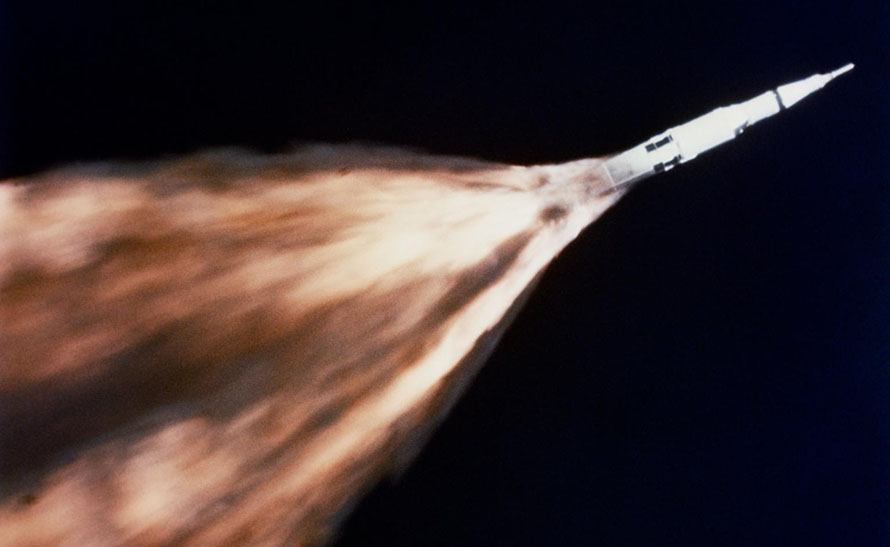
During the ascent, two of the five J-2 engines on the S-II second stage shut down prematurely. The remaining three engines were able to compensate by burning longer, and the vehicle avoided loss of mission. But the shutdowns were a serious red flag: the upper stages of the Moon rocket were not behaving as designed.
Then came an even more worrisome issue. The third stage, the S-IVB, carried a single J-2 engine that had to start, shut down, and then restart for translunar injection. On Apollo 6, the engine failed to restart. Without that restart, a crewed mission would have been stuck in Earth orbit, with no trip to the Moon.
In other words, on the second Saturn V, the architecture we now view as the gold standard of lunar flight appeared uncertain in exactly the areas that mattered most.
How Engineers Saved Saturn V (and What Really Failed)
NASA and Rocketdyne didn’t respond to Apollo 6 by abandoning the Saturn V. They responded by doing what engineers do best: they dug into the data. The investigation traced the S-II shutdowns and the S-IVB restart failure to a specific vulnerability in the J-2 engine’s plumbing. A small liquid-hydrogen line feeding the Augmented Spark Igniter (ASI) used flexible bellows sections and braided reinforcement so it could handle thermal expansion and isolate vibration. In flight, that line turned out to be the weak link.
Analyses and tests showed that in the true vibration environment of the engine, those bellows could resonate. In that resonant mode, the line flexed excessively, leading to fatigue cracking at the bellows. Once cracks formed, liquid hydrogen could leak and chill parts of the engine, and under some conditions hot gases could flow backward, upsetting temperatures and pressures inside the engine. The end result was degraded performance, shutdowns, and in the S-IVB’s case failure to restart.
Critically, the ground-test environment had masked this problem. On the stand and during integration, frost and surrounding hardware effectively stiffened and damped that line. The extra support changed its dynamic behavior, keeping its dangerous resonant mode from showing up. The engine “looked” fine on Earth because the test setup unintentionally braced the very line that would be free to vibrate in vacuum.
Once engineers understood this, the fix was straightforward, if not trivial to implement. Rocketdyne removed the fragile bellows sections and redesigned the line with S-shaped bends in rigid tubing. Those S-bends could still absorb thermal expansion and isolate vibration, but without the thin, flexible bellows that had been prone to resonant failure. The line was also supported more securely so its natural frequencies and responses matched what the engine could tolerate in flight.
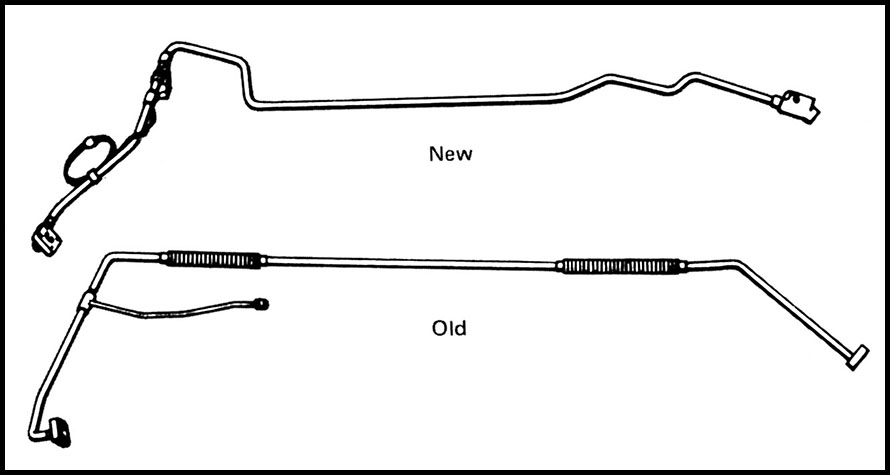
Tests in high-altitude facilities confirmed that the new configuration behaved correctly in a realistic environment. Those changes were in place by the time Apollo 8 flew. Then they did something that, in hindsight, took real confidence: they put a crew on the very next Saturn V.
Apollo 8 flew to the Moon atop the first Saturn V to carry astronauts, and it did so after the troubling anomalies of Apollo 6. This time, the S-II stage performed as intended, and the S-IVB restarted successfully to send the spacecraft on a translunar trajectory.
The arc from Apollo 6 to Apollo 8 is a powerful example that early, serious failures are not proof of programmatic doom. They are inflection points where organizations either rise to the engineering challenge or fall short.
Modern Rockets, Same Story
Fast forward to the present, and we see a similar pattern across multiple programs. SpaceX’s Falcon 9 did not begin as a perfectly reliable rocket. In its early years, it experienced in-flight failures and high-profile mishaps, including the CRS-7 loss and the AMOS-6 pad explosion. Each event led to detailed investigations, design changes, and operational improvements. Today, Falcon 9 is one of the most reliable and frequently flown launch vehicles in history.
Starship and Super Heavy are still in a test-heavy phase, and their development has been highly visible. We have seen vehicles break up, lose control, and disintegrate, but we have also seen steady progress, with each flight expanding the envelope of what is achieved.
New Glenn fits into this same pattern. It is a large, complex launch system in its early flights. NG-3 demonstrated successful booster reuse, which is a significant milestone. It also showed that the upper stage is not yet where it needs to be. That is what development looks like.
What NG-3 Likely Means for Blue Origin and Artemis
So what does this upper-stage failure on NG-3 really mean?
For Blue Origin, it means an intensive period of analysis and corrective action. The upper stage will be examined in detail, including:
- Engine performance, start-up and shutdown behavior, and thermal margins.
- Propellant management, including slosh, pressurization, and residuals.
- Guidance, navigation, and control algorithms.
- Structural and thermal environments.
The result will likely be a combination of hardware refinements, software updates, and operational changes.
For Artemis, the takeaway is not that NG-3 is irrelevant. Blue Origin’s systems must meet an extremely high bar before they are entrusted with critical mission elements. A failure at this stage is a reminder of the work still ahead.
At the same time, it is far better for these issues to surface now rather than later in the program. Every anomaly resolved now increases the probability of success when missions become more complex and have higher stakes.
A Note on the Broader Conversation
Moments like this tend to generate strong reactions, especially when information is still emerging. It is entirely appropriate to ask hard questions, to evaluate performance, and to hold organizations accountable. But it is also important to recognize that early failures do not, by themselves, define the long-term viability of a system.
We should also be cautious about arguments that favor a single provider as the solution to all challenges. Redundancy, competition, and diverse technical approaches have long been strengths of successful space programs. Artemis benefits from having multiple contributors, each advancing different capabilities and learning different lessons. That is a meaningful step forward. Putting all of our hopes on one system may seem simpler, but it does not create the resilience needed for sustained exploration.
NG-3 was not the mission Blue Origin wanted, and it was not the outcome their customer deserved. But it was also not the end of the story. The successful recovery of the first stage, the data returned from the flight, and the experience gained by the team are all part of the same process that has shaped every major launch system in history. What matters now is what Blue Origin does next and how effectively it turns this setback into progress.