
By Burt Dicht
NSS Space Coast Correspondent
Artemis II – By the Numbers
Flight Day 10 — Friday, April 10, 2026
Status at Wake-Up
The crew began the final phase of their journey home to the songs “Run to the Water” by Live — selected by the crew themselves and “Free” by Zac Brown Band, as they prepared for their third return trajectory correction burn. When they woke up, they were 61,326 miles from Earth.
The Final Burn
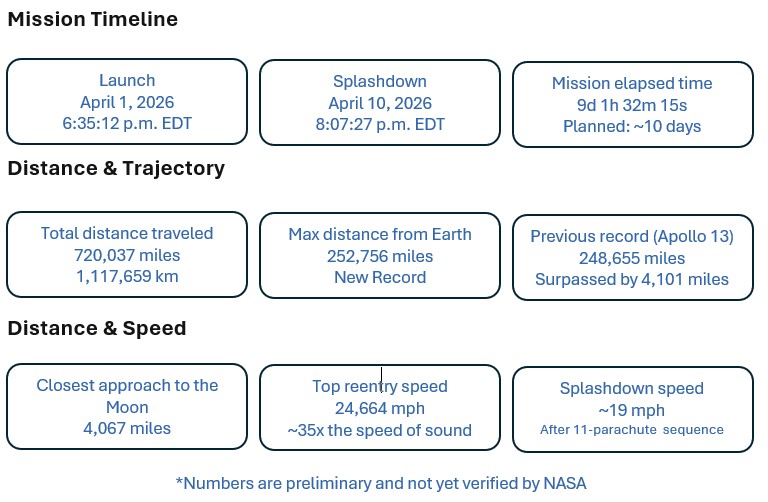
The third and final return trajectory correction burn occurred at 2:53 p.m. EDT, refining Orion’s path for atmospheric entry and splashdown, with the spacecraft making precise adjustments to stay on its targeted course home.
Reentry Sequence — Minute by Minute
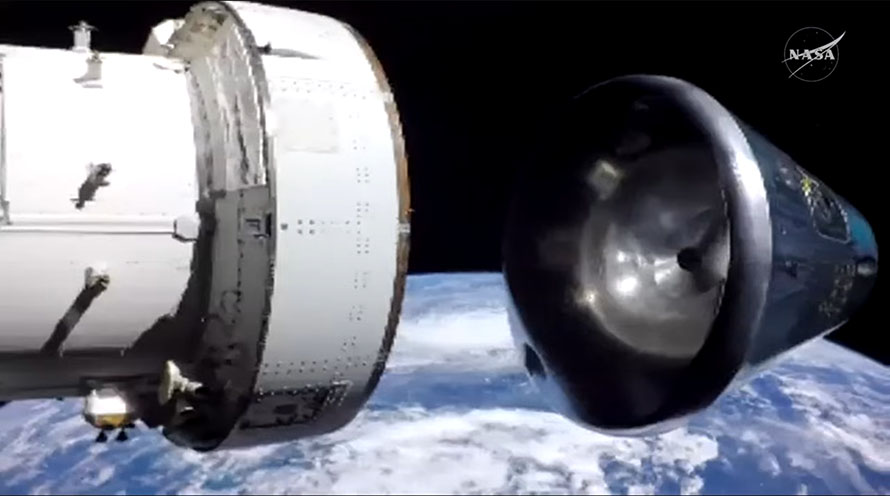
At 7:33 p.m., Orion’s crew module separated from the service module, exposing the heat shield for the spacecraft’s return through Earth’s atmosphere, where it would encounter temperatures of about 3,000 degrees Fahrenheit. At 7:37 p.m., following separation, Orion performed an 19-second crew module raise burn to set the proper entry angle and align the heat shield. At 7:53 p.m., Orion reached 400,000 feet above Earth’s surface while traveling nearly 35 times the speed of sound, beginning a planned six-minute communications blackout as plasma built around the capsule. The crew was expected to experience up to 3.9 Gs. At 8:03 p.m., drogue parachutes deployed at around 22,000 feet, slowing and stabilizing the capsule. At 8:04 p.m., the three main parachutes unfurled at around 6,000 feet, reducing Orion’s speed to less than 136 mph.
Splashdown — Picture Perfect
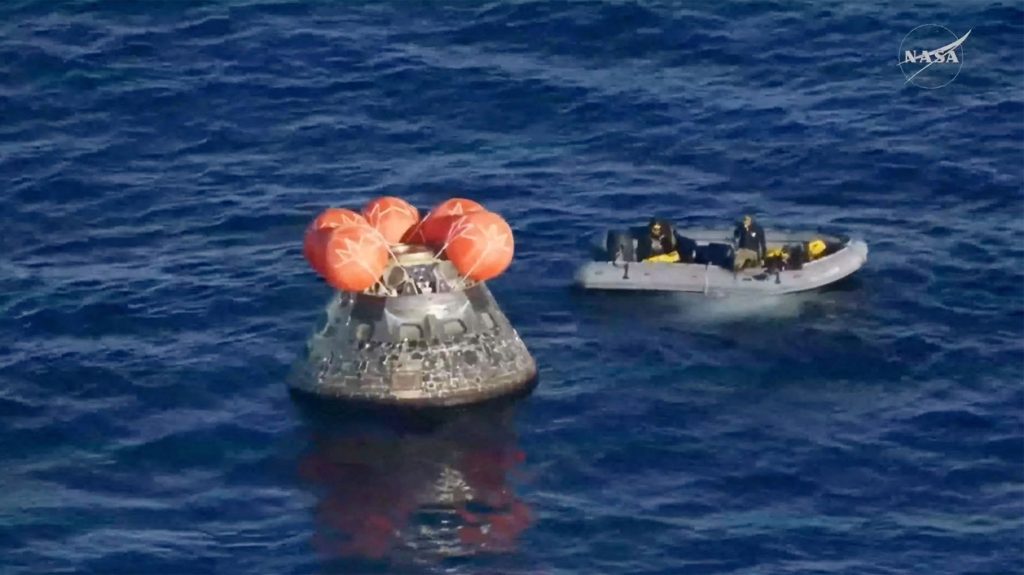
Integrity touched down in the Pacific Ocean off the coast of San Diego at 8:07:27 p.m. EDT — just 27 seconds off the planned target time — after a journey of 694,481 miles. The trajectory was right on track throughout the 13-minute reentry sequence, and the mission concluded in textbook fashion.
Crew Status — All Four Healthy
All four crew members — Commander Reid Wiseman, Pilot Victor Glover, Mission Specialist Christina Koch, and CSA Mission Specialist Jeremy Hansen — are confirmed healthy following splashdown. Commander Wiseman reported, “four green crewmembers,” meaning they were all healthy and not referring to their complexion.

(2 hours after splashdown the astronauts are now onboard the USS John P. Murtha and will undergo a medical evaluation. The recovery team will now focus on bringing the capsule into the well deck.)
Splashdown Quotes:
Mission Control — at the moment of splashdown: “A perfect bullseye splashdown. This is a perfect descent for Integrity.”
“A new chapter of the exploration of our celestial neighbor is complete. Integrity’s astronauts, back on Earth.”
Commander Reid Wiseman — first words after communications restored post-blackout: “Houston, Integrity, we have you loud and clear.” There were big cheers in Mission Control.
Commander Wiseman — from inside Orion, bobbing in the Pacific: “What a journey. We are stable. Four green crewmembers.”
NASA Administrator Jared Isaacman — aboard the USS John P. Murtha: “This is not just an accomplishment for NASA. This is an accomplishment for humanity, again, a historic mission to the moon and back.”
CONGRATULATIONS AND THANK YOU
To the Artemis II astronauts—Reid Wiseman, Victor Glover, Christina Koch, and Jeremy Hansen—congratulations on completing a mission that has inspired millions and marked a historic return of humans to deep space beyond Earth orbit.
Congratulations as well to NASA, the European Space Agency, the Canadian Space Agency, the countless industry partners, contractors, and the tens of thousands of engineers, technicians, flight controllers, recovery teams, and support personnel whose dedication and expertise made this mission possible.
This achievement belongs to every person who helped design, build, test, launch, fly, recover, and support Artemis II.
We have taken the first steps in returning humanity to the Moon and establishing a sustained human presence beyond Earth.
The journey has begun.
Thank you.
SPLASHDOWN THEN AND NOW: FROM CARRIER TASK FORCES TO PRECISION RECOVERY
When astronauts return from space today, the recovery operation can look surprisingly modest.
For Artemis II, Orion descended beneath its parachutes into the Pacific Ocean, where divers, helicopters, small boats, and a single U.S. Navy amphibious ship—USS John P. Murtha (LPD-26)—stood ready to recover the crew.
The entire operation was carefully choreographed, but by Apollo-era standards it was remarkably lean. That was not always the case.
During the Apollo era, splashdown recoveries were major naval operations. Astronauts returning from the Moon on missions such as Apollo 8 and Apollo 11 Moon Landing were greeted by full aircraft carrier task forces. Ships such as USS Hornet (CVS-12) and USS Yorktown (CVS-10) served as floating command centers, surrounded by helicopters, support vessels, medical teams, and extensive communications assets.
These carrier groups were not assembled merely for spectacle. In the 1960s, NASA and the Navy were operating at the very edge of what was technologically possible. Spacecraft navigation was far less precise than it is today, and mission planners had to account for far greater uncertainty in splashdown location. Even a small trajectory error could place the capsule dozens of miles from its planned landing zone.
The Navy provided the only organization capable of responding to that uncertainty. Aircraft carriers offered enormous flight decks for helicopter operations, large medical facilities, robust communications systems, and the manpower required to conduct complex search-and-rescue operations across vast stretches of ocean.
Apollo recoveries also reflected the scientific uncertainties of the era. Early lunar missions required astronaut quarantine because scientists could not fully rule out the possibility that lunar material might carry unknown microorganisms. When the crew of Apollo 11 Moon Landing returned, Neil Armstrong, Buzz Aldrin, and Michael Collins entered a sealed Mobile Quarantine Facility aboard USS Hornet (CVS-12) before being transported to Houston for further isolation and study.
The Cold War added another dimension. Apollo missions unfolded on the world stage, and the presence of a Navy carrier group underscored the technological and strategic strength of the United States.
Modern spacecraft recoveries tell a very different story. Advances in navigation systems, satellite tracking, and highly accurate onboard computers now allow mission controllers to predict splashdown locations with remarkable precision. Instead of preparing for wide dispersions across hundreds of miles of ocean, recovery teams can concentrate their assets in a tightly defined landing zone.
Spacecraft design has evolved as well. Orion was engineered specifically for streamlined ocean recovery. Commercial spacecraft have pushed efficiency even further. SpaceX Dragon capsules are routinely recovered by dedicated recovery vessels supported by fast boats and helicopters rather than large naval task forces. Once Dragon splashes down, teams aboard the recovery ship quickly secure the spacecraft, perform safety checks, and hoist the capsule onto the deck, where astronauts typically exit directly from the ship. The process is designed for speed and operational efficiency, reflecting the more routine cadence of today’s orbital missions.
The contrast among Apollo, Artemis, and commercial recoveries highlights more than technological progress. It reflects a broader shift in how human spaceflight is conducted. Apollo was a national mobilization driven by geopolitical urgency. The resources committed to each mission were enormous, and recovery operations reflected that scale.
Today’s missions are designed with sustainability and efficiency in mind. Artemis still draws on the capabilities of the U.S. Navy, but the goal is to accomplish the same task—bringing astronauts safely home from deep space with a far more streamlined operational footprint. Yet despite the differences in scale, one element remains unchanged.
Whether it is a massive aircraft carrier surrounded by a Cold War task force, a single amphibious ship waiting in the Pacific, or a commercial recovery vessel supporting routine crew flights, the moment of splashdown still represents the same profound milestone: the safe return of human explorers from the frontier of space.








1 thought on “WELCOME HOME INTEGRITY! Taking Humanity Back to the Moon”
Congratulations NASA and crew of the Integrity for the successful Artemis II mission! Looking forward to Artemis III.