By Burt Dicht
NSS Space Coast Correspondent
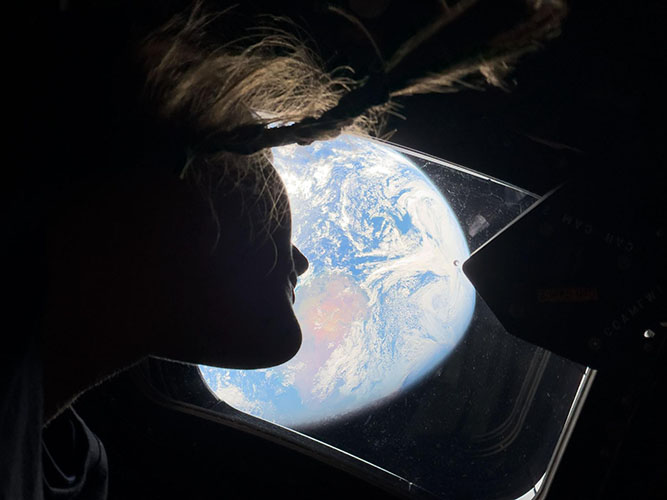
Photo: Artemis II mission specialist Christina Koch peers out of one of the Orion spacecraft’s main cabin windows.

Koch & Hansen Take the Wheel — Orion Flies Deep in Space
Flight Day 4 was Orion’s most hands-on day yet. After waking to Chappell Roan’s “Pink Pony Club” at 12:35 p.m. EDT, the crew shifted from passive transit into active spacecraft testing. At the start of the day, Orion was approximately 169,000 miles from Earth and 110,700 miles from the Moon — past equidistance between the two bodies.
The headline event came late in the evening. Mission specialists Christina Koch and Jeremy Hansen took turns manually flying Orion in deep space, testing the spacecraft’s two thruster control modes over 41 minutes. Their data joins what pilot Victor Glover gathered during the Day 1 proximity operations demonstration and will give engineers the broadest possible picture of how Orion handles with a human at the controls.
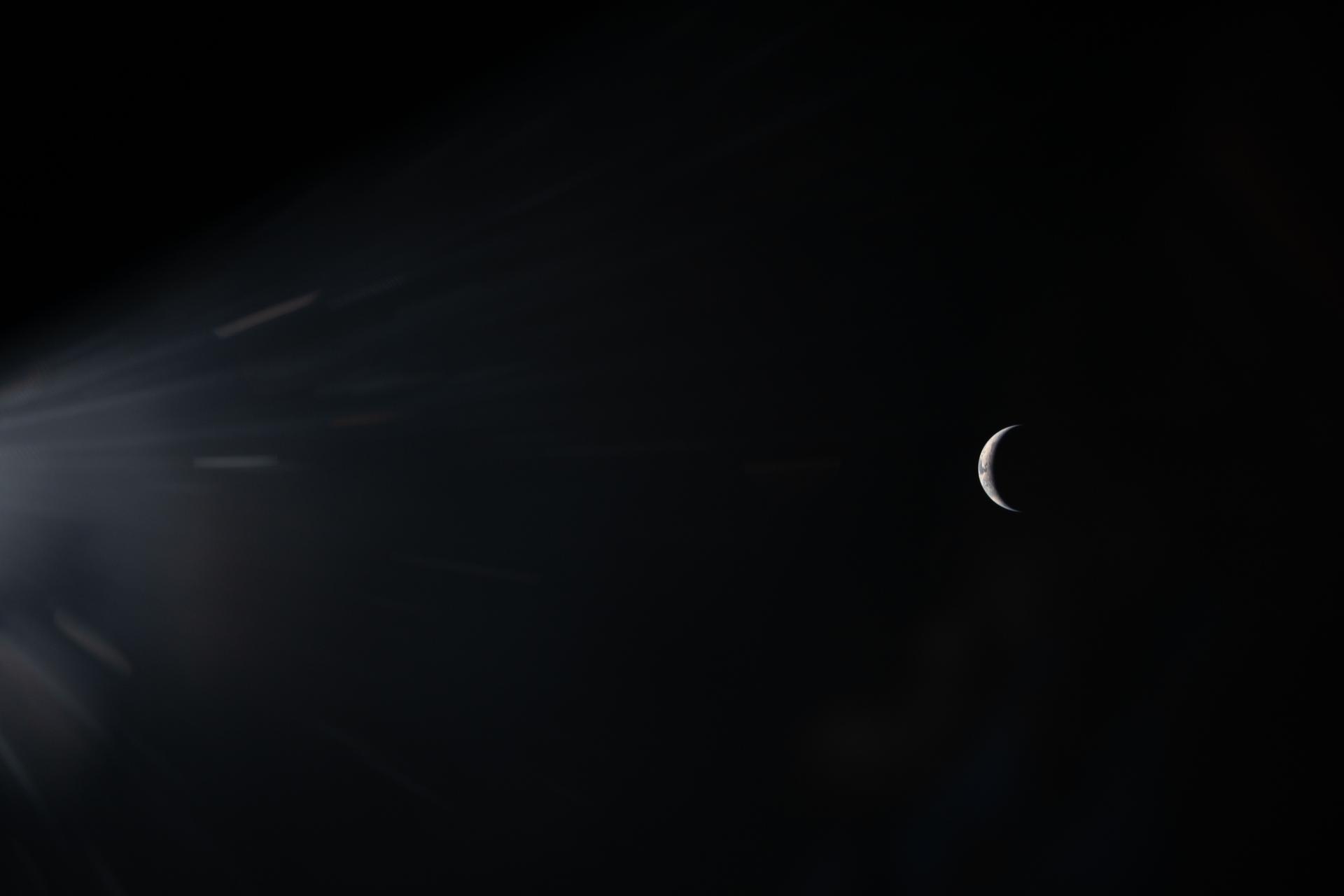
The crew also produced Orion’s first deep-space exterior portrait — the spacecraft photographed itself using a camera mounted on one of its solar array wings. The images are expected to be transmitted to the ground in the coming days.
Key Events — Flight Day 4
- Solar array wing “selfie”: The crew captured exterior photographs of Orion using its solar array wing camera — the first high-resolution portrait of the spacecraft in deep space.
- Lunar science target review: The crew studied the geology target list sent by NASA’s lunar science team — craters, lava flows, and far-side ridge features they will photograph during Monday’s flyby.
- Science payload operations: Crew collected saliva samples for the immune biomarkers study. The AVATAR bone marrow payload and DLR M-42 radiation sensors also continued operating. A 24-hour acoustics test began to characterize the sound environment aboard Orion.
- Manual piloting demonstration: Koch and Hansen alternated at the controls for 41 minutes, evaluating Orion’s six-degree-of-freedom and three-degree-of-freedom thruster modes in deep space. Data transmitted to Mission Control in real time.
- Send a plumber: A toilet problem emerged on Day 4, with a frozen urine blocking the vent line used to dump liquid waste overboard. The crew also reported a burning smell from the toilet area, though Mission Control said there were no major concerns and cleared them to keep using it (see below for a complete recap).
- Sleep period began at 3:15 am CDT: Crew signed off for the night. Mission Control scheduled a wake-up call for 12:00 noon EDT Sunday to begin Flight Day 5.
“So, as they get closer, they’ll be able to see features that human eyes have never before seen.” — Kelsey Young, NASA Science Mission Directorate, press conference April 4
Deep Space Science — Active Payloads
- Biology- AVATAR payload
Carries bone marrow cells from crew blood samples to study how the human immune system responds to deep space radiation and microgravity.
- Biomarkers- Immune monitoring
Crew collecting saliva samples today for analysis. Tracks immune system changes during the mission to inform health protocols for future long-duration missions.
- Radiation – DLR M-42 sensors
Multiple sensors from the German Space Agency installed throughout Orion’s cabin, characterizing the radiation environment across different locations in the spacecraft.
- Health – Actigraphy devices
Each crew member wears a watch-like sensor gathering continuous health data — sleep quality, movement, and physiological response — throughout the mission.
Looking Ahead · Flight Day 5 — April 5
Lunar Sphere of Influence & Spacesuit Drills
Today is a pivotal transition day. At some point late in the day, Orion will cross the lunar sphere of influence — the boundary where the Moon’s gravitational pull overtakes Earth’s. From that point on, the Moon is calling the shots
- Full spacesuit drills — all morning
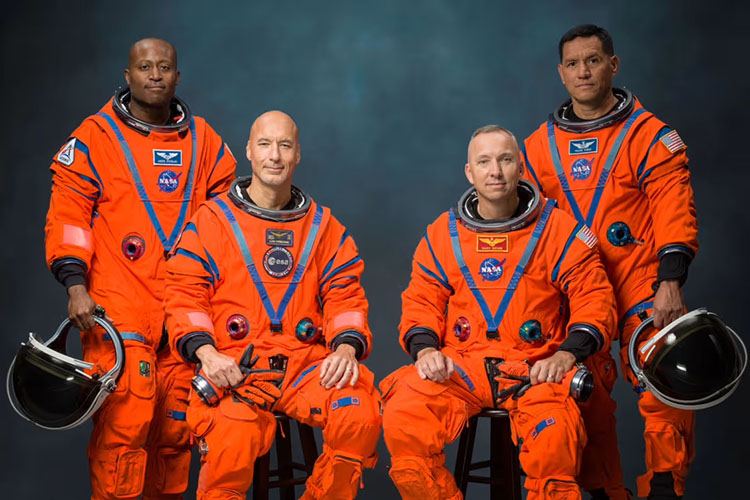
The crew’s orange Orion Crew Survival System suits take center stage. Each astronaut will practice rapid donning, pressurizing the suit, strapping into their seat while suited, and eating and drinking through the helmet port — critical emergency procedures for any loss of cabin pressure.
- Lunar sphere of influence crossing
Later on Day 5, Orion passes the threshold where the Moon’s gravity becomes dominant. No maneuver is required — it is a navigational milestone that marks the start of the lunar approach phase.
- Final lunar target preparation
Last opportunity for the crew to review and rehearse their photography and observation plan before the six-hour flyby window opens tomorrow at 2:45 p.m. EDT.
- Third correction burn (if needed)
A third outbound trajectory correction burn is available but may again be cancelled if navigation performance remains as strong as it has been throughout the mission.
Looking Ahead: On Sunday, April 5, the Artemis II crew will enter the lunar sphere of influence — the point at which the Moon’s gravitational pull becomes stronger than Earth’s. That sets the stage for the mission’s biggest moment: the lunar flyby on Monday, April 6, during which the crew will fly up to 6,000 miles above the surface, lose communication with Earth for 30–50 minutes, and spend approximately six hours photographing and observing the Moon’s far side. Lunar flyby · 2:45 p.m. – 9:40 p.m. EDT.
Even on the Way to the Moon, the Basics Matter: Orion’s Toilet Troubles
For all the excitement of heading back to the Moon, one topic has once again captured public attention: the Orion spacecraft’s toilet.
It may seem like a lighthearted subject, but waste management in space is far from trivial. Crew comfort, hygiene, and health are essential parts of mission success, and in microgravity, something as routine as using the bathroom becomes a serious engineering challenge.
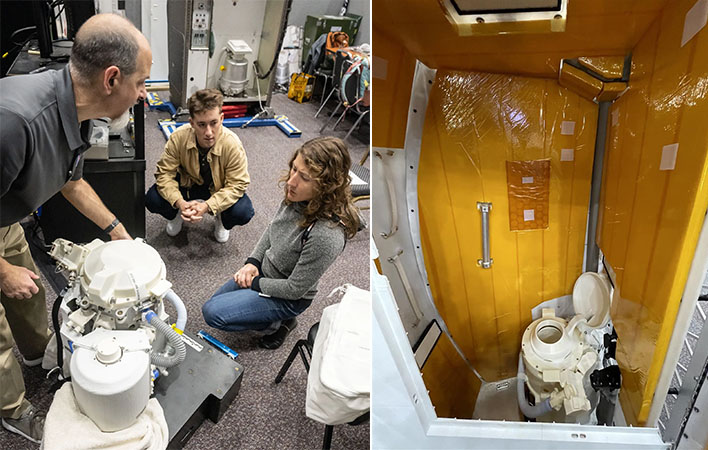
The issue first appeared shortly after launch on Flight Day 1, when the crew noticed a fault light indicating a problem with the waste management system. The initial problem turned out to be related to the pump not being properly primed with water, and after working with Mission Control, Christina Koch helped restore the system.
By Day 4, however, the system became a topic of discussion once again.
Mission controllers reported what appeared to be frozen urine in the vent line, preventing the normal dumping of liquid waste overboard. In the vacuum of space, where temperatures can swing dramatically, even a small amount of trapped liquid can freeze and create a blockage. Ground teams responded by rotating Orion to expose the affected line to sunlight and using onboard heaters to help clear the ice.
At roughly the same time, the crew also reported a burning-heater-like smell coming from the hygiene bay. While understandably concerning, flight controllers later indicated there were no major concerns and believed the odor may have been related to insulation or gasket material near the compartment door rather than any major system failure.
The good news is that the toilet remains operable for solid waste, with backup contingency systems available for liquid waste if needed. That redundancy is exactly why this is a test flight: Artemis II is not only about proving Orion can take astronauts around the Moon, but also about validating every onboard system—including the ones people rarely talk about.
In truth, Orion’s toilet troubles are not unique. Spaceflight history is full of similar stories. The space shuttle and International Space Station both experienced waste management issues over the years, and Apollo crews had to rely on far less sophisticated solutions. In many ways, this is part of a long NASA tradition.
People have always been fascinated by how astronauts go to the bathroom in space, but this episode is a reminder that without Earth’s gravity assist, even the most ordinary tasks become complex engineering problems.
Sometimes the path back to the Moon includes troubleshooting frozen plumbing nearly 200,000 miles from home.