Record-Breaking Mission Helps Pave the Way for Private Citizens in Space
On September 10, the first Polaris Dawn mission departed the Kennedy Space Center for a five-day mission in Earth orbit. The flight is completely private in nature, with billionaire philanthropist Jared Isaacman sponsoring the mission for himself and three other private astronauts aboard a SpaceX Crew Dragon capsule. The crew successfully returned to Earth in the early hours of September 15, splashing down safely in the Gulf of Mexico off the coast of Florida at 3:36 a.m. EDT (0736 GMT). The National Space Society congratulates Isaacman, his crew, and SpaceX for this incredible achievement, one that advances both private spaceflight and civilian access to space.
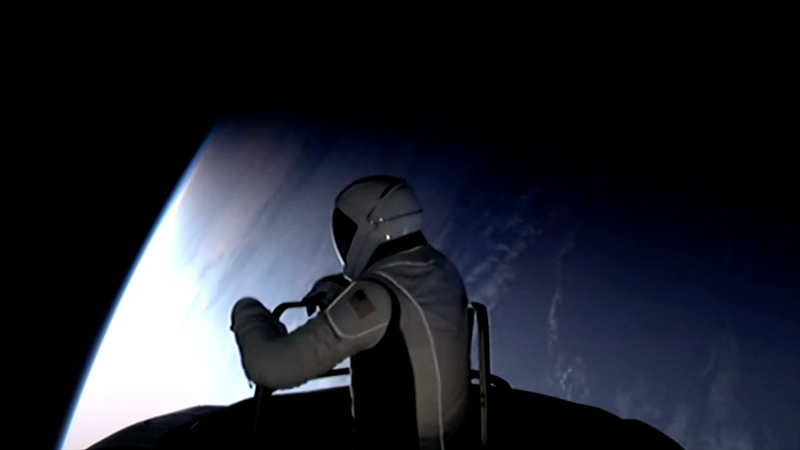
This flight checked off a number of records. At its orbital maximum, 870 miles (1400 km) above Earth, it flew higher than any Earth-orbital flight in history (only the Apollo missions, which left orbit for the Moon, flew higher). It featured the first private “stand-up” spacewalk for two of the crew and was the first time a spacecraft interior was exposed to the vacuum of space since the Skylab 1 mission of the 1970s (the Apollo capsule was exposed to a vacuum as the crew tried to repair the ailing solar panel on Skylab). The flight was Isaacman’s second to focus on philanthropy, with fundraising for St. Jude Hospital an additional focus of the mission. It was also the first test of a new extra vehicular excursion (EVA) space suit designed by SpaceX to withstand the rigors of a vacuum, and the first use of a heads-up display inside a space helmet.
As he stood in the open hatch of the Crew Dragon capsule, looking back at Earth, Isaacman said, “SpaceX, back at home we have a lot of work to do, but from here it looks like a perfect world.”
The other crew members were Scott Poteet, a retired U.S. Air Force lieutenant colonel and business associate of Isaacman’s; and SpaceX engineers Sarah Gillis and Anna Menon. Gillis, who is 30 years old, was the youngest person to ever perform an EVA.
Perhaps most importantly, the mission demonstrated that commercial spaceflight, and flights sponsored by private individuals, can be a meaningful part of the new space age. While this was largely a test flight, a number of research projects were incorporated into the crew’s activities. Some of the more important experiments relate to their extreme altitude, which carried them through the Van Allen Belts, a region of more intense radiation than experienced in lower orbits (for example, the International Space Station orbits below this region at about 240 miles or 386 kilometers). There were, in total, 32 experiments that kept the crew busy. This Polaris Dawn flight is the first of three—Isaacman plans one more in a SpaceX Crew Dragon, and eventually, one in the company’s massive Starship spacecraft.
“The first commercial spacewalk is a signal achievement for private enterprise in space,” said Dale Skran, NSS COO and Senior Vice President. “A spacefaring civilization needs affordable, reliable, and functional spacesuits, and the Polaris Dawn mission made a big step toward this future.”
Notably, while there have been many prior spacewalks, they are still very risky, as is flying at extreme altitude. Any difficulties with the Crew Dragon’s rocket thrusters could have stranded the crew in orbit. While this is true of any spaceflight, the impact of such an emergency in a private space mission would be enormous.
NSS Executive Vice President Hoyt Davidson said, “The Polaris Dawn flight succeeded beyond expectations and has elevated the discussion about the relevance of commercial space, making this approach more plausible and complex missions more achievable. It’s time to reevaluate our approach to spaceflight before budget overruns and schedule slips dim this new horizon.”
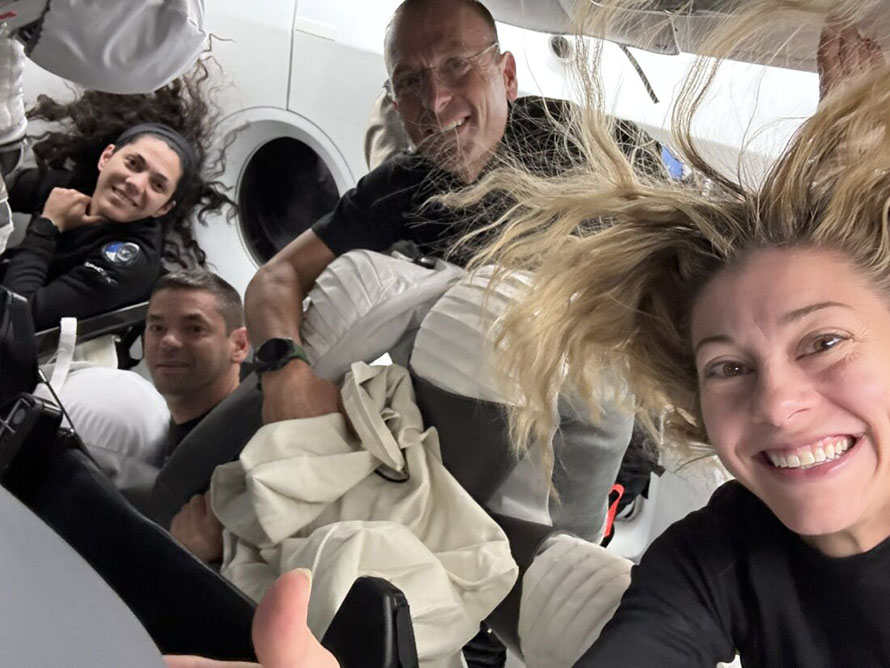
Image: Polaris Dawn crew in space: Sarah Gillis, Jared Isaacman, Scott Poteet, and Anna Menon. Credit: SpaceX.
Top image: Jared Isaacman EVA. Credit: SpaceX.