
By Burt Dicht
NSS Managing Director of Membership
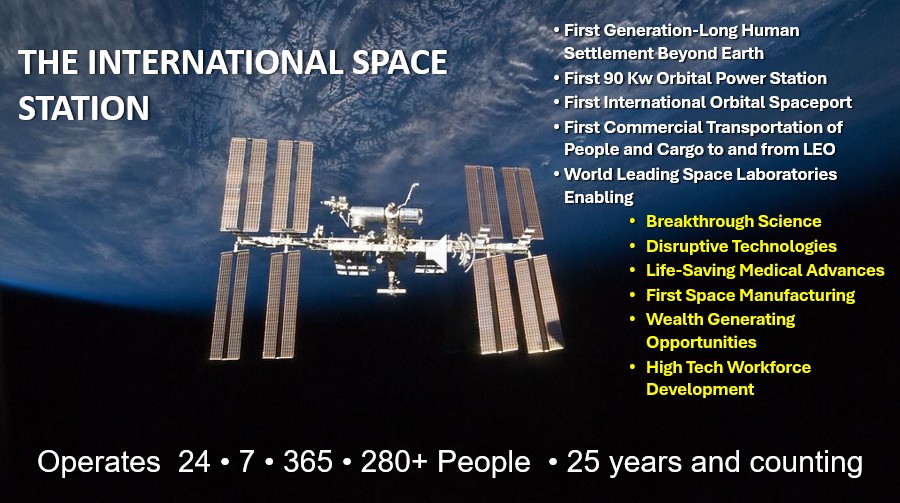
“In Space for Earth” is more than just the title of a presentation. It captures a vision for why we explore, research, and innovate in orbit. The International Space Station (ISS), originally built as a platform for exploration, is increasingly shaping life here on Earth.
 During the September 18 NSS Space Forum, Lynn Harper—a forty-year NASA professional who serves as Strategic Integration Advisor to the ISS National Laboratory and NASA’s InSpace Production Applications (InSPA) program—delivered a powerful account of that impact. Her presentation, “In Space for Earth: Breakthroughs in ISS In-Space Production Applications,” showed how the ISS is evolving into a powerhouse of innovation with tangible benefits across multiple fields.
Harper explained that microgravity enables advances often impossible on Earth, particularly when defects at the atomic and molecular level matter. Recent breakthroughs span biotechnology, medicine, semiconductors, and advanced materials.
Highlights from 2024–2025 include:
- Medical Advances: Space-based manufacturing of artificial retinas is moving toward clinical trials, offering new hope for the visually impaired. Cancer researchers are using microgravity to accelerate drug development, compressing years of disease modeling into weeks. A promising new anti-cancer therapy, Rebecsinib, advanced to FDA clinical trials thanks in part to ISS experiments.
- Pharmaceutical Crystals: More than 80% of over 500 pharmaceutical and industrial crystals produced in space showed improved structure, uniformity, or fewer defects—including crystals for insulin and Keytruda, a leading cancer treatment.
- Advanced Materials: Flawless Photonics demonstrated the first commercial-scale manufacturing of ZBLAN optical fiber in space, producing 11.8 km of superior-quality fiber—surpassing Earth-based records.
- Neurodegenerative Research: Microgravity studies revealed disease-informing changes in organoids and stem cells at an accelerated pace, offering new insights into Alzheimer’s, Parkinson’s, ALS, and multiple sclerosis.
Harper emphasized that these are not isolated experiments but part of a larger transformation in how the U.S. develops industries of the future in low Earth orbit. With contributions from universities, startups, and established companies, the ISS is delivering results with life-saving importance and wealth-generating potential.
Yet for all their promise, these achievements remain largely unknown to the general public. Harper stressed the importance of communication—ensuring that people understand how research in orbit is creating benefits here on Earth. The NSS Space Forum is one way to share this story, and members play a vital role in spreading the word. By amplifying these successes, NSS helps build public support for continued investment in space and inspires the next generation of innovators.
Following her presentation, Harper was joined by NSS member David Cheuvront, a retired NASA engineer who helped design ISS maintenance concepts. Discussion turned to the future, as the ISS faces de-orbiting in 2030. Both Harper and Cheuvront expressed optimism about NASA’s Commercial LEO Destinations (CLD) program, which will rely on commercially developed stations. The ISS will continue its vital research, but with new venues coming online, the scope of in-space applications will only expand.
Harper underscored that this is just the beginning: “I truly do think these technologies and the others from microgravity and space enable U.S. prosperity, leadership, and competitiveness for the future.”
This forum highlighted a powerful message: sometimes it is better, cheaper, and faster to leave Earth. By using space as a laboratory, researchers are accelerating solutions to humanity’s greatest challenges while laying the groundwork for a sustainable commercial space economy.
Author’s Notes:
- A recording of the presentation is available on the NSS YouTube channel: In Space For Earth Recording
- David Cheuvront will expand on his ISS perspectives in a special Space Forum on Nov. 20 titled “Alternatives to Deorbiting the International Space Station (ISS).” More information will be shared soon.






1 thought on “In Space for Earth: Breakthroughs from the ISS”
Thanks for this magnificent forum presentation. Classic examples of space spinoff. -Dr. Sammy