By Burt Dicht
NSS Managing Director of Membership
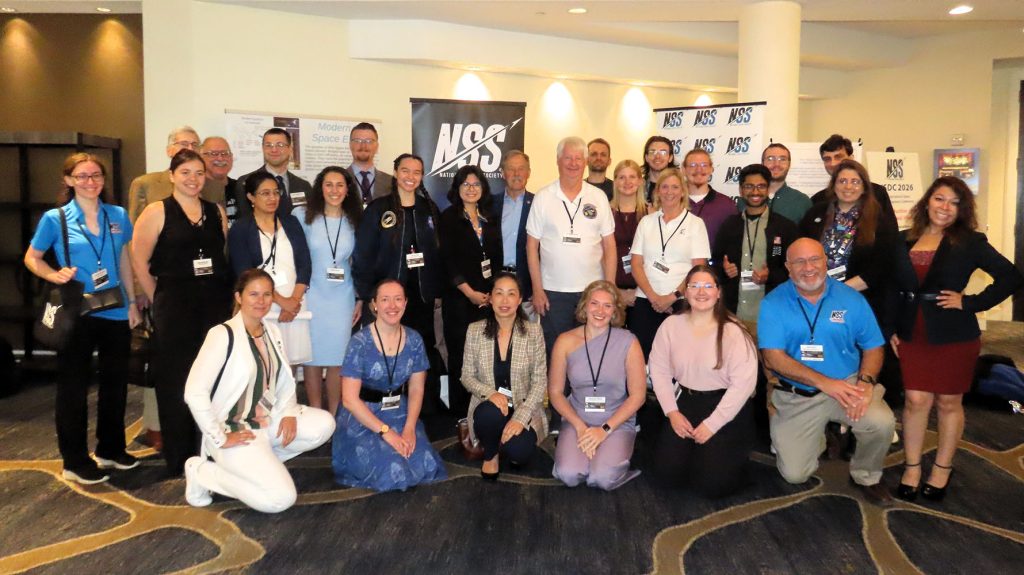
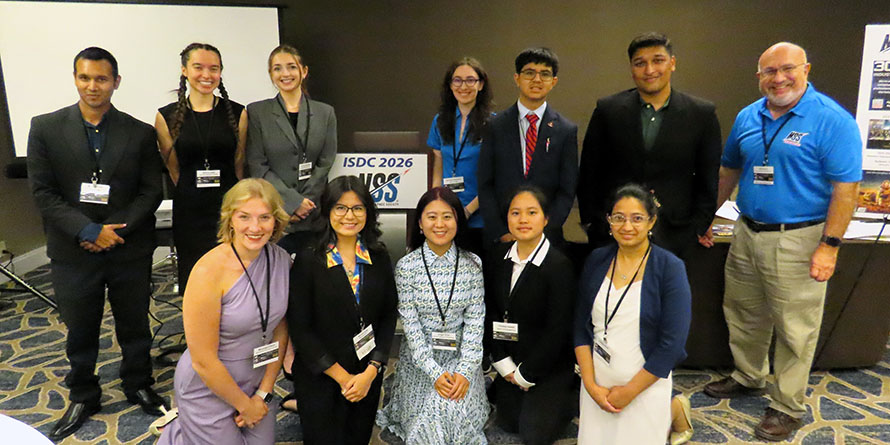
Image: Mentors and participants in the 2026 NSS Speed Mentoring program gather following the session at ISDC 2026. Also pictured are astronauts Hoot Gibson, Steven Hawley, and Susan Kilrain, who attended the conference.
Some of the most meaningful moments at the International Space Development Conference don’t happen on the main stage. They happen in the conversations between students and experienced professionals, in first-time presenters sharing their research, and in the excitement of young people discovering they have a place in the future of space exploration.
At the 2026 International Space Development Conference® (ISDC 2026), held last month in McLean, Virginia, the National Space Society (NSS) continued its commitment to developing the next generation of space leaders through two programs created specifically for university students and early-career professionals: Speed Mentoring and Rising Stars: Collegiate and Early Career Perspectives.
Together, these programs reflect a simple belief: the future of space exploration will be shaped not only by new technologies, but also by the people who create them, operate them, study them, communicate their value, and inspire others to join the journey.
Speed Mentoring: Conversations That Can Change Careers
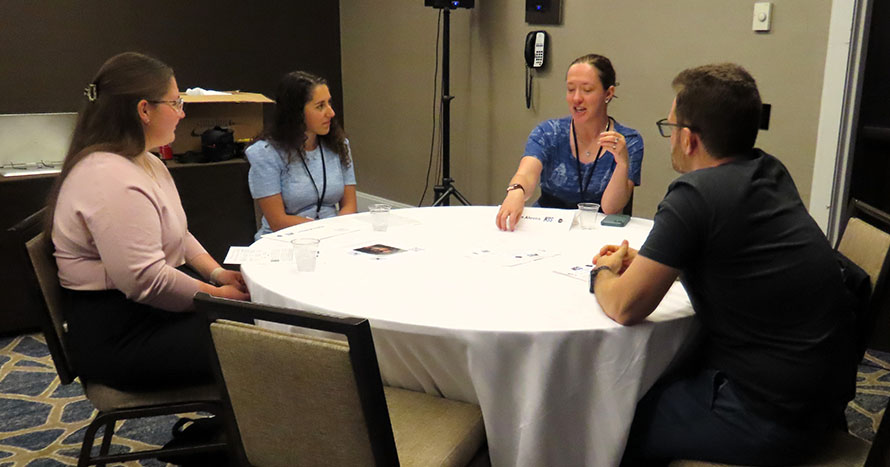
Now in its fourth year, the NSS Speed Mentoring program has become an important opportunity for students and early-career professionals to engage directly with experienced members of the space community. Developed through collaboration between NSS and the Students for the Exploration and Development of Space (SEDS), the program was created to provide something many students struggle to find: candid career advice from professionals who have successfully navigated the transition from the classroom to the workplace.
The format is intentionally personal. The 2026 session featured six mentors and 19 students, maintaining a ratio of approximately one mentor for every three participants. Each mentor began by sharing their own career journey before opening the discussion to questions.
Those conversations quickly turned to the issues that matter most to students beginning their careers:
- How do I get an internship?
- What are employers looking for?
- How do I build a professional network?
- How can I stand out from other candidates?
- What are the best job search strategies?
- How do I balance career growth with life outside of work?
What makes Speed Mentoring especially valuable is its informality. Students receive honest advice from professionals representing different backgrounds, organizations, and career paths while building relationships that often continue long after the conference ends. Perhaps most importantly, they discover there is no single path into the space sector. Engineers, scientists, physicians, attorneys, entrepreneurs, educators, communicators, business professionals, and policymakers all have an important role to play in humanity’s future beyond Earth.
Rising Stars: A Platform for Emerging Talent
While Speed Mentoring helps participants prepare for their careers, Rising Stars gives them an opportunity to showcase what they can already do.
Now in its second year, Rising Stars: Collegiate and Early Career Perspectives provides undergraduate and graduate students, along with professionals in their first five years of employment, an opportunity to present original research, innovative ideas, and emerging technologies in a professional conference setting. The 2026 program was co-chaired by Burt Dicht and Robert Katz.
This year’s session featured 14 presenters from 10 universities and organizations. Their presentations reflected the remarkable diversity of today’s space community, spanning topics including artificial intelligence, astronaut health, lunar exploration, orbital traffic management, communications, space policy, ethics, and law.
Just as importantly, the presenters themselves represented a broad range of disciplines. Building humanity’s future in space will require more than engineers and scientists. It will also require physicians, attorneys, business leaders, educators, policymakers, and communicators working alongside technical experts. Rising Stars celebrates that diversity while giving participants an opportunity to contribute to the broader conversation about humanity’s future in space.
Meet the 2026 Rising Stars Presenters
- Zsófia Bíró (Center for Air and Space Law, University of Mississippi)
- Natalie Byrd (Embry-Riddle Aeronautical University)
- Benjamin Calloway (Photon Orbital Solutions)
- Ginger Chen (Florida Institute of Technology)
- Reef Collins (Mars Institute and University of Central Florida)
- Santiago Gollarza (Wolfpack CubeSat Development Team, BLUECUBE Aerospace)
- Scarlett Hartzman (Mars Institute and Carnegie Mellon University)
- Jessica Mariane Jelke (NASA and The George Washington University
- Mo Tasrif Khan (Embry-Riddle Aeronautical University)
- Rachel Long (Mars Institute and University of California, Davis)
- Margaret O’Brien (Embry-Riddle Aeronautical University)
- Kennady Ruth (Embry-Riddle Aeronautical University)
- Apoorva Somani (United States Air Force Academy)
- Ashling Sugarman (Pepperdine Caruso School of Law)
Voices from Rising Stars
For many participants, Rising Stars became much more than an opportunity to give a presentation. It was a chance to share ideas, receive feedback from experienced professionals, build confidence, and become part of a growing community of future space leaders. Their experiences tell the story best:
“The Rising Stars session is where passion meets opportunity, where curiosity is transformed into contribution and aspiration into impact. It gives emerging researchers, engineers, and explorers the confidence to share their ideas and take the next step toward becoming leaders in the future of space development. — Dr. Ginger Chen, Florida Institute of Technology
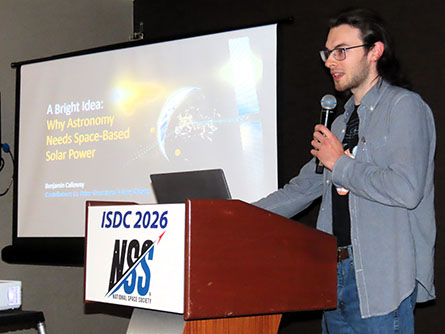
“As a presenter in the 2026 ISDC Rising Stars program, I was honored to speak about recent work I had done and share my passion for space with other young professionals and ISDC attendees. For any student or early-career professional looking to share their ideas, gain presentation experience, and connect with like-minded members of the space community, I would highly recommend participating in a Rising Stars session.” — Benjamin Calloway, Photon Orbital Solutions
“This was my second year presenting at Rising Stars, and I’m incredibly grateful for the opportunity to return. My research was truly a passion project, and being able to share it with industry professionals while receiving their feedback and encouragement was invaluable. Presenting at Rising Stars also opened the door for me to participate in both a LaunchPad session and a BioSpace technical session. It has always been a dream of mine to present my research on a larger stage, and Rising Stars helped make that possible. I will always be thankful for the opportunities, connections, and confidence that Rising Stars has given me.” — Natalie Byrd, Embry-Riddle Aeronautical University
“The Rising Stars program is an excellent opportunity to showcase one’s research in a supportive environment. Participating in Rising Stars increased my confidence speaking before an audience, taught me how to synthesize technical information into an engaging presentation, and connected me with other driven and talented participants. I recommend this program to anyone looking to expand their expertise and professional know-how.” — Ashling Sugarman, Pepperdine Caruso School of Law
“The Rising Stars session allowed me to connect with individuals from all backgrounds in the space field. I truly loved getting to know the other presenters. It was amazing meeting other people in my generation who are making their way into the space industry.” — Scarlett Hartzman, Mars Institute and Carnegie Mellon University
Together, these experiences illustrate what Rising Stars is designed to accomplish. It is more than a technical session. It is an opportunity for students and early-career professionals to develop professionally, build lasting connections, and gain the confidence to become active contributors to the future of space exploration.
Looking Ahead
As the space economy continues to grow, so too does the need for talented people from every discipline. Programs like Speed Mentoring and Rising Stars demonstrate the National Space Society’s commitment to helping students and early-career professionals develop the skills, confidence, and professional networks they need to succeed.
Planning is already underway for ISDC 2027, and NSS encourages students and early-career professionals from every field to consider participating in the next Rising Stars program. Whether your interests are in engineering, science, medicine, law, business, education, communications, or public policy, there is a place for you in the future of space.
The next generation of space professionals is already making its mark. NSS is proud to provide opportunities that help them develop their talents, share their ideas, and build the connections that will shape their careers.