Category: Non-Fiction
Reviewed by: Bart Leahy and Michelle Abendschan
From Ad Astra Fall 2010
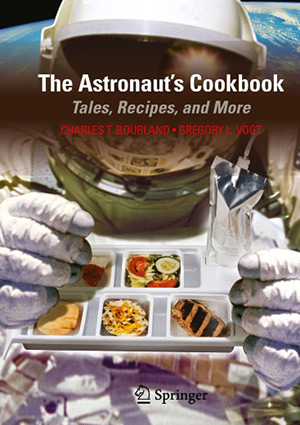
Title: The Astronaut’s Cookbook: Tales, Recipes, and More
Author: Charles T. Bourland and Gregory Vogt
NSS Amazon link for this book
Format: Paperback
Pages: 212
Publisher:
Springer
Date: October 2009
Retail Price: $29.95
ISBN: 1441906231
Wherever human beings travel, we take our food with us. Sampling the local dishes is part of most Earthbound travels. In space, the food preparation and dining environment is often the most adventurous part of the culinary experience, which is the primary lesson one learns from Astronaut’s Cookbook. Even simple items like water, fresh fruit, or cookies must be stored or prepared in ways necessary only in space. The authors write from experience – Charles Bourland is former director of the NASA space food program, and Gregory Vogt is a former NASA education specialist – and partly from firsthand inputs of the astronauts. The result is a unique book that is part an overview of how “space food” is made and part an actual cookbook.
The primary challenge for anyone eating in space is weightlessness. Once it became obvious that astronauts could eat in space without ill effects, the biggest challenges for food preparers on Earth were to make the food packaging take up minimal space and weight, prevent food from getting all over the spacecraft, make it easy to prepare, and most importantly, have it taste good. Space-food packaging faces other challenges, like keeping food fresh for weeks or months at a time, resisting radiation, and staying airtight. Here’s an example: one typical item that we take for granted, salt, must be incorporated into a salad-dressing-like oil so astronauts can apply it directly to the food and reduce the chance of salt getting into sensitive equipment.
Space diners also must consider the effects of microgravity on their bodies. Without the force of gravity, fluids in the human body migrate from the legs and feet to the upper body, making faces puffy. Muscle tone and bone strength also weaken because the body does not need to exert as much effort to support itself as it does on Earth. The body interprets these changes as an excess of blood and increases excretion until a new balance is reached. Bones are weakened through calcium loss, but giving astronauts more calcium can lead to kidney stones.
Yet another problem with eating in space is the change in the sense of taste. Excess fluid in the head causes congestion in the nose, as if suffering from a head cold. Because the sense of smell is impaired, astronauts report that food tastes dull in space compared to Earth. Therefore, astronaut food tends to be spicy and often incorporates hot sauces and other strong flavors.
There are also differences between American and Russian food packaging. The Russians use cans rather than plastic packaging. Without a refrigerator or microwave oven, selections are limited. There is talk of adding a microwave, but they use energy that is precious in space. Overcoming these unresolved challenges is one of the main trials of life on the International Space Station.
Incidentally, this book reminds readers that the infamous “Tang” drink additive was not developed by NASA. It was invented in 1957, and later used on John Glenn’s Freedom 7 mission. Tang masked the aftertaste of the water that came out of the fuel cells, which generated water as a natural byproduct of producing power for the spacecraft.
The Astronaut’s Cookbook has a plastic binding like other cookbooks, which makes it easy to keep open on a particular recipe. The recipes are organized by types: breakfast foods, snacks and appetizers, soups and salads, bread, tortillas, sandwiches, main dishes, vegetables, desserts, and beverages, with an additional section for “future space food.” Along the way, the authors provide anecdotes about NASA’s attempts to perfect these various items from the Mercury missions up through today.
As a writing experiment, I asked Michelle Abendschan, an experimental chef, to write about some of the recipes in The Astronauts’ Cookbook. Michelle had a good time creating Earth-based variations on the recipes (she made vegetarian burgers, tofu brownies – no, really! – and Swedish meatballs). Her write-ups include pictures of the preparation process and can be found at www.tinyurl.com/jemangelaville and www.tinyurl.com/jemangelaville-bugaloo. Bon voyage, and bon appétit!
Bart Leahy is a technical writer and blogger living in Huntsville, Alabama. His blog can be found at www.bartacus.blogspot.com. Michelle Abendschan pays the bills with marketing and in her spare time is an artist, omnivore, and food blogger living in Portland, Oregon.
© 2010 Bart Leahy and Michelle Abendschan
Please use the NSS Amazon Link for all your book and other purchases. It helps NSS and does not cost you a cent! Bookmark this link for ALL your Amazon shopping!