Category: Nonfiction
Reviewed by: Mark Lardas
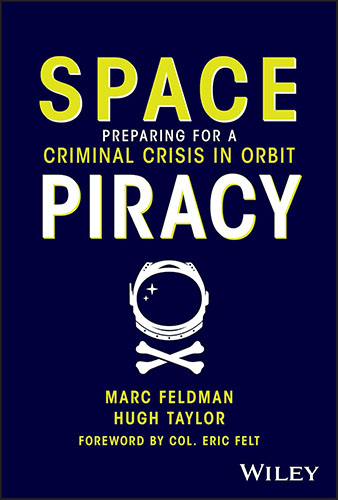
Title: Space Piracy: Preparing for a Criminal Crisis in Orbit
Author: Marc Feldman and Hugh Taylor
Format: Hardcover/Kindle/Audiobook
Pages: 256
Publisher: Wiley
Date: February, 2025
Retail Price: $30.00/$18.00/$13.99
ISBN: 978-1394240203
Find this book
Piracy: the word is evocative. It conjures buried treasure and daring deeds. Even someone as civilized as H. L. Menken succumbed to its lure, writing, “Every normal man must be tempted, at times, to spit on his hands, hoist the black flag, and begin slitting throats.”
At its core, piracy is theft, originally theft at sea with accompanying violence. Today the term includes air piracy and encompasses forms of theft like software piracy. Yet theft remains at the heart of piracy. Wherever men go, crime follows. That implies piracy will migrate to the high frontier. The question is when?
Space Piracy tackles that question. The authors start by possible scenarios for space criminality. Near-term threats include disrupting satellite communications, or hijacking control of a satellite. These generally fall into the category of computer hacking. Ransomware already threatens terrestrial computer systems. Cybercrime in commercial space is a logical extension.
Other scenarios are longer term, including stealing production from an orbital factory or lunar or asteroid mine, or seizing a space tourism flight in orbit and holding those aboard for ransom. These require orbital factories, space tourist destinations and off-Earth mines, but eventually those things will exist. The authors examine their scenarios through the lens of history, showing analogous historical examples.
Space Piracy goes beyond piracy. It discusses all forms of remunerative space-related criminality. The authors show where commercial space offers opportunities for money laundering. Scenarios such as an armed takeover of a commercial spaceport, or interference with satellite data such as navigation signals or tracking information, is criminal and space-related, but is not really piracy. Yet these activities offer potential threats to commercial space.
The book also looks at the legal aspects of space operations. It examines how international and national law affects space activities, including legitimate commercial efforts and criminal actions. The authors offer a framework for space governance, including organizations that nations and international agencies can create to police space.
The authors highlight the extent to which successful historic piracy is state-sponsored. Nations from Elizabethan England to modern Somalia used pirates to enrich their country and attack foes. Once the need for pirates’ services disappears, the pirates disappear. This will likely carry forward in space. Some of the book’s more outré scenarios can succeed only with the backing of a rogue nation. Space piracy, when it appears, will likely be warfare by other means.
We have not yet experienced space piracy because the risk-reward ratio is not yet right. Hijacking a freighter in the Red Sea requires a Zodiac boat and several assault rifles. The payoff far exceeds the investment. Launching a cubesat to jam a broadcast satellite (a scenario presented in the book) remains sufficiently expensive that the ransom received would be too low to make it attractive to pure criminals. State-sponsored piracy may emerge sooner than pure for-profit criminal activity, because for states, profit is less important than disrupting a foe. Crippling a strategic adversary’s commercial space efforts through piracy may be attractive to an unscrupulous nation. It offers plausible deniability, reducing the potential for a retaliatory counterstrike.
The book will interest both casual readers and space professionals. It keeps most discussions on a high level, directing those seeking a deeper understanding of specific topics to where they could find more. Each chapter ends with a one paragraph takeaway summarizing the chapter’s main point.
The book has flaws. It badly needs an acronym table. It also contains minor factual errors in peripheral issues. (One example: Spanish inflation was not the result of piracy. It resulted almost exclusively from New World silver flooding in far faster than the Spanish economy grew. Too much silver was chasing too few goods.) Yet while the authors make petty errors on minor items they get the big picture right. Unchecked space piracy will hobble the development of a space economy and space development.
While many of the authors’ fears of criminal activities are unlikely in the near term, criminals will exploit openings once they appear. This book offers a useful warning. Preparation and preventative action can deter space-based criminality before it develops.
Space Piracy is a very interesting book that should be read by anyone with an interest in commercial space.
© 2025 Mark Lardas