Category: Nonfiction
Reviewed by: Douglas G. Adler
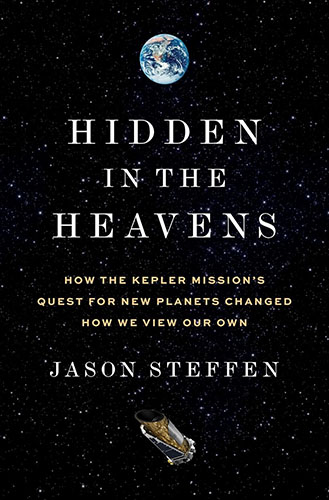
Title: Hidden in the Heavens: How the Kepler Mission’s Quest for New Planets Changed How We View Our Own
Author: Jason Steffen
Format: Hardcover/Kindle
Pages: 272
Publisher: Princeton University Press
Date: October 2024
Retail price: $29.95/$16.17
ISBN: 069124247X
Find this book
It could be argued that the biggest breakthrough in astronomy of the past few decades has been the discovery of planets orbiting stars other than our own, known as exoplanets. Many find the notion of an exoplanet extremely exciting, even intoxicating, as it allows us to know, for a certainty, that there are indeed other worlds out there that we could, at least in theory, visit someday. Ever since the first confirmed discovery of an exoplanet in 1995, orbiting the star 51 Pegasi, scientists have worked tirelessly to invent and refine new techniques to discover more exoplanets, and in this regard they have been wildly successful. As of this writing, there are over 5000 confirmed and catalogued exoplanets.
Many readers may not be aware of the critical role the Kepler Space Telescope played. Designed specifically to hunt for exoplanets, the Kepler Space Telescope mission alone accounts for more than half of all confirmed exoplanets to date.
In, Hidden in the Heavens: How the Kepler Mission’s Quest for New Planets Changed How We View Our Own astronomer Jason Steffen gives readers an exceptionally granular view of the entire mission, managing to pack an incredible amount of information into a relatively slim volume.
After some introductory discussion, Steffen does a deep dive on how the telescope, and its mission were designed. Going beyond a simple technical discussion, Steffen takes readers inside the conferences were scientists gathered to hash out mission priorities, details of the telescope’s design including how it would acquire data, what its resolution would be, and how (and how often) it would transmit that data to Earth, and other details. He gives a bit of insight into the different personalities of the various scientists working on the project, which are very interesting to read.
Extensive text is devoted to exactly how exoplanets can be identified and how the Kepler Space Telescope actually worked (the mission ended in late 2018), as well as to what the mission actually found and how the data was used by, and useful to, astronomers. These passages are some of the most interesting, and most technically dense, of the entire book.
The mission findings, both with regards to exoplanet discovery and stellar astrophysics, are also covered in great detail. The end of the mission, where the spacecraft began to “show its age” and the final legacy of the mission from scientific and historical perspectives, are where Steffen wraps up.
The chapter on the legacy of the mission was one of the most interesting, with discussion of two successor missions: NASA’s Transiting Exoplanet Survey Satellite (TESS) and the European Planetary Transits and Oscillations of Stars (PLATO). TESS has long since been launched and is operational, while PLATO hopes to launch in 2026. These missions are similar to, but distinctly different from, the Kepler Space Telescope and are felt to be complimentary projects designed to further exoplanet science. Steffen could probably write a separate book about each of these missions.
Make no mistake, this is not light reading for the armchair astronomer. The book has a much narrower focus than most space and astronomy themed books marketed to a wide audience. Younger and/or casual readers may not be interested in tales of graduate students working on subprojects using Kepler data to complete their dissertations or vivid descriptions of planning seminars where noted scientists horse-traded to get the mission to conform to their special interests. There was a lot on the line for these researchers who wanted to make important discoveries in an area of astronomy that they cared passionately about.
Overall, Steffen has given interested (and motivated) readers a unique opportunity to learn not just about exoplanets, but how the culture of professional academic astronomers really works in the context of a NASA mission costing over half a billion dollars and spanning many years. Dedicated readers will find Steffen’s book a worthwhile endeavor.
© 2024 Douglas G. Adler