Category: Children’s Book
Reviewed by: Marianne Dyson
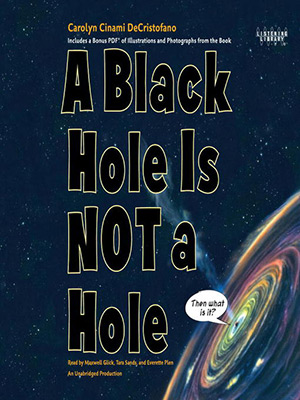
Title: A Black Hole Is Not a Hole
Author: Carolyn Cinami DeCristofano
Illustrator: Michael Carroll
Ages: 10 to Young Adult
NSS Amazon link for this book
Format: Hardcover
Pages: 80
Publisher: Charlesbridge
Date: February, 2012
Retail Price: $18.95
ISBN: 1570917833
Is there anyone alive who isn’t at least a little bit curious about black holes? This excellent book about these mysterious objects explains that black holes are “not the kind you can dig in the ground or poke your finger through.” The book then answers the obvious question, “if a black hole is not a hole, then what in the universe is it?”
The introductory chapter lays the foundation for a detailed answer to this question. First, the issue of distance in space is discussed, so that young readers will be assured that black holes are not a threat to the Earth or solar system.
A black hole is then described by comparing it to something familiar, a whirlpool. The text clearly explains how a whirlpool is the same and also how it is different from a black hole. The illustration by well-known space artist Michael Carroll that accompanies this explanation is partially reproduced on the cover. The full art is stunningly beautiful.
The second chapter focuses on gravity because black holes are “a place in space with a powerful pull.” A creative and effective analogy of snowballs of different densities introduces the idea that as more matter is packed into a ball of a certain size, it weighs more, and that weight is a measure of gravity’s pull. For example, a snowball weighs about as much as a loaf of bread, whereas a black hole of the same size weighs as much as 10 Earths!
Chapter three covers the topic of how black holes form from the collapse of stars. This leads into chapter four’s explanation of how even light takes time to travel from place to place. The limit on the speed of light, and that this is why black holes are black, is a challenge to explain even to adults. The author did a good job without getting too technical, though younger readers may be confused about light being bent by gravity. The fact that gravity does not have to touch something to pull on it, and the concept that light travels in a straight line are not introduced until the upper elementary grades.
The way that scientists “see” black holes even though they are invisible is another tricky concept to explain. Chapter five compares x-rays to footprints that show the direction of black holes. A photo of a gravity lens is also offered as an example of how black holes can be found by their effects. This concept is definitely beyond most elementary and even middle-school readers, but may spark an interest in more advanced reading materials on the subject.
The history of discovery of black holes via their radio “noise” is covered in chapter six with the focus being on where black holes are actually located. Readers will be relieved to know that the closest one to Earth is a comfortable 1,600 light years away in the direction of the constellation Sagittarius.
Chapter seven is sure to be a favorite of young readers because it contains an imaginary close encounter with a black hole and introduces the irresistibly entertaining word “spaghettification.” The images provided for this chapter are simply outstanding, showing how gravity bends normally well-separated light from stars in all directions into a ring as the hapless “spaghettified” (sorry, just had to use that word!) traveler crosses the point of no return.
The final chapter touches on the basic concept of gravity as a shape, per Einstein’s General Theory of Relativity. Although young readers should easily grasp the idea of mass making “dimples” and depressions in the “fabric” of space, elementary students may find this concept at odds with gravity as a directional force that always pulls things downward. Teachers and parents might try swirling marbles in a large funnel to show how the planets avoid falling into the sun as long as they move quickly in their orbits.
The back matter of the book includes an extensive historical timeline, a glossary, and an author’s note about how the reader can know that the information in the book is correct. The author lists numerous primary sources, books by experts, and trustworthy websites.
One additional method of knowing the information in a space-related book is correct is to read a book review by a physicist! I’m happy to report that I didn’t find any technical errors in this book.
However, as the author points out, new information about black holes is being discovered all the time. So they can be forgiven for not mentioning one recently confirmed new type of supernova of super-massive stars that doesn’t produce a black hole as expected. Students who have read this book will have the background to understand and appreciate the excitement of these new discoveries, and maybe go on to make some of their own.
© 2012 Marianne Dyson
Please use the NSS Amazon Link for all your book and other purchases. It helps NSS and does not cost you a cent! Bookmark this link for ALL your Amazon shopping!