
By Burt Dicht
NSS Space Coast Correspondent
Today’s successful launch of the Nancy Grace Roman Space Telescope will help answer two key questions: How does the universe work? Are we alone?
These are two questions we have pondered since we first looked toward the night sky. And now, a new instrument promises to change not just what we know, but how fast we can learn it.
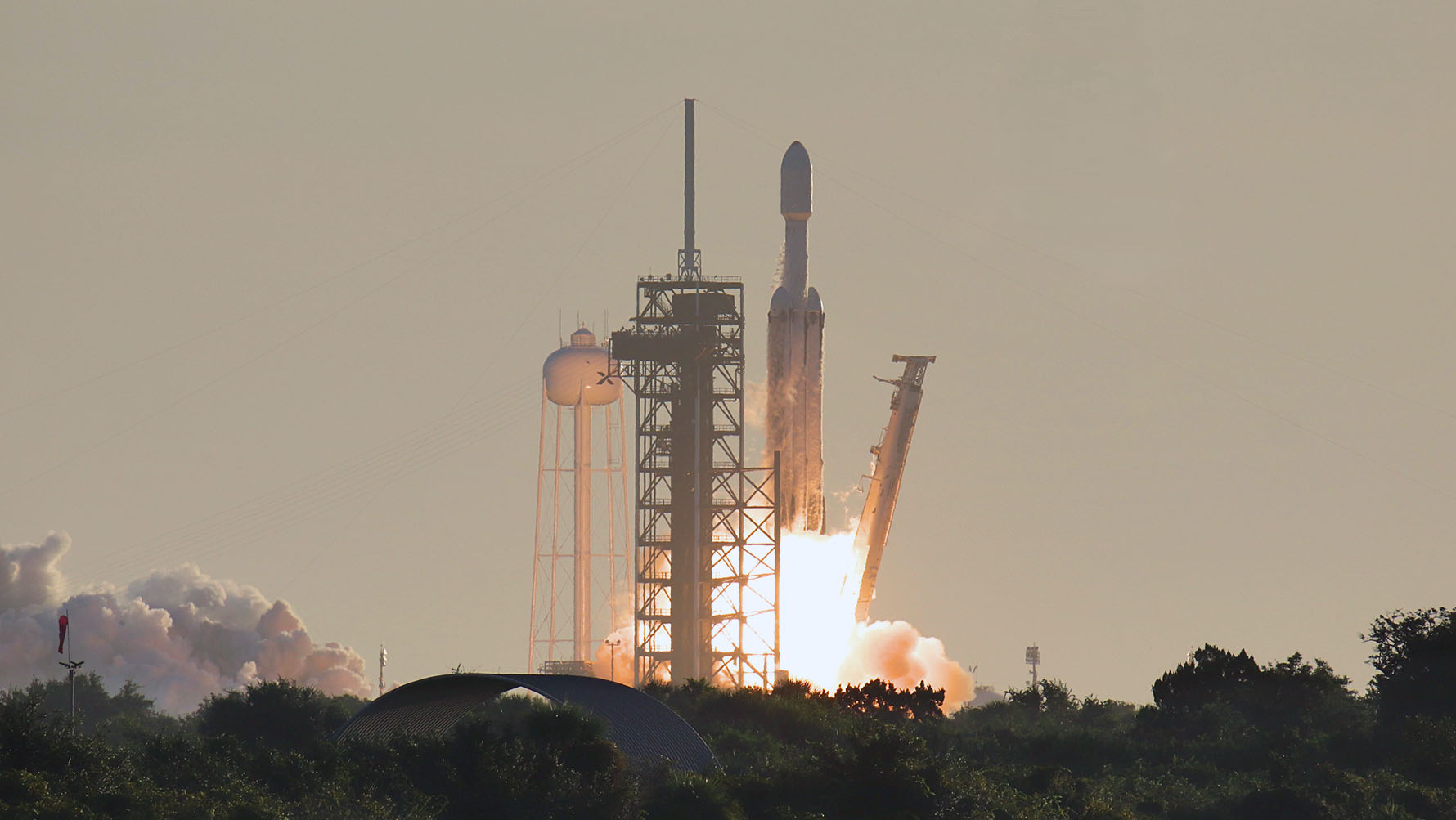
NASA’s Nancy Grace Roman Space Telescope launched today from Kennedy Space Center at 7:26 a.m. EDT aboard a Falcon Heavy rocket from Launch Complex 39A. Roman is NASA’s newest flagship astrophysics observatory. Its name, its design and its mission all trace back to a story worth telling.
I recently sat down with Dr. Nicky Fox, head of NASA’s Science Mission Directorate, to talk about what Roman is actually built to do. Our conversation ranged from dark matter and dark energy to distant worlds beyond our solar system. What became clear is that Roman’s extraordinary capabilities are aimed at some of the most fundamental mysteries in science.
What Is the Nancy Grace Roman Space Telescope?
Roman is designed to survey the cosmos in infrared light with a field of view at least 100 times larger than Hubble’s, while providing similar sharpness and resolution. That combination is the key to understanding why Roman matters.
Hubble and the James Webb Space Telescope excel at studying individual objects in extraordinary detail. Roman is built for breadth. It is a survey machine, designed to capture enormous swaths of the sky and repeat that process over and over during its five-year primary mission. Roman also carries enough fuel to potentially operate for a decade.
The scale of that difference is hard to overstate. Roman’s Wide Field Instrument uses an array of detectors to produce roughly 300-megapixel images, each covering a patch of sky larger than the full Moon. A single Roman image can contain the equivalent detail of about 100 Hubble images.
Multiply that capability across years of observations and Roman will downlink approximately 1.4 terabytes of raw science data every day — the highest data volume of any NASA astrophysics mission to date. Its processed data is expected to total about 20 petabytes during its five-year primary mission. That data will be processed and made publicly available, turning Roman into a resource not only for the scientists who designed its core surveys, but for researchers around the world.
Roman will operate in an orbit around the second Sun-Earth Lagrange point (SE-L2) about one million miles from Earth, the same general region where Webb operates. That location provides the stable environment needed for the precise observations Roman will make.
Roman represents a new generation of space observatories, but its name reaches back to the beginnings of NASA’s space astronomy program.
Who Was Nancy Grace Roman?
Every NASA flagship mission carries a name, and few carry one as fitting as this one.
Dr. Nancy Grace Roman was an American astronomer born in Nashville, Tennessee, in 1925. She earned her doctorate in astronomy from the University of Chicago in 1949, at a time when women faced significant barriers to careers in physics and astronomy.
She joined NASA in 1959, just months after the agency’s founding, and in 1961 became NASA’s first Chief of Astronomy and the first woman to hold an executive position at the agency.
In the 1960s, Roman helped bring astronomers and engineers together to develop the concept of a large space-based telescope. She then spent years building the scientific and institutional support needed to make it a reality.

That telescope eventually became the Hubble Space Telescope, and Roman’s role in bringing it to life earned her the nickname “Mother of Hubble.”
She retired from NASA in 1979 and passed away in December 2018 at the age of 93. In May 2020, NASA renamed its next flagship astrophysics observatory, then known as Wide Field Infrared Survey Telescope (WFIRST), in her honor.
It was a fitting continuation of her legacy. The woman who helped make one of history’s great space telescopes possible now has her name on an observatory designed to take the next step.
Question One: How Does the Universe Actually Work?
When I asked Dr. Fox what Roman was built to discover, she framed the first half of its mission as an effort to understand the invisible architecture of the universe itself.
Look out into space, she explained, and it appears mostly empty. But that emptiness is deceiving. Vast amounts of matter exist that we cannot see directly. We know it is there because of its gravitational effects, including the way it bends the light of objects behind it.
Astronomers call this dark matter, the unseen scaffolding that helps hold galaxies and galaxy clusters together.
Then there is an even stranger mystery: dark energy.
Where dark matter helps pull things together, dark energy appears to be driving the accelerating expansion of the universe. Scientists know the expansion is accelerating, but they still do not fully understand why.
Roman will help investigate that mystery by mapping the distribution of galaxies and dark matter, observing distant supernovae and measuring patterns in the large-scale structure of the universe. Together, those observations will allow scientists to trace how the universe has expanded over billions of years.
Fox described the goal as developing a kind of cosmic “fudge factor” — measurements precise enough to help determine whether dark energy is constant or whether its influence has changed over the history of the universe.
The answer could fundamentally alter our understanding of how the universe works and perhaps even its ultimate fate.
Question Two: Are We Alone?
The second question takes Roman from the largest structures in the universe to individual planets orbiting distant stars.
When Hubble launched in 1990, astronomers had not yet confirmed planets orbiting Sun-like stars. Today, we know of thousands of exoplanets, and the question is no longer whether other planetary systems exist, but how common they are and what kinds of worlds are out there.
Roman will attack that question in several ways.
Its Coronagraph Instrument is designed to utilize advanced technologies for blocking the overwhelming glare of a star so that much fainter objects nearby can be observed.
Fox compared the process to developing a custom “prescription” for each star Roman observes. The challenge is contrast. A planet can be billions of times fainter than its host star, making it extraordinarily difficult to see.
The coronagraph is primarily a technology demonstration, but what engineers learn from it could help pave the way for future observatories capable of directly studying Earth-like planets and perhaps one day searching their atmospheres for evidence of life.
Roman will also conduct one of the most ambitious exoplanet censuses ever attempted. Using gravitational microlensing, it will monitor hundreds of millions of stars toward the center of the Milky Way.
That survey is expected to discover more than 1,000 planets, including worlds at distances from their stars that have been difficult for other planet-hunting methods to detect. Roman may even find free-floating planets wandering through the galaxy without a host star.
Roman will also search the same enormous dataset for transits, the slight dimming of a star as a planet passes in front of it. Combined with microlensing and direct imaging, NASA estimates Roman could uncover around 100,000 new exoplanets, dramatically expanding our understanding of the planetary systems that populate our galaxy.

A Speed Advantage That Is Hard to Grasp
What makes these very different science goals possible within a single mission is Roman’s extraordinary surveying speed. NASA has illustrated the difference with a striking comparison. In one simulated deep-field survey, Hubble would need approximately 85 years to map a region of sky to the same depth and detail Roman could achieve in just 63 days.
That is not a typo.
A survey that could consume nearly a human lifetime of Hubble observing time could be completed by Roman in about two months.
The reason comes down largely to field of view. Hubble was designed to examine a relatively small patch of sky at a time in extraordinary detail. Roman combines comparable sharpness with a field of view at least 100 times larger.
Multiply that advantage across surveys involving millions or billions of galaxies and hundreds of millions of stars, and the time savings become enormous.
That speed is not simply a convenience. It is what makes Roman’s science possible. Mapping dark matter and investigating dark energy require observations across huge areas of the sky. Finding exoplanets through microlensing requires continuously monitoring vast fields of stars. Roman’s wide-field view turns investigations that might otherwise take generations into projects that can be completed within a single mission.
A Community Telescope
One phrase Fox used during our conversation stayed with me. She called Roman a “community telescope.”
Scientists and researchers from around the world have helped shape Roman’s observing program, but its value will extend far beyond the investigations planned before launch. Roman will produce an enormous public archive of observations that scientists will be able to examine for years to come.
And Roman’s observing program can respond to what scientists discover. That may be one of the most exciting aspects of the mission. We know what Roman was built to investigate. What we do not know is what it will find that nobody anticipated.
I mentioned to Fox that our knowledge of the universe is constantly expanding, but Roman could have the ability to rewrite some of that knowledge almost daily. She agreed that its potential is enormous.
History suggests that the greatest observatories often become famous not only for the discoveries they were designed to make, but for discoveries no one expected when they were launched. Roman may be no different.
The Journey Begins
Roman is now beginning its roughly one-million-mile journey to SE-L2.
At the post-launch press conference, NASA Administrator Jared Isaacman reported that Falcon Heavy had placed Roman where it needed to be, its solar arrays had deployed and the spacecraft was communicating with the ground team at NASA’s Goddard Space Flight Center.

The trip to SE-L2 will take about 90 days, but the spacecraft will be busy throughout the journey. Engineers will turn on and check its systems and instruments as Roman gradually configures itself for operations. Science commissioning will follow, preparing the telescope for the observations that will define its mission. Its first images are expected at the end of the year or the opening months of 2027.
Roman will not replace Hubble or Webb. Instead, the three observatories will complement one another. Roman can survey enormous areas of sky and identify interesting objects and phenomena. Hubble, Webb and other observatories can then take a closer look.
Roman becomes, in effect, a wide-field scout for the universe.
A Legacy Beyond the Science
There is another part of the Roman story that should not be overlooked.
Projects of this scale are extraordinarily difficult. They require years of work, billions of dollars in public investment and the efforts of thousands of engineers, scientists, technicians and support personnel.
Roman launched nine months ahead of its original schedule, an accomplishment that deserves attention in an era when major government programs are often associated with delays and cost growth.
At the post-launch press conference, Roman Project Manager Jackie Townsend of NASA Goddard described launch as an endpoint of sorts for the engineers and technicians who designed, developed, assembled and tested the observatory. She and Isaacman both praised the team that brought Roman to the launch pad.
I asked Townsend what lessons from Roman could be carried into future programs. She said the team is already capturing those lessons, not simply as technical reports but as stories that can help shape future projects. Many members of the Roman team have already moved on to new assignments, taking what they learned with them.
That may be another important part of Roman’s legacy. Nancy Grace Roman helped establish the foundation for a generation of space telescopes. Decades later, the people who built the observatory carrying her name are taking their own experience to the missions that will follow.
Two Questions
Roman is now on its way to SE-L2, but its real journey is just beginning. In the coming months, the telescope will be commissioned, its instruments checked and calibrated, and then its enormous window on the universe will open.

What happens after that is much harder to predict. But that unknown is what makes this so exciting,
We know the questions we want Roman to help answer. We want to better understand dark matter and dark energy and how the universe has evolved. We want to know how common planetary systems are and what kinds of worlds exist beyond our own.
But history tells us that our greatest observatories often make discoveries their designers never anticipated.
Nancy Grace Roman spent much of her career making the case that putting powerful telescopes above Earth’s atmosphere could transform astronomy. The telescope that now carries her name takes that vision to another level — seeing more of the universe, gathering data at an extraordinary pace and making that information available to researchers around the world.
We have been asking these two questions for generations: How does the universe work? And are we alone?
Roman may not give us the final answers. In fact, it will almost certainly raise new questions we have not yet thought to ask. But beginning today, we have a remarkable new tool to expand our understanding of the universe and perhaps our place within it.