Category: Nonfiction
Reviewed by: Peter Spasov
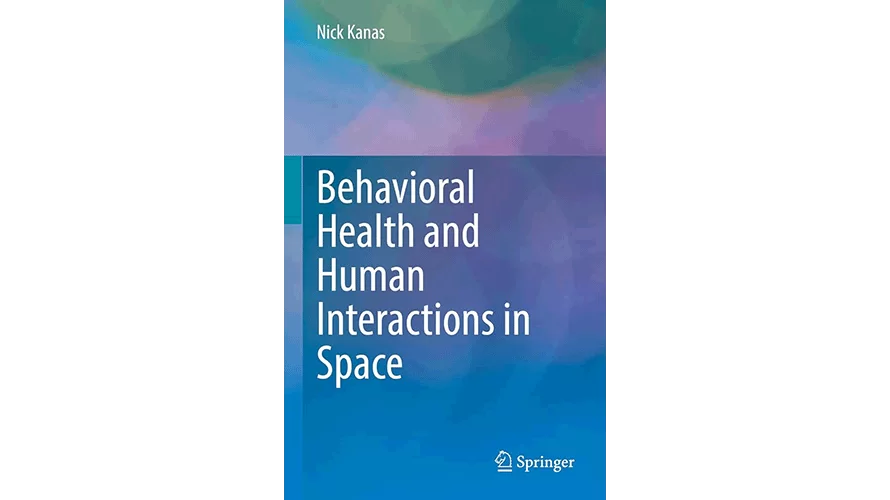
Title: Behavioral Health and Human Interactions in Space
Author: Nick Kanas, M.D.
Format: Hardcover/Kindle
Pages: 447
Publisher: Springer
Date: February 2023
Retail Price: $89.99/$89.99
ISBN: 978-3031167225
Find this book
Spacecraft are confined environments where crew are isolated from family, and outlets for unwinding are limited. With experience in crewed space missions, we have learned much and yet, we have no experience with venturing far beyond, where Earth is barely visible and the time delay of radio communications extends to minutes and beyond. Nevertheless, there is an extensive collection of knowledge regarding human behavior for these scenarios based on analog studies and the records of near-Earth missions. Although psychological challenges abound, they appear solvable. And now, with Behavioral Health and Human Interactions in Space by Nick Kanas, M.D., we have another extensive knowledge base.
With over fifty years of experience in the field of psychological stress, the author has collaborated with NASA, ESA and others, having earned several awards. His textbook catalogues discoveries gained from analogs such as submarine crews and Antarctic research bases, plus simulations of space expeditions such as Mars 500 or of living in off world simulations such as Biosphere 2. Additionally he reports findings collected from actual space missions run by NASA, ESA, the Soviets, Roscosmos and the Chinese space program.
Personal stressors include radiation, microgravity, illness, monotony, isolation, and the Earth-out-of-view phenomena. Social stressors involve group tension, sexual urges, cultural differences and time delay of radio communications. The lack of a regular 24-hour day can impact alertness and mental sharpness. Astronauts have experienced insomnia and ‘space fog,’ when mental performance is compromised. Some remedies are exercise, regulated workloads and more autonomy. Staggered schedules may better suit long-term voyages.
Generally, astronauts adjust to the space environment within weeks. Most report space missions as a positive, especially when viewing Earth as a large globe. Due to the famed overview effect, some experienced a form of spiritual enhancement. However, to avoid and minimize psychiatric problems, future crew may include those trained in psychotherapy in addition to remote support with experts on Earth.
Major factors for crew harmony remain the ability to work without emotional problems and to interact socially with crewmates during both work and leisure. Astronaut selection currently tends to rely on various psychological tests; however these do not necessarily preclude issues from occurring during actual missions. Generally a shared enthusiasm for space travel contributes to harmony, whereas spacecraft ambient noise and space sickness tend to hinder relationships. Reports indicate that often a primary concern was the support provided to families back on Earth.
Cultural awareness for international crews can become problematic. Kanas noting that Russians were generally being more cultural aware than Americans, with the author offering some speculations as to why this is so. He also conjectures that in time, we may evolve a more universal space language to transcend a nation’s language. Prospective crew should undertake more training related to multiculturalism, coping with confined environments, group dynamics and organizational norms. Astronauts tend to use problem-oriented approaches over emotion-based, with social support and humor being recognized as useful coping strategies. Yet, despite the challenges for crewed missions, Kanas remains a strong advocate for becoming a space-faring society.
Concerning communications involving significant time delays, Kanas describes a strategy developed by researchers called Braiding, whereby communications is structured into topics (the braids) to assist astronauts with following a conversation, the technique having been simulated for collaborating on operational tasks with a round-trip delay exceeding seven minutes.
The author even mines science fiction for data. For instance, he highlights lessons derived about life in a lunar colony using Robert A. Heinlein’s The Moon Is a Harsh Mistress. Similarly, for colonizing Mars, he analyzes Kim Stanley Robinson’s Red Mars for potential psychological advice.
The book contains ten chapters, with most ending with a summary of key points and a problem section with scenarios for the readers to mull over. Each chapter also includes an extensive list of references. Kanas reviews studies using a rigorous methodology, most of which are published in peer-reviewed journals. Personal experiences of some astronauts are included. The book includes seventy nine illustrations, some tables, a Glossary and Acronyms section, and an Index. Many chapters also include an archives section of an early NASA technical memorandum he co-authored of early studies from the 1950s and 1960s, hence extending the scope of supporting material back in time. Quotations and conclusions link the memorandum to the more current findings described in the book.
The challenge remains: how to best work and live in space. Hence long-duration crewed space missions may require further solutions to psychiatric and sociological problems. As we gain more experience with space missions, we’ll be better able to support human interactions. But until then, this textbook delivers a solid foundation for understanding human behavior in outer space.
© 2023 Peter Spasov