Category: Nonfiction
Reviewed by: Susan Raizer
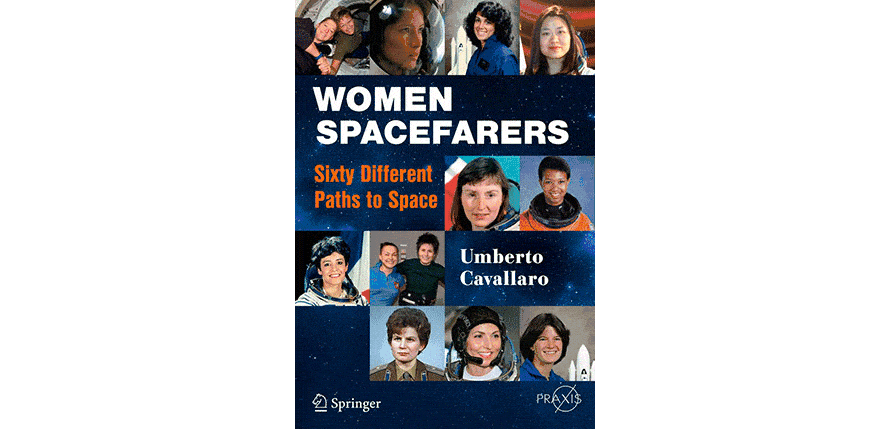
Title: Women Spacefarers: Sixty Different Paths to Space
Author: Umberto Cavallaro
NSS Amazon link for this book
Format: Paperback
Pages: 403
Publisher: Springer/Praxis
Date: March 2017
Retail Price: $24.95
ISBN: 978-3319340470
In Women Spacefarers: Sixty Different Paths to Space, author Umberto Cavallaro has included biographies of sixty women from many of the countries active in space exploration and human spaceflight. What is unique about the book is the author’s choice of his subjects. Most of the women highlighted in the book had the ‘space bug’ as youngsters or teenagers but felt that there were too many obstacles, including gender issues, for them to actively pursue their dreams. Many took different paths, including the sciences, engineering or military service, as a stepping stone to realizing their dreams.
Umberto Cavallaro, is the editor of the Italian Astrophilately Society’s quarterly journal, AD*ASTRA (not the same as that of NSS!). He has worked with the European Space Agency, is the author of several books about space exploration, and has translated Walter Cunningham’s “All-American Boys” into Italian. The author also included several appendices listing the missions the women flew on, those who performed EVAs and those in the military, as well as a bibliography, postcards or other memorabilia from their mission and a list of which of the women were married to other astronauts.
The author chose to report on women in space because of the disparate percentage of women vs. men who became astronauts, cosmonauts and taikonauts in the early days of space exploration. The preface of the book discusses the social and political challenges of the early space age in which women, whether or not qualified (such as the experienced aviators known as the Mercury-13) were deemed unsuitable for space flight. The author cites Simonetta Di Pippo, the Director of the United Nations Office for Outer Space Affairs, who states that at the time of the publishing of the book, women accounted for 11% of total space farers equating to 60 women from a total of 550 people (book’s reference) who flew in space. NASA stated that 59 women flew in space as of July, 2017.
Each short chapter is devoted to one woman, although in the case of American shuttle and ISS astronauts, the same information is repeated in different chapters when various women occupied the same missions. The format is identical for each woman. Each chapter has a photograph of the subject and begins with the women’s early life and discusses their early flirtations with space. Many of the women eschewed a space career path because of perceived obstacles in their way. Each chapter discusses their first thoughts about space flight as a viable option, gleaned from personal interviews with the subject or through third party accounts and archival material. The chapter describes their education, home life, some little known facts about them, their eventual entry into a space related job and finally what they were pursuing at the time of the book’s publication. For those women who have passed away, it discusses how and when they passed, paying homage to the women lost on Challenger and Columbia.
The book begins with the biography of USSR cosmonaut Valentina Tereshkova, who in 1963 was the first woman to fly in space and who had to endure gender bias from her male counterparts. The second woman to fly in space, Svetlana Savitskaya (also a Soviet cosmonaut) was the first woman to perform a space-walk. She had the distinction of having an apron designed for her mission!
The next chapter was devoted to Sally Ride, who became the first American female astronaut in 1983. The remaining chapters discuss primarily American female astronauts and their first achievements, including: the first teacher, first mother to fly in space, first long duration space farer (Shannon Lucid), first female doctor or scientist, first commander of a shuttle and the space station and the first female astronaut to be dismissed from the space program (Lisa Nowak). Other female astronauts came from United States partner countries, including those from Canada, Japan, the European Space Agency, England, Iran, China and Russia. Some of the ‘firsts’ were because of prior military service (such as Susan Helms, who was a three star General), or because of musical talents or academic excellence.
Since we live in an internet age, most of the information in the book is readily available on the NASA website and various other search engines. National Space Society members may find the book interesting as a reference guide, especially for young women interested in pursing careers in space.
© 2017 Susan Raizer
Please use the NSS Amazon Link for all your book and other purchases. It helps NSS and does not cost you a cent! Bookmark this link for ALL your Amazon shopping!