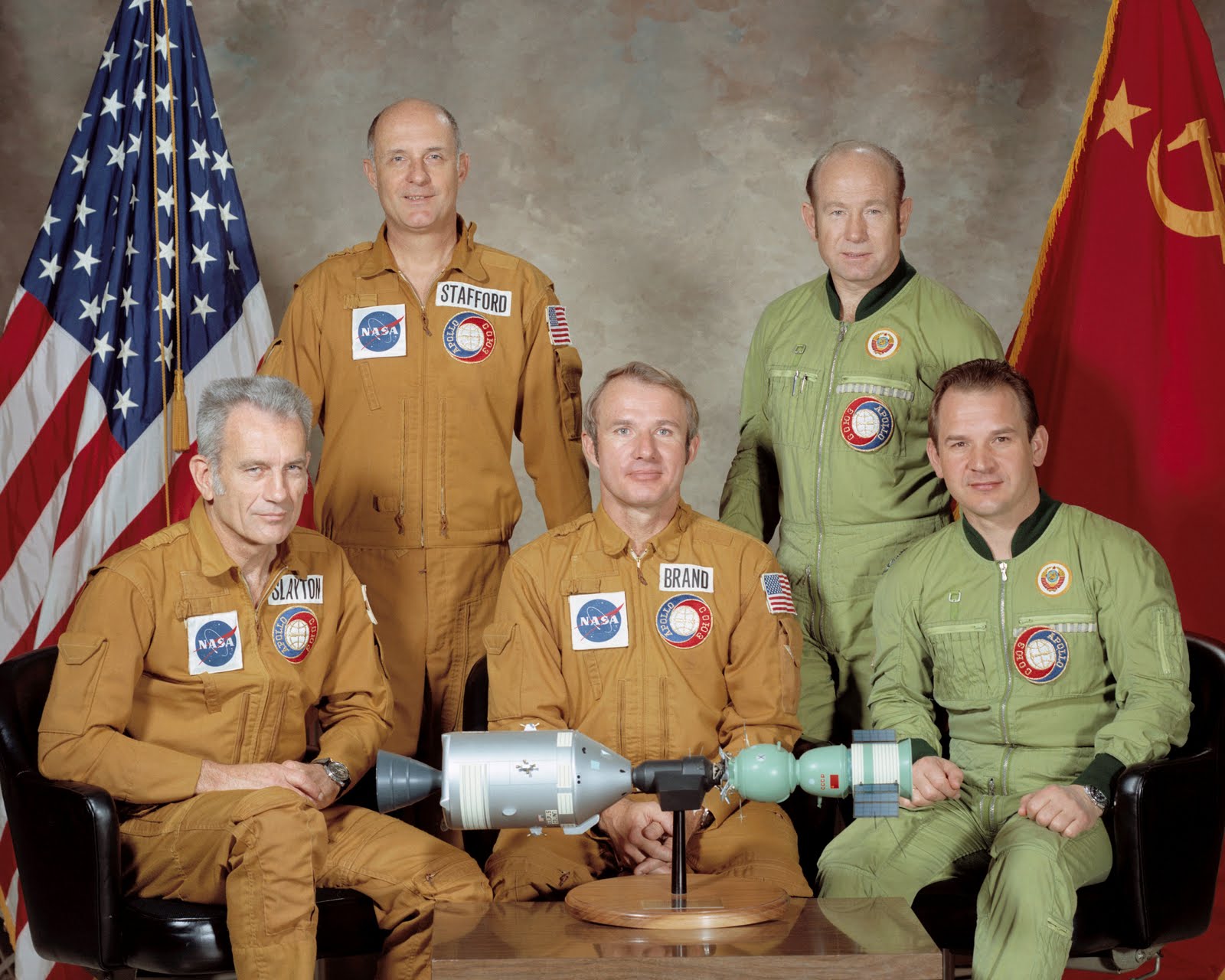
Apollo-Soyuz Test Project crews. From left, Apollo’s crew consisted of Donald “Deke” Slayton (a Mercury 7 astronaut), Thomas P. Stafford, and Vance Brand. Soyuz’s crew consisted of Alexei Leonov (a veteran cosmonaut) and Valeri Kubasov. 1975 NASA photo.
- The then-Soviet Union was responsible for sending the first unmanned mission (Sputnik-1, or “Satellite-1”) and the first orbital manned mission (Vostok-1, or “East-1”) into space. The USSR kicked off the “space race” on both sides of the world.
- The USSR sent up the first space station well before Skylab was launched. Salyut-1 was launched into space in 1971. Salyut missions continued well into the 1970s. The Mir space station, launched in 1986, housed several U.S. shuttle astronauts until its decommission in 2001.
- The Apollo-Soyuz Test Project mission was the first collaborative docking between crews from different nations. It set the precedent for future projects between the U.S. and Russia, such as the current International Space Station. Also, astronaut Thomas Stafford and cosmonaut Alexei Leonov remain close friends.
- Alexei Leonov also was the first human ever to complete an extravehicular activity, otherwise known as a spacewalk, in 1965.
- The USSR sent the first woman in space in 1963. Valentina Tereshkova was launched into orbit on Vostok-6; she also was the first civilian (non-military) person to fly in space. The U.S. did not send women into space until 1983.
- The Soyuz program has had a 97% success rate over nearly 45 years. This is pretty amazing in itself given the obvious risks of putting humans and unmanned spacecraft into space.
Emily Carney is a writer, space enthusiast, and creator of the This Space Available space blog, published since 2010. In January 2019, Emily’s This Space Available blog was incorporated into the National Space Society’s blog. The content of Emily’s blog can be accessed via the This Space Available blog category.
Note: The views expressed in This Space Available are those of the author and should not be considered as representing the positions or views of the National Space Society.