The NASA Kepler and K2 Team is the winner of the National Space Society’s 2017 Space Pioneer Award in the Science and Engineering category. This prestigious award will be presented to team representatives Charles K.Sobeck, Project Manager, and Dr. Natalie Batalha, Project Scientist, on Sunday, May 28, 2017 at the National Space Society’s 2017 International Space Development Conference® (isdc2017.nss.org). This will be the 36th ISDC® and will be held in St Louis, Missouri, at the Union Station Hotel. The conference will run from May 25-29, 2017.
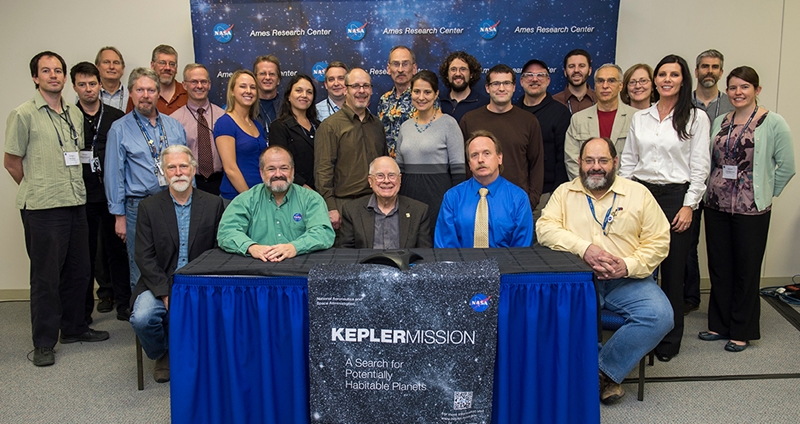
NSS proudly presents this award in recognition of the massive amount of work carried out by the whole team to propose, design, launch and operate the Kepler and K2 missions and to analyze the resulting data over many years. It also recognizes all of the many volunteers who have been poring over the Kepler data to assist in finding planets around other stars.
About the Space Pioneer Award
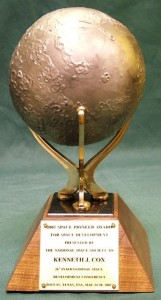 The Space Pioneer Award consists of a silvery pewter Moon globe cast by the Baker Art Foundry in Placerville, California, from a sculpture originally created by Don Davis, the well-known space and astronomical artist. The globe, as shown at right, which represents multiple space mission destinations and goals, sits freely on a brass support with a wooden base and brass plaque, which are created by the greatly respected Michael Hall’s Studio Foundry of Driftwood, TX. NSS has several different categories under which the award is presented each year, starting in 1988. Some of the recent winners of Space Pioneer Awards include Elon Musk, Ray Bradbury, Robert Bigelow, Apollo Astronaut Russell L. Schweickart, Dr. Michael Griffin, and the Rosetta Mission Team.
After no less than five mission proposals, starting in 1992, the Kepler mission was finally approved in December of 2001 as a Discovery Class mission. Launched on March 7, 2009, the Kepler spacecraft has returned an enormous database, recording the brightness variations of more than 160,000 stars and galaxies. In addition to the primary objective of detecting and characterizing the distribution of terrestrial-size exoplanets, the mission has revolutionized the field of asteroseismology – the study of stars through their intrinsic brightness variability – ushering in a new golden age of stellar astrophysics.
As of January, 2017, Kepler and the follow-on mission K2 have confirmed 2514 actual exoplanets out of 5216 planet candidates. Kepler has made a massive contribution to the ongoing effort to obtain a large statistical sample of exoplanets so that the frequency of each type of planet can be estimated. In addition, it has helped to revolutionize our understanding of what types of exoplanets and exoplanet systems actually exist.
NASA’s Ames Research Center manages the Kepler and K2 missions for NASA’s Science Mission Directorate. JPL managed Kepler mission development. Ball Aerospace & Technologies Corporation operates the flight system with support from the Laboratory for Atmospheric and Space Physics at the University of Colorado in Boulder.