By Dale Skran, NSS Executive Vice President
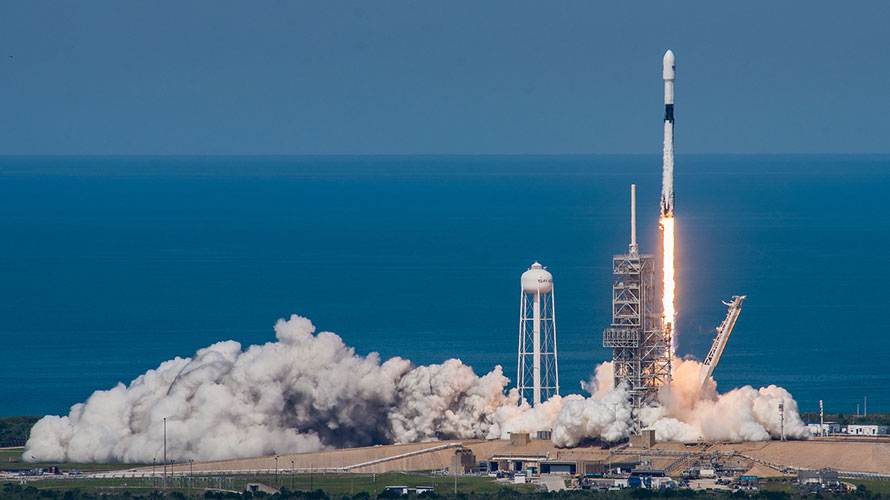
For Banglasdesh, today marked the launch of the first Bangladeshi satellite, a significant milestone for the poverty-stricken nation. For those interested in space development and settlement, this launch was important for another reason—it was the first flight of the Falcon 9 Block 5.
Although there have been many successful F9 flights—18 last year, and 9 so far this year including today’s flawless launch and recovery of the first stage via a drone ship in the Atlantic—there has never been an F9 first stage that flew more than twice. On May 10th prior to the launch Musk said, “We’ve been able to land 24 of the first stage boosters, 11 on land, 13 on a drone ship, and we’ve reflown 11.”
F9 Block 5 is targeted for ten flights without refurbishment and up to 100 flights with refurbishment every ten flights. An additional goal is 24 hour turn-around, which, if achieved, would be without precedent.
Among the many improvements in the Block 5:
- Merlin engines thrust up 8% to 190,000 pounds at sea level, and up 5% to 220,000 pounds in vacuum.
- The inter-stage and landing legs use a new thermal protection material which is black and does not require paint to protect it from water damage.
- A much stronger “octaweb” to hold the first stage engines, with additional thermal protection between the engines to protect against an engine fire.
- The landing legs have been re-designed to allow them to be retracted and stowed rapidly.
- The aluminum grid fins used for control during first stage re-entry have been replaced with titanium grid fins. The new fins can withstand up to 2000 degrees Fahrenheit and require no work between flights.
- The first stage heat shield is now a water-cooled titanium structure that can respond to hot-spots generated during hypersonic flight.
- Complete avionics upgrade.
- Meets NASA “human rating” requirements.
- Meets Air Force reliability requirements.
- Uses “Fairing 2.0” which is designed for full recovery and is also a bit bigger.
- New COPVs (Composite Overwrapped Pressure Vessels) that are much stronger and more reliable than the previous version.
- New Merlin turbine blades designed to reduce hairline cracks.
- Faster propellant loading.
- 100s of small changes to improve re-usability.
NASA is requiring seven successful launches of the F9 Block 5 before crews are launched, so we now have 1 down and 6 to go. Although B5 is critical for the Commercial Crew program, its greater significance will be if it is truly re-usable to a large degree. Musk stated that the price of an F9 with a reused first stage is currently in the $50M range, but that the operational cost of the F9 B5 would be more like $6M per flight. SpaceX will not be lowering the price to this level since it needs to recover sunk costs and raise cash for building the “Big Falcon Rocket,” but the direction is clear—launch costs are coming down and space development is going UP!