By Dennis Wright
President, International Space Elevator Consortium
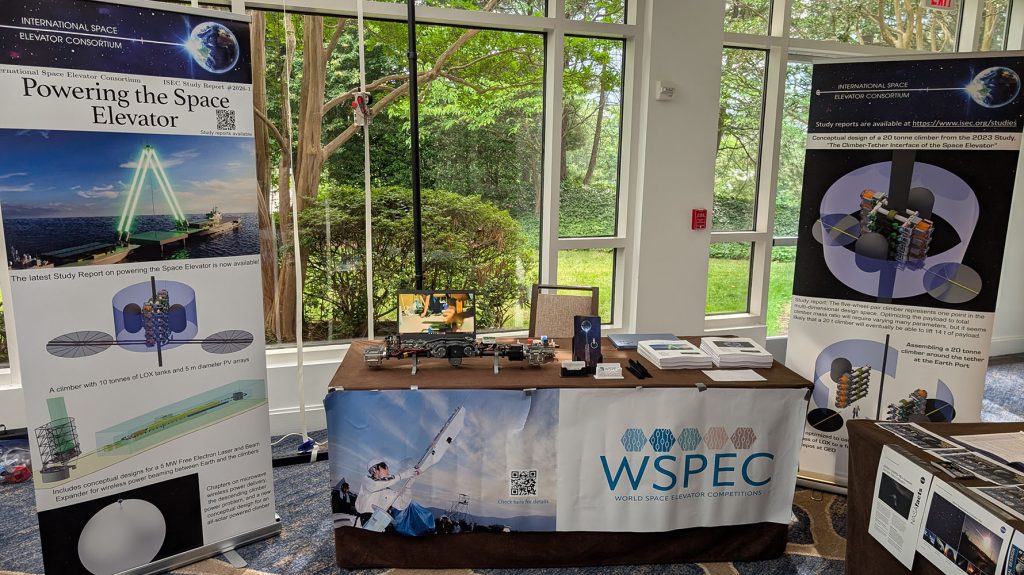
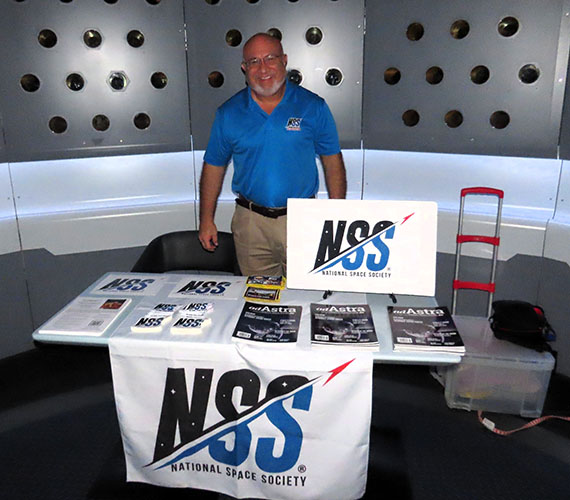
Image: The International Space Elevator Consortium/World Space Elevator Competitions table at ISDC with space elevator posters on either side and a climber from a space elevator competition.
For the first time, the space elevator track at ISDC expanded to two sessions: the morning dedicated to powering the space elevator and the afternoon covering a variety of issues critical for space elevator development.
While the technology for a space elevator climber is close at hand, getting power to it is an open question. The three top contenders are solar power, microwave beaming and laser beaming. Each of these was discussed in detail in the morning session. In the concluding discussion session, the pros and cons of each were debated.
The afternoon session touched on space elevator architecture and how it will transform access to space, a quantitative look at how environmentally friendly the space elevator is and a political and policy look at who will own it and how it might be managed in order to avoid conflicts. Advances in the development of a space elevator tether material were discussed as were the efforts to develop a dynamic simulator of a taut tether with a moving climber. Energy efficiency studies indicated the huge advantage of using space elevators instead of rockets, especially when it comes to moving very large amounts of mass into space. This last aspect figured importantly in a talk on terraforming the Moon.
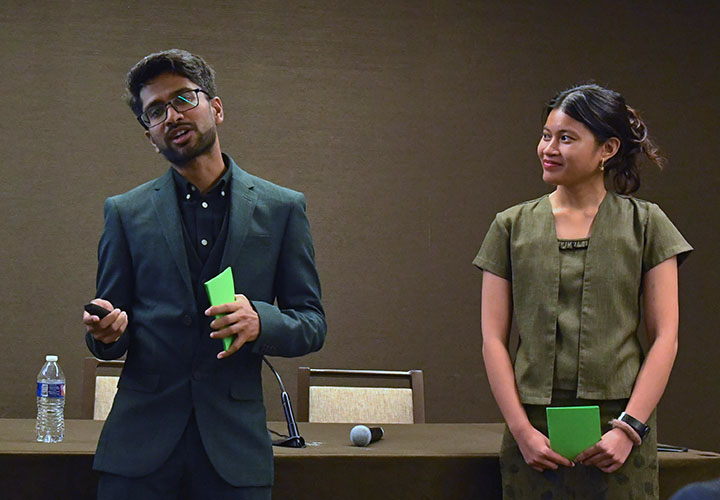
An excellent presentation by a student team from Ireland described their detailed settlement habitat and plan of operations.
The session was capped by a lively panel discussion on space elevators and space settlement. The panelists were Bob Zubrin, Pete Swan, Larry Bartoszek and Steve Griggs, with moderator Dennis Wright, who likes provocative topics. Is the space elevator essential for settlement? Most of the panelists thought so, with some disagreement as to the extent, mode and location (Earth, Moon, Mars) of space elevator operations. Lots of participation from the audience added depth and new ideas to the discussion.




1 thought on “The Space Elevator Track at ISDC”
Do we need a Beanstalk to settle the solar system?
maybe. Settle by how many? how difficult is this Beanstalk? Capacity? How far are we going?
I’d think: we need it. Maybe soon, maybe later, to reach further targets. Instantly would give us the Moon without breaking us.
Count on surprises. Build it before China does.