By Burt Dicht
NSS Space Coast Correspondent

THE FINAL FULL DAY IN SPACE
Flight Day 9 – Almost Home
On their last full day in space, the Artemis II crew began the morning with “Lonesome Drifter” by Charley Crockett, approaching Earth at 147,337 miles. By midday, Orion was traveling at 2,808 mph — a speed that will continue building rapidly as Earth’s gravitational pull strengthens.
OVERNIGHT UPDATE — SECOND RETURN TRAJECTORY BURN
Orion’s thrusters ignited for the second return trajectory correction burn at 10:53 p.m. EDT Thursday, fine-tuning the spacecraft’s path toward Earth. The burn went smoothly and Integrity remains precisely on course for Friday’s splashdown. A third and final correction burn is scheduled for today at 1:53 p.m. EDT if needed.
PACKING UP FOR HOME
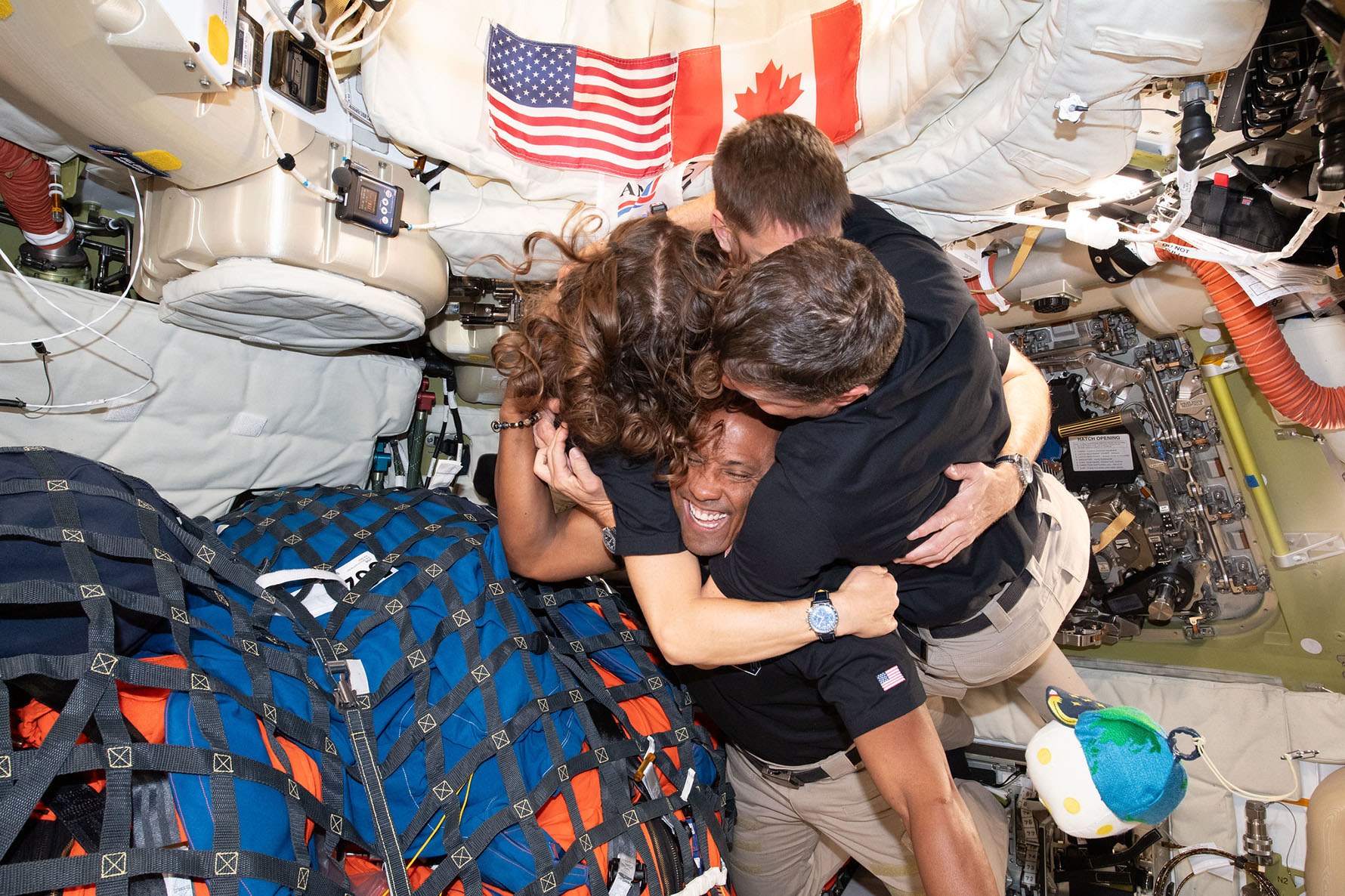
The crew spent the day preparing the cabin and studying entry procedures ahead of splashdown, stowing equipment and installing their seats to ensure all items are secured for reentry. After 10 days in deep space, the small cabin of Integrity is being methodically transformed from a living and working environment into a tightly secured reentry configuration.
THE HEAT SHIELD — THE FINAL TEST
During the only previous Orion test flight to the Moon the uncrewed Artemis I in 2022 — the heat shield suffered more damage than expected, prompting NASA to modify the reentry trajectory specifically to reduce stress on the shield for Artemis II. Engineers completed a final inspection of the crew module’s surface in the days before reentry and reported no concerns and no issues that would impact the return.
NASA’s Lakiesha Hawkins acknowledged the weight of the moment plainly: “We’re down to the wire now. We’re down to the end of the mission, and obviously getting the crew back home and getting them landed safely is a significant part of the risk that’s still in front of us.” Flight Director Rick Henfling echoed that with confidence in the engineering work done: “I have a lot of confidence in the engineering that was done and the testing that was done. When I sit console on entry day, the heat shield is not going to be something that I’m thinking about.”
Today’s reentry will be the definitive real-world test — and NASA goes into it with every reason for confidence.
RECOVERY FORCES IN POSITION
The USS John P. Murtha is now on station in the Pacific Ocean off the coast of San Diego, leading recovery efforts. Navy MH-60 Seahawk helicopters from Helicopter Sea Combat Squadron 23 have arrived on the ship’s flight deck and are conducting final air operations training ahead of Friday’s recovery.
Flight Director Jeff Radigan explained what happens immediately after splashdown: “There are a number of systems that we have to begin an orderly shutdown, and the crew has to orient themselves and begin ‘safing’ the spacecraft so they can open the hatch, and that takes a little bit of time.” He added that recovery forces will work in parallel to ensure no one is hit by falling debris from reentry.
WEATHER — STILL LOOKING GOOD
The weather forecast remains favorable for the splashdown site within 100 miles of the coast of San Diego, with the majority of weather criteria in order for a safe recovery mission both by sea and by air.
UNDERSTANDING ORION’S “OXIDIZER ISSUE”
One of the questions I have been hearing repeatedly and one that NASA has now addressed several times in its press briefings — concerns the so-called “oxidizer issue.” Given how alarming that phrase can sound, especially to those worried about the crew’s safety, it is important to explain exactly what NASA is referring to. For many people, hearing a term that sounds like “oxygen” immediately raises fears that the astronauts could be in danger.
NASA has been careful to clarify that this is not a life-support issue and has nothing to do with the crew’s breathing oxygen supply inside the cabin. Instead, this is a propulsion system issue involving a minor helium leak in the pressurization system associated with the oxidizer side of Orion’s propulsion system.
The service module uses a hypergolic propulsion system, in which fuel and oxidizer are stored separately and fed to the engine and thrusters under pressure. Helium provides that pressure, ensuring that the propellants flow properly during major maneuvers and attitude control firings. According to NASA, the leak is small, stable, and well within operational margins, which is why the agency’s response has remained consistent throughout multiple press conferences.
Most importantly, the spacecraft has already successfully completed its major burns, including the translunar injection and the lunar flyby trajectory maneuvers, demonstrating that the propulsion system has continued to perform as required.
That said, this is not an issue NASA will simply dismiss. Because Orion’s service module is intentionally jettisoned prior to reentry and burns up in Earth’s atmosphere, the hardware will not be available for postflight inspection. Before Artemis III, NASA and the European Space Agency will need to fully understand the root cause of the leak using telemetry and engineering data and develop any required corrective actions. This is exactly why Artemis II is such an important test flight: it allows engineers to uncover issues in an operational deep-space environment and address them before Orion carries astronauts toward a lunar landing.
FLIGHT DAY 10 PREVIEW — SPLASHDOWN DAY
Friday, April 10, 2026
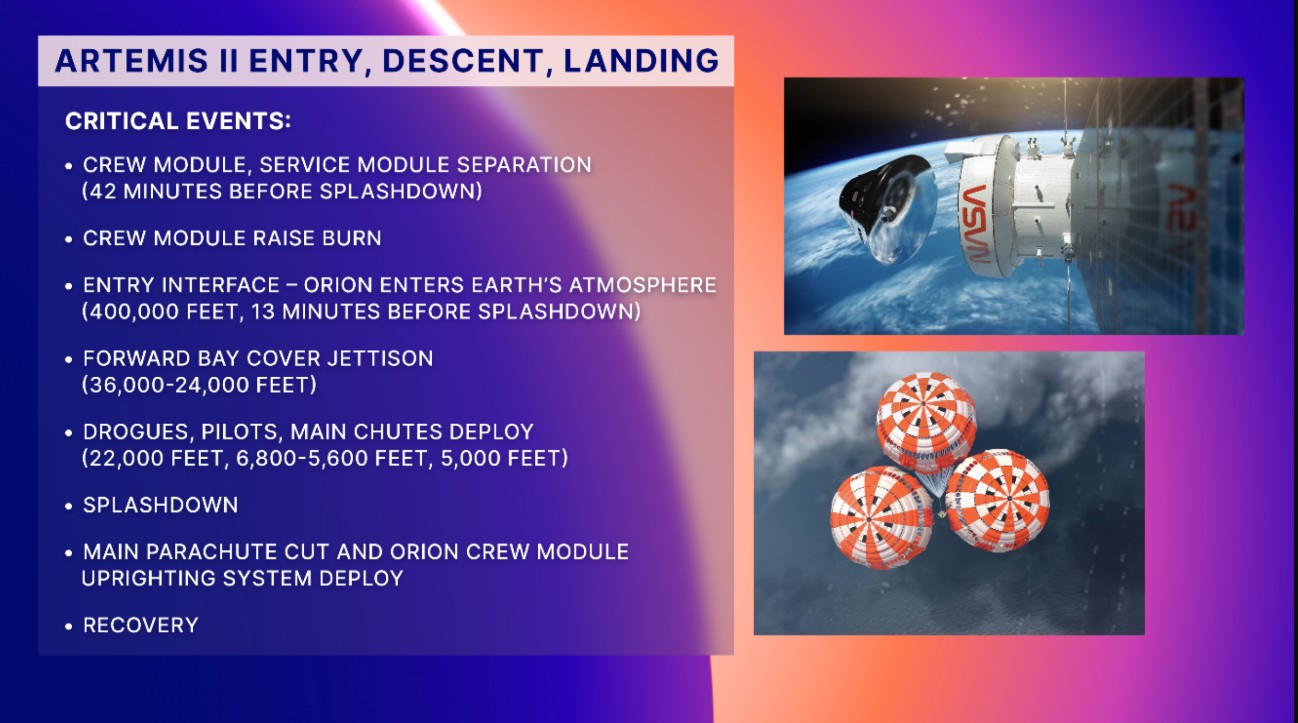
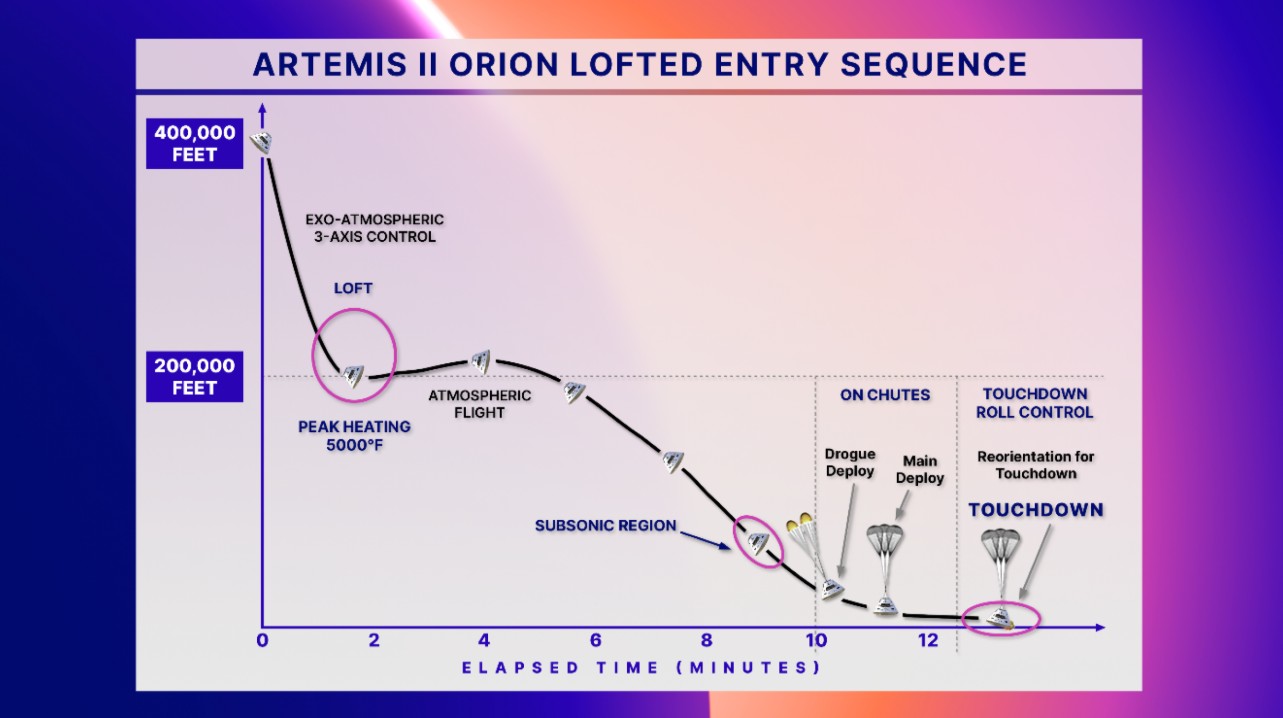
Everything now points to this evening’s splashdown which is targeted for 8:07 p.m. EDT (5:07 p.m. PDT) off the coast of San Diego. NASA Live coverage begins at 6:30 p.m. EDT on NASA+, Amazon Prime, Apple TV, Netflix, HBO Max, Discovery+, Peacock, and Roku. The 13-minute reentry sequence — from atmospheric entry to splashdown — will be the most physically intense phase of the entire mission, with the crew experiencing up to 3.9 Gs and a six-minute communications blackout as plasma engulfs the capsule.
TIMELINE OF KEY EVENTS (ALL TIMES EDT)
6:30 p.m. — Live return coverage begins on NASA+, Amazon Prime, Apple TV, Netflix, HBO Max, Discovery+, Peacock, and Roku.
~7:25 p.m. — The crew configures the capsule’s cabin for reentry, stowing baggage and ensuring everything is ready for the reentry.
~7:37 p.m. — Orion performs a final quick burn to maneuver into the correct position and attitude for reentry and splashdown.
~7:25 p.m. — The service module — which has provided power and propulsion throughout the mission — separates from the crew module and burns up in the atmosphere.
7:53 p.m. — As Orion descends through about 400,000 feet, the spacecraft enters a planned six-minute communications blackout as plasma forms around the capsule during peak heating.
The Fiery Plunge — 13 Minutes That Have to Go Right
- “It’s 13 minutes of things that have to go right,” said NASA Flight Director Jeff Radigan during the final mission status briefing. In his own mind, he added, it’s more like “an hour and a half of things that have to go right.”
- The Orion capsule will hit the atmosphere at a predicted 23,840 mph — mind-bogglingly fast, and hot enough to create temperatures of 5,000 degrees Fahrenheit on the heat shield’s surface. Together, the friction and compression of the atmosphere create a plasma bubble that engulfs the spacecraft and it’s that plasma that blocks all radio signals in and out.
- Retired NASA astronaut Barry “Butch” Wilmore put it plainly: “Everything’s different. The speeds are much, much greater coming back from deep space.”
The Parachute Sequence
After emerging from the blackout, Orion will jettison its forward bay cover, deploy its drogue parachutes near 22,000 feet at 8:03 p.m., and then unfurl its three main parachutes around 6,000 feet at 8:04 p.m. to slow the capsule for splashdown. By the time Orion hits the water, the parachutes will have slowed it to a far safer 20 mph.
Splashdown — 8:07 p.m. EDT
Splashdown is targeted for 8:07 p.m. in the Pacific Ocean just off the coast of San Diego. During the 13-minute descent, the crew will have effectively traversed 1,701 nautical miles. Based on the planned trajectory, the spacecraft will not be visible to those on the California coast, as it will be targeting a landing area well offshore.
Recovery — USS John P. Murtha
Within two hours after splashdown, the crew will be extracted from Orion and flown to the USS John P. Murtha by helicopter. Once aboard, the astronauts will undergo post-mission medical evaluations in the ship’s medical bay before returning to shore and boarding an aircraft bound for NASA’s Johnson Space Center in Houston.
Flight Director Radigan expects the four astronauts to arrive in Houston on Saturday, where they will reunite with their families and loved ones.