Category: Nonfiction
Reviewed by: Casey Suire
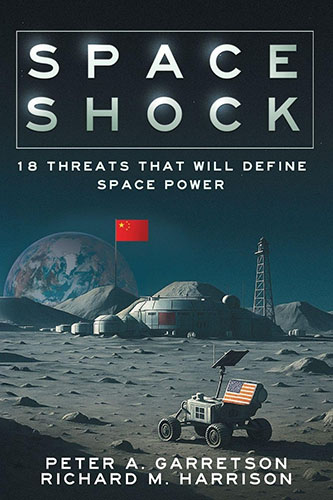
Title: Space Shock: 18 Threats That Will Define Space Power
Authors: Peter A. Garretson and Richard M. Harrison
Format: Paperback/Kindle
Pages: 330
Publisher: Armin Lear Press
Date: October 2025
Retail price: $24.95/$9.99
ISBN: 978-1968919009
Find this book
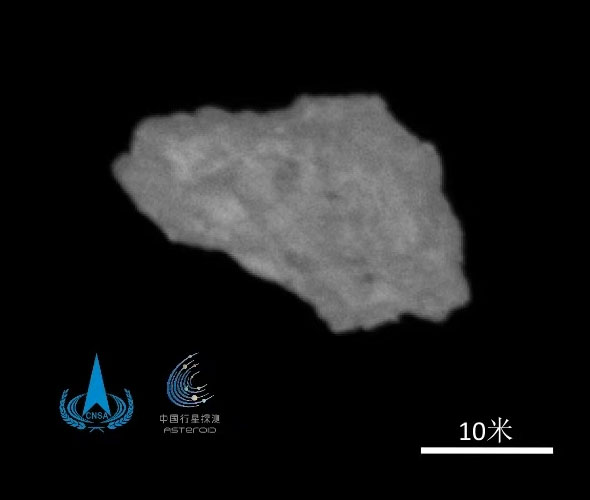
2025 was a very productive year for the Chinese space program. In late May, the China National Space Agency (CNSA) launched Tianwen-2 to collect samples from the near-Earth asteroid 469219 Kamoʻoalewa (which in 2035 will rendezvous with the main belt comet 311P/PANSTARRS). In late June, the Shijian-21 and Shijian-25 spacecraft docked in geostationary (GEO) orbit and conducted a landmark servicing and refueling mission. During August, engineers subjected Lanyue, China’s new crewed lunar lander, to simulated take-off and landing tests. In November, the Tiangong space station hosted the first BBQ in space. Using a specially designed microgravity oven, taikonauts cooked New Orleans-style chicken wings and black pepper steak. Additionally, several new Chinese launch vehicles, such as the Long March 8A, Long March 12A, and Zhuque-3, debuted in 2025.
These impressive space achievements by the PRC (People’s Republic of China) are part of a larger plan to dominate the cosmos. By the mid-21st century, China aspires to create an economic zone between the Earth and the Moon worth $10 trillion annually. What should the United States do? In 2023, Garretson and Harrison wrote an excellent book titled The Next Space Race: A Blueprint for American Primacy on how the USA should anticipate future PRC actions in space. With Space Shock, the authors explore how America should respond to various Chinese space accomplishments.
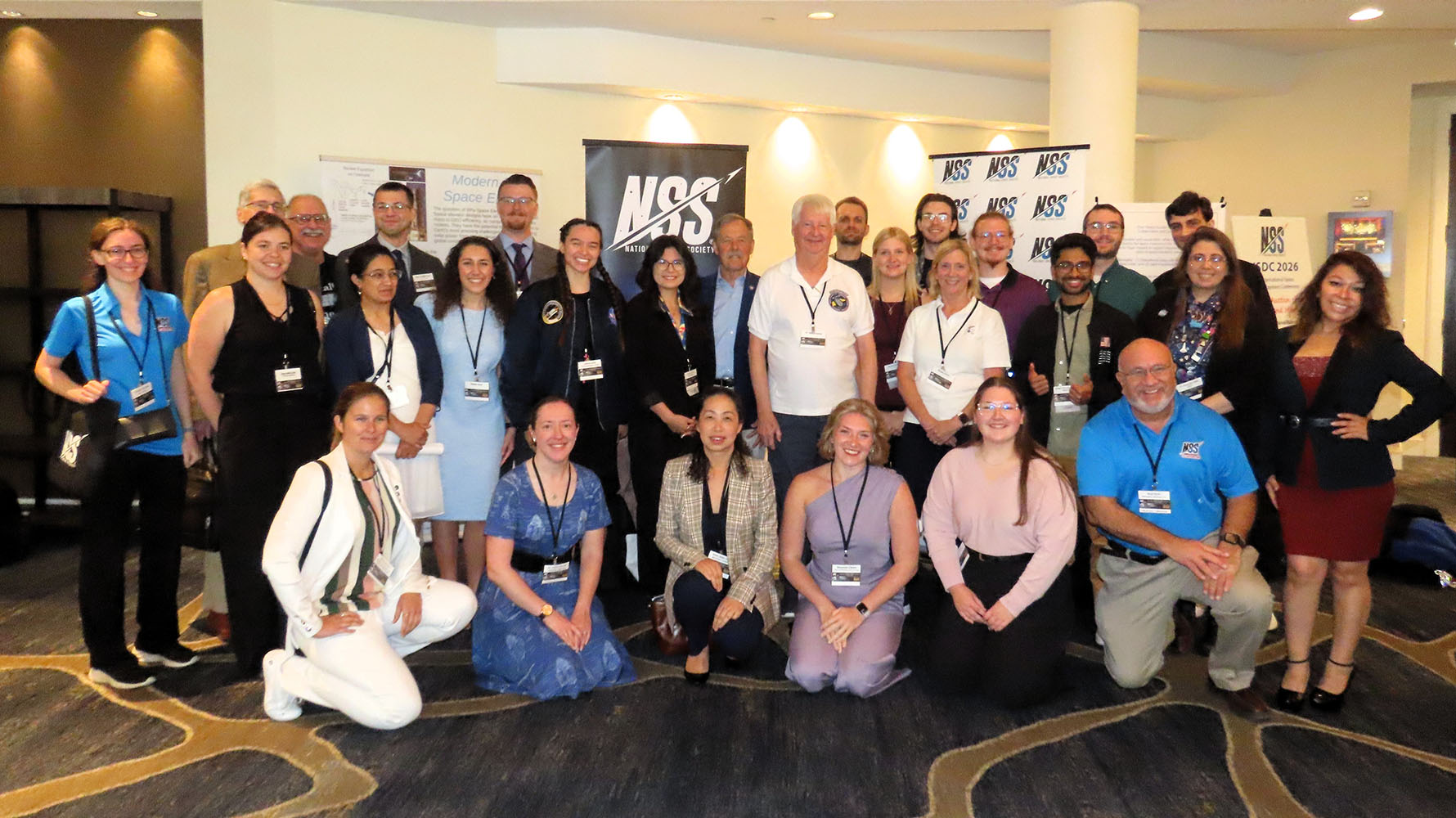
Garretson and Harrison’s new book is based on three simulated National Space Council (NSpC) workshops held between February and April 2024. Many influential space leaders, including some from the National Space Society, attended each workshop. Participants were assigned a role in the NSpC exercises: Vice President, NASA administrator, Secretary of State, White House Press Secretary, etc. In all three workshops, players were given an hour to respond to six different scenarios involving Chinese activities in space. Each scenario is presented in a near-future news article from a fictitious publication called The Daily Astronomer. Many readers will likely play along and formulate a course of action for the NSpC.
The bulk of Space Shock details the results of all eighteen simulated exercises. While Garretson and Harrison’s findings and recommendations from the three NSpC games won’t be revealed here, their analysis of current U.S. space policy is quite eye-opening. Early in the book, it’s stated that “the stakes in this 21st-century space race are arguably higher than they were during the Cold War, because space activities today are tied to our economic vitality, national security, and control of critical infrastructure and resources.”
Some scenarios assigned to the mock NSpC involve commercial spaceflight disasters. How to handle fatalities in space? This question isn’t pleasant to think about, but it will likely happen one day. Currently, the FAA (Federal Aviation Administration) faces limits on regulating commercial human spaceflights. Overregulation, many experts believe, will harm the development of the young commercial spaceflight industry. This FAA learning period began in 2004, and at the time of this writing, it expires on January 1, 2028. Some in the space business believe this date should be extended even further. The NSpC players debated how to regulate commercial spaceflight accidents.
Additionally, what happens if space tourists become stranded? Who will rescue them? Late in the book, Garretson and Harrison recommend that the United States “establish an Emergency Space Rescue Protocol with a modest but functional rescue capability based on modified Dragon or Starliner vehicles.” This is an ironic suggestion considering Starliner’s flawed maiden crewed mission; the spacecraft still needs to prove itself. Furthermore, the book mistakenly states that “SpaceX hopes to fly eight crew around the Moon.” This is a reference to dearMoon, a proposed lunar tourism flight that was canceled back in June 2024.
The NSpC players also addressed emerging space technologies. What if China constructed 3D-printed structures on the Moon using lunar regolith? The ability to manufacture igloo-like habitats on the Moon would make the Artemis Base Camp look underwhelming. What about China’s ambitions with space-based solar power (SBSP)? One NSpC exercise involved the PRC orbiting a 500 kW (kilowatt) solar power station. To put that in perspective, the book states that the International Space Station (ISS) has 100 kW; pages later, this figure suddenly changes to 120 kW. Also, China wants to deploy a 1-megawatt (MW) solar power station in geostationary (GEO) orbit. This colossal structure will be one kilometer wide.
What if China harnessed nuclear power in space? NASA is already thinking about this scenario. Last year, then-acting NASA administrator Duffy called for a 100 kW nuclear reactor on the Moon. Furthermore, current NASA boss Jared Isaacman championed nuclear propulsion in Project Athena. Mr. Isaacman notes in his proposal that China and Russia are already working on space nuclear systems. Interestingly, one scenario not explored in Space Shock is artificial intelligence. Both China and the U.S. are racing to develop solar-powered AI data centers in space. Last May, the Chinese launched the first batch of AI satellites in their Three-Body Computing Constellation. The final constellation will consist of 2,800 satellites. While the mock NSpC players didn’t discuss Chinese AI data centers in orbit, all illustrations in Space Shock are AI-generated. Some readers will likely not like this decision. Human space artists are (so far) much better.
Arguably, the most intriguing NSpC scenarios involve China beating the U.S. back to the Moon. Beijing wants to land taikonauts on the lunar surface by 2030. A Chinese lunar mission will consist of the Mengzhou crew capsule and the Lanyue lunar lander. Each spacecraft will launch on separate Long March 10 boosters; afterward, both vehicles will rendezvous and dock in lunar orbit. Two taikonauts will take Lanyue down to the Moon’s surface.
The reaction of many Americans to China’s lunar ambitions can be summarized as, “So what? There is no race. We already did this decades ago.” For others, there are concerns that Beijing will get to the Moon first and claim it as Chinese territory. The PRC will then have control over valuable lunar resources, such as helium-3 and lunar water ice. In the NSpC simulations, some players correctly pointed out that any potential Chinese lunar land grabs would violate the Outer Space Treaty. However, it was also noted that “the legal challenges surrounding lunar territorial disputes remain complex and largely untested.”
Blue Origin and SpaceX have recently prioritized human lunar missions. Blue Origin recently announced it was pausing New Shepard tourism flights for at least two years; the company will focus more on their Blue Moon lunar lander. For SpaceX, the company has surprisingly shifted its attention from Martian to lunar cities. Each Starship HLS will require multiple fuel tanker missions before landing on the Moon. While Starship HLS boasts an impressive payload advantage over Lanyue, the untested orbital refueling requirement still needs to be proven.
Some U.S. space officials are very worried that China will beat NASA back to the Moon. Notably, NASA announced plans to return to the Moon back in January 2004; only three months prior, China launched their very first human spaceflight mission. Now, after twenty-two years, there are growing doubts America will make it to the Moon before China. What is going on? In any case, anyone that cares about American leadership in space should read this book.
© 2026 Casey Suire