The National Space Society invites you to the next Space Forum
Thursday, July 31, 2024, 9:00 pm to 10:15 pm EST
Training for Mars:
Life and Lessons from Crew 315 at MDRS
With special guests

What does it take to live and work on Mars?
Analog research helps us answer that question. It’s a critical tool for preparing humans to explore Mars—and to venture even farther beyond Earth.
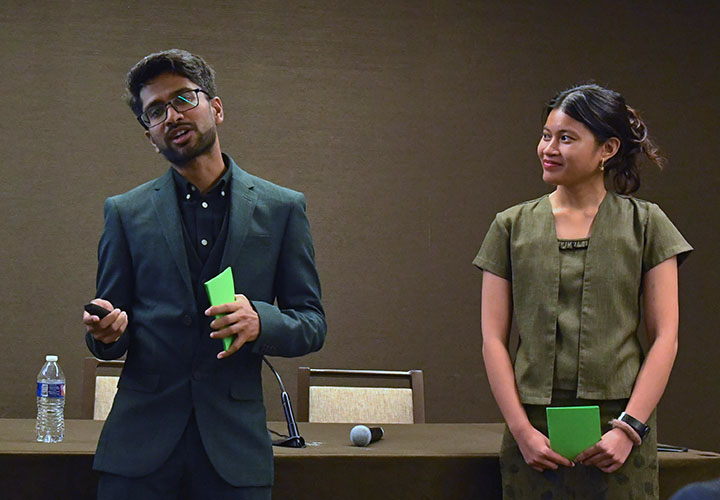
Here’s your opportunity to hear directly from two people who’ve lived the experience. The National Space Society invites you to a special Space Forum featuring David Laude, Commander, and Tim Gagnon, Crew Artist—members of Crew 315 at the Mars Desert Research Station (MDRS) in Utah, a leading site for Mars analog missions, operated by The Mars Society since 2001.
From April 20 to May 3, 2025, Crew 315 conducted a two-week Mars analog mission with a five-member interdisciplinary team that included experts in aerospace engineering, health and safety, journalism, and more. Their goal: to advance the science and logistics of human exploration on the Red Planet. Their work included:
- Nine research projects focused on engineering systems, drone operations, life sciences, and the development of an article for Harper’s Magazine
- Simulated EVAs (Mars walks) in full analog spacesuit gear
- Experiencing the psychological, social, and technical challenges of long-duration isolation
- Habitat operations including maintenance, system checks, and adherence to mission protocols
David and Tim will share firsthand what it was like to live and work in a Mars-like environment—the challenges, the discoveries, and the lessons learned for the future of space exploration. Don’t miss this exciting and informative event offering a glimpse into what it may take to live on another world. Register for the space forum today.
* * * * * * * * * * * * * * * *
David Laude’s passion for space exploration was ignited in childhood—first by watching the launches of Apollo 11 and the space shuttle, then deepened by meeting two astronauts who walked on the Moon. That early inspiration launched a lifelong pursuit of science, engineering, and a dream of one day participating in a mission to Mars. A U.S. Air Force veteran, David earned both a Bachelor of Science and a Master of Engineering in Electrical Engineering. Over the course of his career, he has designed advanced integrated circuits, holds seven patents, and has presented technical papers at international conferences.
As a founding member of The Mars Society, David blends technical expertise with a deep commitment to exploration—both scientific and human. He has also pursued formal studies in anthropology and archaeology, giving him a unique multidisciplinary perspective on the challenges of long-duration space missions. As Commander of Crew 315 at the Mars Desert Research Station, he brought leadership, ingenuity, and a spirit of discovery to this analog Mars mission—contributing to the preparation for humanity’s future on the Red Planet.
Tim Gagnon’s lifelong journey in space exploration began not with rockets, but with a sketchpad. Born and raised in Hartford, Connecticut, Tim developed a deep fascination with both spaceflight and art. Like many of his generation, he watched his childhood heroes launch into space on a black-and-white television. For his 16th birthday in 1972, he received a life-changing gift: the opportunity to witness the Apollo 17 launch in person as a guest of NASA.
Decades later, in 2004, that passion became a profession when astronaut John Phillips selected Tim to design the Expedition 11 mission patch for the International Space Station. After the patch’s debut, Tim was contacted by Dr. Jorge Cartes of Madrid—another aspiring patch designer. Tim promised that if another opportunity arose, they’d collaborate. In 2007, that promise was fulfilled when the STS-126 crew selected Tim and Jorge to co-design their mission emblem. The partnership thrived, and thanks to crew recommendations, the duo went on to create patches for STS-127, 129, 132, and 133, as well as for numerous ISS Expeditions—spanning 22 through 55—and the historic One Year Mission.
As Crew Artist for Crew 315 at the Mars Desert Research Station, Tim brought a creative lens to the mission, continuing his legacy of linking human spaceflight with the enduring power of visual storytelling.
Register today to reserve your seat and ask your questions. Use the link below.
Register no later than July 31 at 8 pm EST