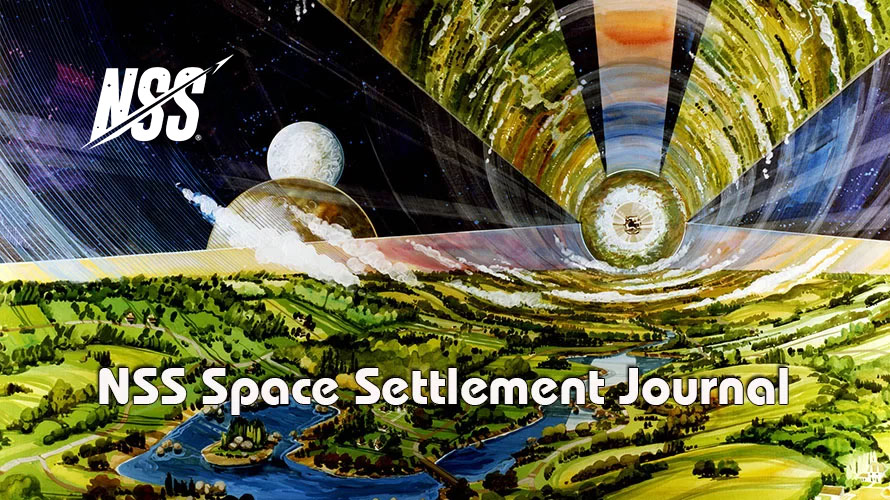
New in the NSS Space Settlement Journal:
Rotation of Space Settlements, by Rainer Rollfs.
Abstract
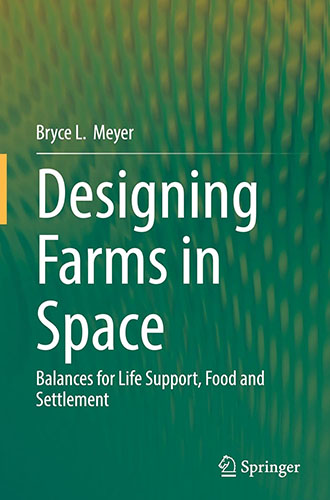
Free-floating space habitats can rotate to produce artificial gravity. Structural matter supports the habitat against the resulting centrifugal forces and air pressure. Expanding from a previous work on the energy flow, a physical model is developed to compute the structural mass for habitats of various sizes and shapes, taking into account self-weight in horizontal and vertical support (and bridges between vertical cables). Lower limits on the habitat size are given by the acceptable rotation rate (demanding high rotational radius) and relative shielding mass (demanding high volume-to-surface ratio). Upper limits are posed by co-rotation of the energy collection system (for light and electricity), by the acceptable structural mass, and by the distribution of coolant and light. At small sizes, the dumbbell shape is preferred due to its compactness and adjustable rotational radius. Cylinder and (oblate) spheroid are better for very large habitats due to their lower structural mass, with torus and tube in between. Assuming default parameters (1600m3 of interior volume, 40kW of power, and 100 tons of interior mass per person, shielding of 5 tons per m2, ratio of tensile stress to density of 105 Nm kg ), shielding dominates the mass budget below a population of some 10,000. Co-rotation of the energy collection system is feasible for cylinders with populations up to 200,000 and for dumbbells up to a few million. The minimum total mass per person is achieved in a sphere of 6 million inhabitants, where structural and cooling mass are each 10 tons per person and shielding is 20. Both cooling and structural integrity require ever more mass per person for larger habitats (but even a billion seems possible).



2 thoughts on “Rotation of Space Settlements”
Thanks Rainer for this outstanding work and your previous physical modelling study of energy flows in space habitats. This paves the way for engineers to design of our first spin gravity habitats in LEO which can be lower in mass (less shielding). This dovetails nicely with Dale Skran’s vision of split life cycle space settlement where these habitats become cyclers, first in the Earth-Moon system and then, after adding shielding, between the Earth and Mars. Rotating settlements will then augment lower gravity surface colonies with 1g artificial gravity free space birthing centers to have and raise healthy children throughout the solar system: https://spacesettlementprogress.com/split-life-cycle-approach-to-settling-the-solar-system/
I worked in the nuclear industry for over thirty years. A few suggestions for your space habitats. Put the water on the outside, it’s a good shield. Use lunar regolith blocks from the Moon like the Moonshot Museum, it might be cheaper. The original equipment for activation of structures research on Columbia was a generation older than the obsolete but functional equipment our nuclear power plant was replacing. Watch out for activation of things like the trace amounts of fire retardant put in organic compounds like lubrication oil or paints to reduce flammability.